

The quick version
Choose a suitable Traditional Cache, read its page and walk to it by a permitted route. Search carefully, sign the physical log, close the container and replace it exactly. Record Found it online only after visiting and signing; an unsuccessful search gets Didn't find it. Finish back at your agreed meeting point.
Saved on this device only — clearing your browser's cache or site data removes them (no account backup).
Choose a cache you can actually visit
Before inviting the group out, create or sign into a Geocaching account and open the app. Confirm that your account can open the full page for each intended cache; account or app restrictions can affect access. Choose an active Traditional Cache, preferably Regular or Large, with difficulty and terrain ratings of 1 or 1.5. These ratings are useful starting filters, not a promise that the approach or retrieval suits everyone.
Read the description, attributes, hint and recent logs. Check park hours, permitted paths, current closures, parking or transit, walking distance and the return route. A recent successful find is encouraging; repeated recent unsuccessful searches are a reason to choose a backup, not proof that the cache has vanished. Skip caches requiring climbing, water crossings, special retrieval tools or an approach your group cannot manage. Check local conditions and each person's needs rather than assuming an easy rating guarantees access.
Choose a meeting and finish landmark, a walking route and a turnaround time that leaves room to return before closing or darkness. Share the plan with someone staying behind. Bring one charged GPS-enabled phone with working location/navigation and readable cache details, a pen that writes, water, walking shoes and suitable layers. Carry snacks if appropriate for your route. Check reception and battery needs; test any downloaded information before relying on it, and retain a usable return-route map. Bring a power bank if needed. Ordinary trade items are optional.
For this suggested group format, everyone stays together. Pick a navigator to hold the phone and read the page aloud; the others help check the path and search. Choose the first cache and a backup before setting off. Nobody needs to hide a new container or bring prizes.
Navigate, find, sign and replace
Open the first cache together
At the meeting point, confirm the cache name and GC code, the identifying code on its page. Read the size, relevant attributes and approach instructions aloud. Select the app's navigation for that cache, then walk by the permitted path. The direction arrow points toward coordinates; it does not establish a safe or permitted straight-line route.
Look beyond the phone
Near the coordinates, stop chasing a moving GPS dot and inspect the surroundings. GPS brings you to an area, not necessarily the exact hiding spot. Look for an appropriate container or camouflage matching the description. Check reachable hiding places gently, keep the group in sight and use the hint when needed. Do not dig, trample planting, damage property or force a fitting open. This walking outing does not include climbing or reaching into hazards.
Sign the physical log
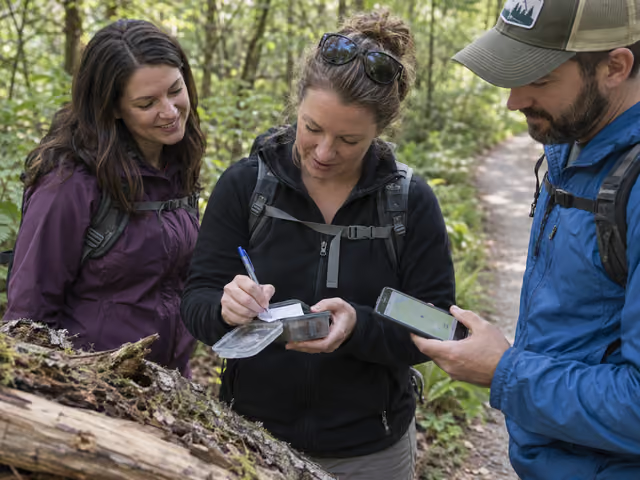
When you find the container, remember its precise placement before opening it. Follow any opening instructions. Each participant claiming this find signs their geocaching username and the date in the log; one shared outing account may sign its own username instead. Handle the log with dry hands and keep it protected. Being the person who spotted the box first earns no special score.
Leave the cache ready for the next finder
Taking ordinary trade items is optional. If you take one, leave something of equal or greater value; do not leave food or scented items. Keep the log in the container. A coded trackable is a traveling item, not a souvenir: leave it unless you understand its mission and will log and move it onward. Close the lid properly. Have the original finder replace the container in its exact location and orientation, restoring its original concealment rather than improving the hide.
Record the result and decide where to go next
On the cache page, choose Log cache, then Found it after visiting and signing. Use the visit date and write a brief, spoiler-free account; post later if reception is unavailable. Each account logs only the caches its user actually visited and signed. After an unsuccessful search, record Didn't find it (DNF) and what happened without declaring the cache missing on that basis alone. Move to the planned backup only if the group and remaining return time allow it. Otherwise turn back.
Close the outing
Return together to the agreed finish landmark after the chosen route or when you turn back. Confirm everyone is present and any borrowed gear is returned, then complete outstanding online logs. The outing ends there even if no cache was found. There is no winner, score threshold or tie-breaker; finds and DNFs describe your visits. Start a later outing by checking the listings and conditions again.
For this Traditional Cache format, a Found it log requires the visit and physical signature. Seeing an unreachable container, finding only its attachment, or hearing that a friend found it does not qualify.
Handle the common snags calmly
Someone wants to keep searching. Any person can ask the group to turn back. Respect the agreed turnaround and changing conditions. A cache can wait for another visit; an unresolved search is not a loss or a reason to split the group.
The GPS or hint seems wrong. Check that everyone is reading the same GC code, then reread the description and hint. A moving dot or an easy rating is not permission to cross a fence or closed boundary. Stop if the approach is unclear. Explain briefly to a curious passerby that you are geocaching if asked, while avoiding exposing the hide unnecessarily.
The container is missing, damaged or the log cannot be signed. Don't install a replacement or move the hide without the owner's permission. Describe a failed search as a DNF. For a definite problem such as a broken container or full log, use the available owner-attention reporting option and contact the cache owner. If the log is wet, full or absent and you cannot sign, don't claim a normal signed find or treat a photo as an automatic substitute; explain the problem to the owner.
Friends disagree about trade items. Leave an item if you cannot make a fair trade or cannot tell whether it is a trackable. If it is a trackable and you take it, look up its mission, log Retrieve promptly, carry it onward to a suitable cache and log Drop when placed there. Leave it if you cannot do that. Avoid publishing hiding-place spoilers or trackable codes.
There are no formal turns. The navigator reads and the group searches cooperatively; people can swap jobs between caches. Show newcomers how to open the page and find the hint before walking, so one confident person does not control the whole outing.
Already know the game?
Ideas & Twists
Choose a variation together before you start.
Geocaching · See main rules
Suggested hosting variationHint-first outing
Read the supplied hint together before approaching each cache rather than saving it until you are stuck. Keep all searching, signing and replacement rules. If no hint is supplied, use the description without inventing one. This puts the emphasis on the walk and recognizing hides; it does not change what qualifies as a find.
Geocaching · See main rules
Supported equipment alternative with suggested preparationUse a handheld GPS
Replace the navigating phone with a handheld GPS receiver. Before leaving, use Geocaching.com to load the chosen coordinates in the device's required format, confirm the GC codes and save readable descriptions, attributes, hints and a return-route map separately. Test the receiver and bring sufficient batteries. Carry the same pen and outdoor essentials. Sign at the cache and post logs through your account after returning; live access to a phone is no longer required, but a GPS device and advance website access still are.
About this guide
Traditional Cache seeking on Geocaching.com, using public HQ guidance reviewed October 2, 2026; no boxed edition or tournament rules apply. Group size, walking together, navigator jobs, turnaround and route finish are hosting suggestions. The handbook's other cache types have different requirements. Local cache access and conditions need checking before each outing. Community discussions informing the hosting choices are documented in the research packet.
- Geocaching HQ · cache types ↗
- Geocaching HQ · new geocacher help ↗
- Geocaching HQ · first-cache search tips ↗
- Geocaching HQ · finding and logging etiquette ↗
- Geocaching HQ · SWAG and trackables ↗
- Geocaching HQ · beginner's guide to trackables ↗
- Geocaching HQ · unsuccessful searches ↗
- Geocaching HQ · full logbook advice ↗
- Geocaching HQ · outdoor preparation ↗
Ready for something different?
Find another game →