

The quick version
Gather 2–8 players and agree on a dictionary. Take clockwise turns adding one letter to the end of a shared fragment. Completing an allowed word of four or more letters loses the round, even if it starts a longer word. Instead of adding a letter, challenge the last player: they must name and spell an allowed longer word beginning with the entire fragment. A failed defense costs them a loss; a successful defense costs you one. Each loss adds the next letter of GHOST. Reset after each loss; five losses eliminate a player. The last player remaining wins.
Saved on this device only — clearing your browser's cache or site data removes them (no account backup).
Agree on words before the first letter
This guide hosts 2–8 people playing individually in a clockwise circle. Sit within easy speaking distance at home, in a break room or at an outdoor table away from loud activity. Everyone plays; the host also keeps track of losses. Choose a first player by agreement. Bring one print English dictionary and identify its title and edition to everyone. Use that same book throughout; consult it only to settle a disputed word, not to hunt for moves.
Use these word rules: only English words written as one uninterrupted string of letters, with at least four letters. Proper names, abbreviations, and spellings requiring capitals, spaces, apostrophes or hyphens do not count. A spelling with an ordinary lowercase meaning may count under that meaning even if it is also a name. Accept a plural or inflected form only if the book explicitly lists or gives it; do not invent forms. These are this guide's chosen house word boundaries.
Track each player's losses as G, GH, GHO, GHOS, then GHOST. People can remember and announce their own letters; paper and pen are optional. You can also write the shared fragment where everyone can see it. The normal finish is one surviving player. For a shorter game with everyone involved until the end, choose the fixed-round variation before starting.
Extend, challenge and start a fresh fragment
Start with one letter
The first player says one letter. The next player repeats that letter and adds one more at the end. Continue clockwise, repeating the complete fragment and adding exactly one letter. Do not rearrange, remove or replace letters, and do not add at the front. Each turn changes the shared fragment; players do not hold separate secret words.
Keep a longer word possible
Aim for a fragment that begins an allowed word, while avoiding a complete allowed word of four or more letters. Short words such as CAR do not end a round because they are below the minimum; CARD does. CARD still loses even if the speaker meant CARDINAL. You may change the word you have in mind as the letters develop. Bluffing with a doubtful continuation is allowed, but a challenge can expose it.
Check a completed word
After each letter, pause before the next turn. If the fragment is an allowed complete word of at least four letters, its speaker loses the round immediately. Any active player may point this out during that pause. If disputed, check that exact word in the agreed dictionary. If it is not allowed, resume with the same fragment and next player; an honest request to check a completed word carries no penalty. Once another letter is added, this guide does not reopen an earlier move.
Challenge instead of adding
Only the next player in order can say 'challenge', and only before adding their own letter. They challenge the player who added the last letter. That player must name and spell one allowed word longer than the entire current fragment, beginning with that fragment in the same order. They may use any valid continuation, not only the word originally imagined. They must propose it from memory before a lookup; then check it if disputed. A valid defense makes the challenger lose this round. An absent or invalid defense makes the challenged player lose. Either result ends the round; revealing a defense is not another ordinary turn.
Take one loss and reset
Give exactly one loss letter to the round loser. A player stuck on their turn may surrender and take that loss instead of extending or challenging. Clear the fragment after every loss. The next active player clockwise after the loser starts a fresh fragment with one letter; if the loser is eliminated, skip them. Everyone still active keeps their accumulated loss letters.
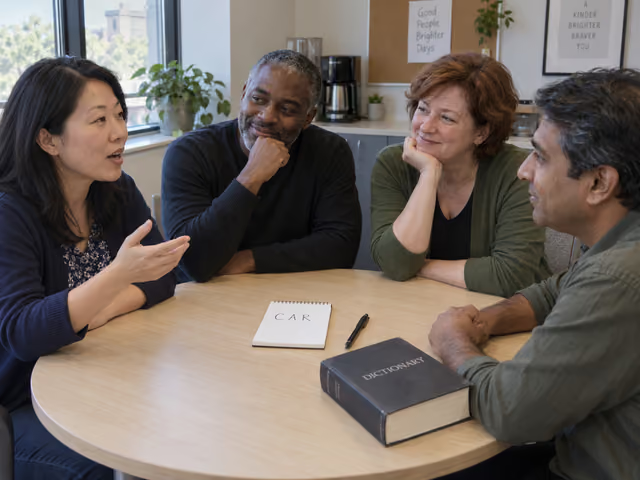
Say C, then C-A, then C-A-R. CAR is short enough to survive. Adding D produces CARD and loses, even though CARDINAL could continue it. Reset to an empty fragment. Explain that a challenge asks for a longer word beginning with the whole current fragment, not for its definition or a yes/no guess.
Five losses spell GHOST
A fifth loss completes GHOST and removes that player from the turn order. Eliminated players may watch or help check a word when asked, but do not suggest moves or challenge. Continue around the remaining players until one is left; that person wins. Two players simply alternate turns. Resolve one loss at a time, so the normal last-survivor game has no tied winner.
There are no points for word length, no reward for revealing the word you were thinking of, and no extra loss for a longer completed word. For another game, clear every player's loss letters and move the first seat one place clockwise from the previous game's first player.
Make challenges clear and disputes brief
Say letter names distinctly and repeat the whole fragment before adding. Anyone may ask for it to be repeated without using their turn. A spoken correction is allowed before the next player's move only when everyone agrees the speaker was misheard; it is not a chance to change a regretted letter. If nobody can reconstruct a disputed fragment, discard that round without a loss and let the same first player restart. Use the optional written record if this keeps happening.
Allow thinking time; this version has no turn clock. Do not help the current player choose a letter. When defending a challenge, the speaker can say they concede rather than browsing for a rescue. Once a word is checked, accept the book's ruling and keep playing. A missing word may be real English but is still unavailable under this game's chosen book. Change dictionaries or word permissions between games, not during a disputed round.
Vocabulary experience can make this game uneven. Start with the unscored example, and use the fixed-round version if elimination would leave friends waiting. Keep conversation at a comfortable indoor volume. Play while gathered and stopped; keep drivers out of the game whenever a vehicle is moving.
Already know the game?
Ideas & Twists
Choose a variation together before you start.
Ghost · See main rules
Suggested house version of SuperghostBoth ends
Add one letter either at the front or at the end, keeping all existing letters together and in order. Repeat the new complete fragment aloud. A challenge defense must name a longer allowed word containing that entire fragment as one continuous block; extra letters may come before, after or on both sides. The fragment itself still loses if it is an allowed complete word of four or more letters. Keep the dictionary, GHOST losses, elimination, clockwise restart and last-survivor finish from the main game. This uses Superghost's two-end idea but keeps five losses rather than changing the penalty word.
Ghost · See main rules
Suggested house variationFixed rounds, everyone stays
Replace elimination with a game of exactly twice the starting player count in rounds: four rounds for two players, sixteen for eight. Keep all players in the order after every loss, recording one loss each time rather than dropping someone at five. Keep the same word rules and challenges. After the last round, the player with the fewest losses wins; tied lowest-loss players share the win, with no sudden-death extension. The next player clockwise after each loser still starts the next round.
Ghost · See main rules
Suggested house variationWrite the fragment
Add paper and a pen, with one player serving as recorder while also taking ordinary turns. After each spoken move, the recorder writes the entire updated fragment and reads it back before the next player acts. Once confirmed, that written fragment governs challenges; the speaker may correct a transcription error during readback but cannot change their chosen letter. Keep all other rules, penalties and finish unchanged. For a two-end game, rewrite the fragment so the added letter's position is clear.
About this guide
Traditional spoken Ghost with explicit house hosting choices. MIT's problem set supports end-only letters, a four-letter minimum and losing on complete words or impossible prefixes; its automated two-player program does not supply this group game's challenge procedure. Jed Hartman's account supports group turns, challenges, dictionary arbitration, GHOST elimination and two-end Superghost. The 2–8 range, exact word permissions, challenge timing, restart, dispute handling and fixed-round finish are choices for this guide. This is not the Ghost card game or an online app's different rules.
Ready for something different?
Find another game →