

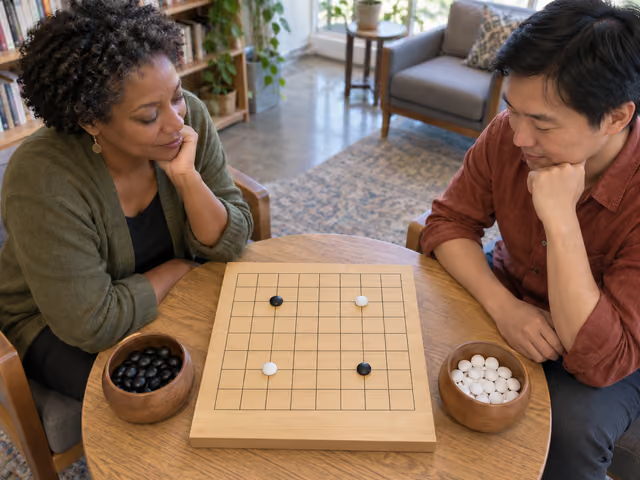
The quick version
Start with an empty 9×9 board. Black places one stone on a line intersection; White replies. Take turns placing or passing. Remove enemy strings with no empty neighboring intersections. After consecutive passes, agree which stones are dead or resume play. Count living stones plus enclosed empty points, then add 7.5 to White. Higher total wins.
Saved on this device only — clearing your browser's cache or site data removes them (no account backup).
Set up a small board
This guide uses a physical 9×9 board and American Go Association rules with area counting, agreed before play. It is an even game: no starting stones and 7.5 points of compensation, called komi, for White. A larger board and a handicap are options below. No particular commercial edition or clock is needed.
Sit opposite each other with the board within reach. It has nine lines in each direction, making 81 intersections. Choose colors; Black moves first. Keep spare stones accessible and captured stones off the board in separate containers. Bring enough stones to keep playing through captures and passes; a complete Go set is suitable. Do not use a chessboard's squares.
For a practice capture before the game, put one white stone on a corner intersection and a black stone on one of its two neighboring intersections. Black can capture it by occupying the other neighbor. Remove both colors after the demonstration, then begin with an empty board.
Place, connect and capture
Make the first move
Black places one stone on any empty intersection, including an edge or corner. White then places one white stone. Continue alternating. Stones stay where placed until captured; you cannot slide them or play on an occupied point.
Count liberties
A liberty is an empty intersection immediately above, below, left or right of a stone. Diagonals do not count. Same-color stones touching along these lines form a string and share all its liberties; count a shared empty point only once. An isolated center stone has four liberties, an edge stone three and a corner stone two. A string with one liberty is in atari: the opponent may be able to capture it next.
Resolve captures before self-capture
After placing, remove every enemy string whose last liberty your move filled. Captured stones leave empty intersections. Your own new stone and its connected string must have at least one liberty after those captures. A move leaving your own string with none is illegal. Thus a surrounded point can be legal when your placement captures enemies and opens a liberty.
Prevent repetition
You may not recreate an earlier complete board position with the same player next to move. In the common single-stone ko fight, immediate recapture would do this: play elsewhere or pass first. If the opponent also plays elsewhere, a later recapture may be legal because the whole board has changed. A pass is always legal; it does not automatically make every recapture legal.
Pass when ready
Instead of placing, say 'pass' and hand the opponent one of your stones, kept off the board. You can play again on a later turn if your opponent continues. A pass followed by a placement is not two consecutive passes. Do not stop merely because stones outline a large region: open borders and threatened strings can still change it.
Settle the board, then count
Two consecutive passes start the finish. Leave the position intact and agree which remaining stones could not avoid capture if play continued. Remove only stones both players agree are dead. A group with two separate genuine internal eyes can survive: the opponent cannot fill either eye without self-capture. Diagonal gaps can make an apparent eye false. Groups can also survive through mutual dependence, called seki; do not declare every group with fewer than two eyes dead.
If you disagree, leave the disputed stones in place and resume alternating play. The opponent of the last player to pass moves next. Try to capture the disputed group or defend it. After another consecutive pair of passes, check again. If neither will demonstrate a capture, the AGA fallback is four consecutive passes in total with the disagreement unresolved: all stones still on the board count as alive. White makes the final move; add a White pass, with its pass stone, if Black passed last.
For area counting, each living stone on the board is one point. Each empty intersection in a region bordered only by living stones of one color is another point for that color; the board edge can complete a border. An empty region touching both colors is neutral and scores for neither. This applies to shared liberties in seki too. Ignore all captured, removed-dead and pass stones: they are not extra points under area counting.
Count Black's living stones and enclosed empty intersections. Do the same for White, then add 7.5 to White. For example, Black with 35 living stones and 8 enclosed empty points has 43; White with 27 living stones and 10 enclosed points has 44.5 after komi, so White wins by 1.5. The half point prevents a tie. Count each intersection once and keep the board intact until both totals are checked.
Help the first game make sense
Before a move, ask: can I save a string, capture one, close a boundary or invade space the opponent has not secured? You do not need to capture every enemy stone to win. In area counting, filling a secure empty point with your own living stone usually replaces one point with another; it may still be a poor move if there is useful play elsewhere or it destroys an eye. Fill safe neutral points before passing because a living stone there adds to your area.
For your first game, discuss liberties quietly after each move and allow time to examine the finish. Point to the exact disputed string rather than arguing about who 'owns' a vague region. Do not rearrange stones for counting until agreement. Review a missed capture together afterward, then swap colors for a fresh game.
Under AGA rules, an illegal move caught before the opponent replies is taken back, including restoring any resulting captures, and treated as a pass with a pass stone. A later discovery stands unless both players agree to restore the earlier position. For a learning session, you may instead agree before play to let a promptly noticed illegal move be corrected with another legal placement; that is a house teaching rule. If the board is accidentally disturbed and cannot be restored together, this guide suggests stopping without a result and starting again.
Already know the game?
Ideas & Twists
Choose a variation together before you start.
Go board game · See main rules
Official board-size optionRoom to recover
Use a 13×13 Go board and enough stones for its 169 intersections. Keep two players, alternating placements, all capture and repetition rules, pass stones, agreed area counting, White's last move and 7.5 komi. The finish and scoring are unchanged. More space lets a local mistake leave other parts of the board to contest; it also asks you to examine more strings before finishing. Choose the size before the first move.
Go board game · See main rules
Official one-stone handicapGive the learner first-move help
The weaker player takes Black and starts on an empty board as usual. Replace White's 7.5 komi with 0.5; do not pre-place any stones. This is the AGA one-stone handicap, meaning the first-move advantage is retained rather than compensated. Keep area counting, pass stones, all legal-move rules and the normal finish. Higher total wins and the half point still prevents ties. Agree on this before starting.
Go board game · See main rules
House teaching formatFirst capture
Use the same empty 9×9 board and two colors, but the first player to capture any enemy stone wins immediately, even if several are captured together. Keep alternating placements, shared liberties, the self-capture restriction and repetition rule. Remove komi and area scoring. If both players pass consecutively before a capture, call it a draw and restart with colors swapped; no dead-stone negotiation is needed. Use this as a capture lesson, then return to the main game to learn territory and finishing.
About this guide
The main game selects the AGA's allowed area-counting method rather than its territory-counting default. Both AGA rule PDFs are linked by the association's tournament page and cover legal moves, disputes, passes, scoring and handicap compensation. The British Go Association diagrams support the capture, eyes and seki explanations; its handicap and scoring conventions do not override this guide's chosen AGA format. Practice, discussion and accident remedies are host suggestions; First capture and the optional learning correction are explicit house rules. Tournament clocks, rankings and multi-player Pair Go are separate formats.
Ready for something different?
Find another game →