

The quick version
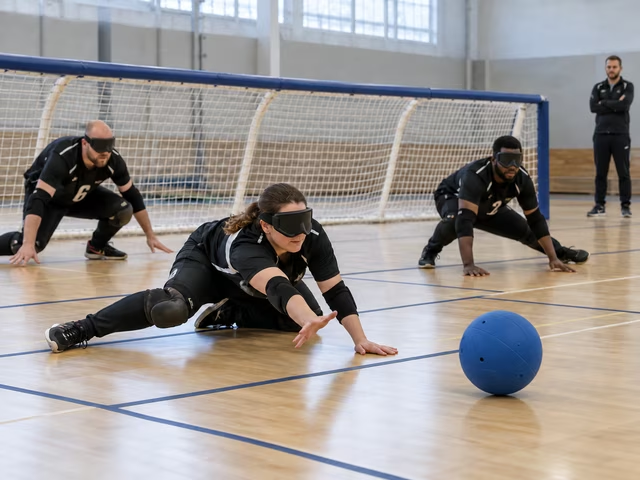
Three players defend each end of a tactile 18 m by 9 m court. Roll the bell ball along the floor toward the other goal. A ball completely over the goal line earns one. After a save, your team has ten seconds to return the ball across halfway. Play two five-minute halves.
Saved on this device only — clearing your browser's cache or site data removes them (no account backup).
Get the game ready
Book a beginner session and discuss each participant’s access and support requirements with the club. The coach fits eyeshades and protection, checks the ball and teaches the tactile lines while play is stopped. A regulation ball is heavy; the coach chooses an appropriate introductory ball and pace for this group.
Use the club’s tactile court and protected goal structure, with three people per side: left, center and right. The first 6 m from each goal is its team/landing area; the central 6 m is neutral. Start every new player with stationary gentle rolling, no run-ups, spinning throws or diving. A court assistant returns out balls while players stay in position.
Play the first game
Orient before starting
The coach helps everyone locate their positions and identifies the stop and play commands. Toss for first possession. The referee announces quiet please and play before each restart. Spectators and the throwing team remain quiet during the ball’s travel; safety calls always take priority.
Roll along the floor
Release from your own team/landing area so the ball rolls through your landing area and the neutral area toward the far goal. Keep it on the floor in this house session. Do not throw overarm or toward a person’s head. The coach stops a lifted or uncontrolled throw and gives opponents possession.
Defend, control and return
Use only the ground-defense technique the coach has taught, staying within your team’s area and clear of teammates. After first defensive contact, control and return the ball over halfway within ten seconds. You may make a quiet agreed call or pass to a teammate before the throw, but stop team noise once it is released.
Reset safely
A full goal-line crossing earns one and the conceding side restarts. An untouched throw out gives the receiving side possession; a blocked-out ball is returned to the defenders. A ten-second violation, unsafe throw or other playing fault gives opponents a stationary restart in this house version. To adjust eyeshades or ask for orientation, call stop and wait for the referee.
Two five-minute halves
Pause the clock at every referee stoppage. Rest for three minutes at halftime, swap ends with assistance and give the other side first possession. Most goals after the second half wins; ties stand. Keep eyeshades in place until the referee has stopped all balls and gives permission to remove them.
Help everyone get started
This is a sport invitation, not a simulation of someone else’s daily experience. Respect players’ own knowledge and preferred assistance. A qualified coach is needed for orientation and defense instruction; a casual blindfold game in an ordinary room is not an equivalent setup. Cheer during stoppages and restore quiet before play.
Already know the game?
Ideas & Twists
Choose a variation together before you start.
Goalball · See main rules
Suggested house variationAlternate throwers
A player may not take two consecutive team throws. A saved ball must therefore be passed if its catcher made the previous throw. A repeat throw gives opponents possession. Keep the gentle roll and the ten-second team limit, extending it to fifteen seconds if the coach agrees before the match.
Goalball · See main rules
Suggested house variationPass before return
Every possession requires one controlled pass to a teammate before the shot. Use a fifteen-second house possession limit rather than ten. An immediate shot is stopped and given to opponents. Keep two five-minute halves and normal goals.
Goalball · See main rules
Suggested house variationAnnounced lane
Before releasing, the shooter says left, center or right from their own perspective. They must aim for that third of the far goal; the referee decides where it crossed. A goal in a different third does not score and becomes an opponent restart. Keep the main time and other rules; defenders gain useful information.
Goalball · See main rules
Suggested house variationRotating positions
After every two total goals, stop the clock and have the coach guide each team through left-to-center, center-to-right and right-to-left. Reorient everybody before restarting. Keep the match score and short halves. Each person must coordinate from a different defensive position.
About this guide
The gentle floor-only delivery, short halves, beginner ball choice, no running/diving and possession-only penalties are editorial house adjustments requiring the coach’s agreement. All five variations are house formats. This guide does not claim international competition eligibility for recreational participants.
Ready for something different?
Find another game →