

The quick version
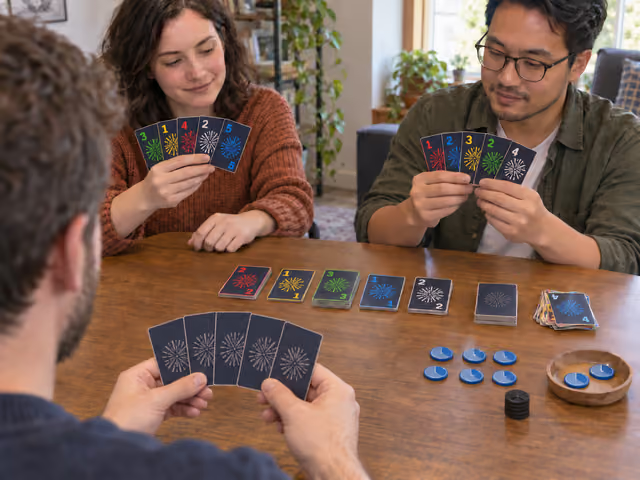
Use the five-color deck. Deal five cards each for two or three people, four each for four or five. Hold the faces toward the other players. Take clockwise turns doing exactly one action: spend a blue token to clue every matching card of one color or number in one teammate's hand; discard one card to recover a blue token; or play one card. Each color must start at 1 and grow one number at a time. A wrong play uses a fuse. The third wrong play loses immediately; five completed sequences win with 25 points. Otherwise, after the last draw, everyone gets one more turn, including the drawer, then add the five top numbers.
Saved on this device only — clearing your browser's cache or site data removes them (no account backup).
Deal cards you must not look at
This guide uses the physical R&R Games card edition and its English rule sheet credited 2013. Remove all ten multicolor cards, leaving 50 cards across white, red, blue, yellow and green. Each color contains three 1s, two 2s, two 3s, two 4s and just one 5. Other editions and expansion modules need their own component instructions.
Put all eight blue clock tokens on the table as available clues. Place the four black fuse tokens in a stack with the longest fuse on top and the explosion at the bottom. Keep the box lid beside them for spent tokens. Leave five spaces for the color sequences, plus a face-up discard area. Shuffle the 50 cards into a face-down draw deck.
Deal five cards per person for two or three players; deal four for four or five. Pick them up with their faces toward everyone else and their backs toward you. Do not peek while dealing, drawing or moving cards. Seat everyone so they can see the other hands and the public cards. The player wearing the most colorful clothes starts; if that is unclear, choosing a starter together is a house suggestion. Continue clockwise.
Before starting, agree whether to use the strict communication rule below or the memory-reminder house twist. For a first game, avoid assuming that a clue secretly means 'play this now'. Explain any agreed clue conventions before dealing; an experienced player's private convention is not a rule everyone else must know.
One clue names one color or one number
On your turn, move one available blue token into the lid. Choose one teammate and name either one color or one number in their hand. Point to every card matching that choice. If they hold two green cards, identify both; you cannot highlight just the useful one. You cannot combine a number and color, clue your own hand, split a clue between people, or give a clue that matches no card. Repeating a previous legal clue is allowed, but still costs a token and your whole turn. With no available blue tokens, choose play or discard instead.
For example, 'These two cards are 1s' tells their owner the numbers of those cards, not their colors. It also tells them the other cards in that hand are not 1s. New cards drawn later were not part of that clue. The owner may rearrange or raise cards to remember what was said, keeping the faces hidden from themselves.
In the strict base format, game information travels through paid clues. Other players do not coach a turn, confirm remembered clues, explain a deduction, warn against a discard, or signal approval through a nod, expression or emphasis. A color clue does not officially promise a card is playable. Save the discussion of why a move worked for after the game. The optional reminder twist changes this communication boundary explicitly.
Choose exactly one action on your turn
Give information
Use the complete color-or-number clue described above. You spend one blue token, do not play or discard, and do not draw. Then the next person acts.
Discard to recover a clue
Say that you are discarding, reveal one card from your hand into the public discard area, and return one blue token from the lid to the table. Draw one replacement without looking at its face. Discarding is not allowed when all eight blue tokens are already available. A discarded card never comes back into the deck; keep the discard area inspectable.
Play a card
Say that you are playing and reveal one card. It is legal only if it is a 1 starting an empty sequence of its color, or the next number after that color's current top card. Put it on that sequence, leaving its progress clear. Each color gets exactly one sequence, with one of each number in order. A duplicate, a skipped number or a card beyond a completed 5 fails: put it in the discards and move the top black fuse token into the lid. A failed play does not recover a blue token.
Replace a played card
After a successful or failed play, draw one replacement without seeing its face if the deck has cards and the game has not ended. Successfully playing a 5 completes that color and returns one blue token from the lid, if one is there; the supply never exceeds eight. A third failed play or completion of all five colors ends the game immediately, before any further turns.
Keep the action distinct
You must take one legal action; there is no pass. Giving a clue never permits a second action. At eight clues, play or clue; at zero clues, play or discard. Without a draw deck, plays and discards simply leave fewer cards in your hand.
At the start all eight clues are available, so a discard is illegal. If you see two 1s in the next player's hand, a legal first action is spending one token and pointing to both while saying 'These are 1s'. Do not name their colors or tell the person which to play. On their turn, that player makes their own choice; a 1 starts its color only if that color is still empty.
Count the final turns, then the shared score
The third failed play ends the game in a shared loss, even during the final turns. Completing all five sequences through 5 ends it in a shared win worth 25 points. Otherwise, when somebody draws the last card, finish that current turn. Each player then takes one additional turn, clockwise, with the last-card drawer taking the final one. Nobody draws replacements during these turns. For example, with three people, if A draws the last card, the remaining turns are B, C, then A.
If those turns end without a loss or perfect completion, add the highest number reached in each of the five colors. An empty color is zero: tops of 5, 3, 4, 1 and 3 give 16 points. This is one team result, not individual points; there is no player tie or tie-breaker. Losing the last remaining copy of a needed number limits that color's eventual score but does not itself end the base game.
To play again, reveal hands for a discussion, gather played, discarded and undrawn cards, remove any multicolor cards, reset all tokens, shuffle and redeal. Comparing another game's score is optional; a tied score needs no extra round unless everyone wants one.
Protect useful cards and each other's decisions
Keep discarded numbers and colors visible. Since there is only one 5 of each color, discarding it prevents that color from finishing. If both copies of a 3 are gone before a color reaches 3, its 4 and 5 cannot be played successfully either. Duplicate cards are often useful discards after their number has already been built, but you still need information about your own hand to choose them. Do not point out someone's safe discard for free.
Use a neutral voice and a consistent pointing order for clues. A host can clarify general rules such as 'You must identify every matching card', but should not use a rules explanation to reveal a live hand. Let the player make the decision. When a mistake happens, apply the normal fuse rule and discuss the reasoning after the finish rather than blaming the person who received a clue.
For disputes, check the visible color stacks, discard history, available tokens and the actual rule sheet. A wrong play has a specified consequence; an incomplete clue or accidental peek does not have a publisher-specified repair in this edition. This guide's house remedy is to stop an information-compromised game without a score, explain the correction, then shuffle and redeal. Do not quietly remove a fuse or invent a punishment midgame.
Before gathering the group, check that people can distinguish the edition's color markings, read the numbers and hold or support cards facing outward. This is a seated game with memory and visual-information demands, not a universal access guarantee. Use the reminder twist if everyone wants less memory pressure; it is a different communication agreement, not a promise of a higher score.
Already know the game?
Ideas & Twists
Choose a variation together before you start.
Hanabi · See main rules
House communication optionRemembered clues, not fresh advice
Agree before dealing that a player may ask for a repeat of a paid clue about cards still in their hand. Another player may repeat only the color or number previously given and identify its original surviving cards; do not add deductions, reveal a newly drawn card, confirm playability or recommend an action. If nobody can reliably reconstruct the clue, give no answer; spend a normal clue on a later turn. These reminders cost no token or turn. All new information still uses a legal paid clue, and dealing, card counts, plays, discards, fuses, final turns and the shared 25-point maximum remain unchanged. Label scores as reminder games when comparing sessions. This deliberately relaxes strict memory play.
Hanabi · See main rules
Official multicolor variant 1Six separate fireworks
Before shuffling, add all ten multicolor cards to the five-color deck, making 60. The sixth suit has three 1s, two each of 2, 3 and 4, and one 5. Treat multicolor as its own clue color and build a separate 1–5 sequence; it never substitutes for a missing card of another color. A multicolor clue identifies every multicolor card in one hand, and number clues still identify every card of that number. Keep the same hand sizes, eight clues, fuse limit, replacement draws and one-final-turn-per-player finish. Six completed colors win immediately at 30; otherwise sum the six top numbers. Completing the multicolor 5 recovers a clue just like another 5. The printed 25-point rating scale does not rate this 30-point format.
Hanabi · See main rules
Official multicolor variant 3Rainbow clues
Add all ten multicolor cards for a 60-card, six-sequence game, with the same hand sizes and 30-point maximum as Six separate fireworks. Change only the color-clue matching: you cannot name multicolor as a clue. Every multicolor card counts as a match for every ordinary color clue, so 'red' must point to all red cards AND all multicolor cards in that teammate's hand. Number clues still use the printed number. When playing, a multicolor card belongs only on the sixth multicolor sequence; it cannot fill a gap in red or another color. All sequences still run 1–5, every successful 5 can recover a clue, and the base fuse, token, draw and final-turn rules still apply. Do not combine this with the separate multicolor-clue permission.
About this guide
Main mechanics follow the R&R English physical-card rule sheet credited 2013, inspected as page images. Its 50-card five-color setup and 25-point finish govern the base game. The current product overview's blanket five-card sentence does not override the sheet's four-card hands for four or five players. The sheet's score paragraph says six fireworks, but its base setup, worked example and perfect finish use five; six belongs to multicolor variants. Four fuse components include the explosion marker, giving three failed plays, not four. The memory-reminder agreement and exposed-information redeal are explicit house suggestions. Two multicolor twists use official variants; no tile edition, expansion or online convention system is imported.
Ready for something different?
Find another game →