

The quick version
Use the USA circuit for two laps. Each player starts in first gear with seven cards, six Heat in the engine, and a shuffled deck of 12 Basic cards, three Starting Upgrades and three Stress cards. Choose a gear and that many cards together; resolve cars from front to back. Move, react, optionally slipstream, pay for crossed corners, discard and refill. Finish the whole round when cars cross the final finish line: furthest ahead wins, with the Race Line breaking a side-by-side tie.
Saved on this device only — clearing your browser's cache or site data removes them (no account backup).
Prepare the USA race
This guide uses Days of Wonder's English physical base game, following the publisher's currently linked basic Rules v1.1. Play one two-lap race on the USA board with 2–6 people, one car each. Use the base game's Starting Upgrades; leave Garage drafting, Legends, weather, championships and expansion equipment aside. Solo play needs a separate Legends format.
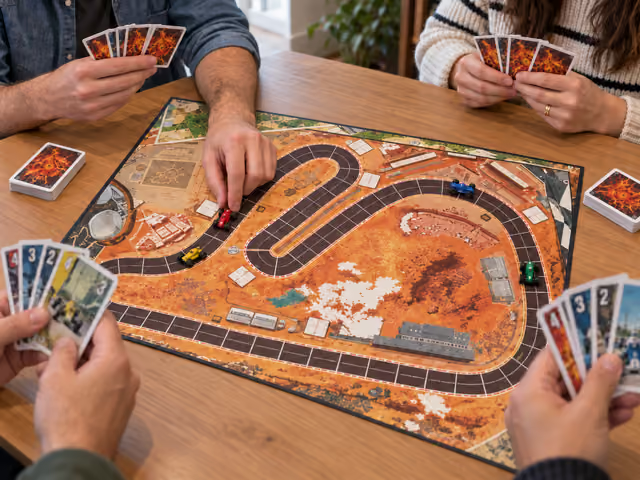
Bring one USA circuit board from the base set, its basic rules booklet, and one matching car, player mat and Gear pawn for each player. Per player, take 12 colored Basic cards, three each of values 1, 2, 3 and 4; the three matching chevron-marked Starting Upgrades, valued 0, 5 and one Heat; three Stress cards; and six additional Heat cards. Keep all unused Stress cards beside the board as the spinout reserve. Allow table space for the large board, each mat, concealed hands, draw decks and discard piles. No dice, ordinary playing-card deck, phone or score sheet is required.
Shuffle each player's 12 Basic cards, three Starting Upgrades and three Stress into an 18-card draw deck on the mat's left spot. The extra Heat upgrade starts inside that deck; the six other Heat cards start face up on the mat's Engine spot. Leave the discard spot empty, set every Gear pawn to 1, and draw seven cards each. Heat in your engine is spendable; Heat in your hand is clogging it and cannot normally be played.
Randomly choose the starting order and fill grid spots from the lowest number upward. A space is one forward step and contains two side-by-side spots; changing lanes never adds distance. The printed Race Line decides which spot is ahead within the same space. Point out the Corner Lines and their speed limits; ignore the separate Legends Lines. Tell everyone that crossing the finish line once completes lap one and crossing it again completes the race. Have the host announce each car's completed lap aloud so nobody mistakes the first crossing for the finish.
Choose together, then resolve each car
Set the round order and shift
At the start of each round, note cars from front to back, using the Race Line to rank side-by-side cars; keep that resolution order for this round. Everyone simultaneously stays in their current gear or shifts one gear up or down, within gears 1–4. A shift of exactly two gears costs one Heat immediately: move it from Engine to discard. You cannot pay with a Heat card in your hand, and cannot take a two-gear shift without the payment. Gears cannot jump by three.
Choose exactly as many cards as your gear
Still simultaneously, put cards face down in your Play Area: one in gear 1, two in gear 2, three in gear 3 or four in gear 4. Basic, Stress and the Starting Upgrades 0 and 5 are playable. Heat, including the Starting Upgrade Heat, is not. Once everyone has committed, the frontmost car resolves all remaining steps before the next car starts. Other players leave their chosen cards face down until their turn.
Reveal cards and move
Reveal your chosen cards. For each Stress card, flip your draw deck until a Basic card marked with the Basic symbol appears. Discard every skipped card, including other Stress, Heat and the Starting Upgrade 0 or 5; put the Basic card over that Stress in the Play Area. Resolve each Stress separately. Add all revealed speed values, including those replacement Basic cards, and move forward exactly that total number of spaces. Take the spot nearest the Race Line when available. You may pass through occupied spaces. If both spots in your destination are full, stop at the nearest earlier space with a free spot; do not push or jump past the blocking cars.
React with cooling, adrenaline and a boost
The last car in this round's fixed order gets adrenaline; in a race that started with five or six cars, the last two get it. This grants an optional extra one space, adding one to speed, and an optional one Heat of cooldown. You may use either, both or neither, and cannot trade one bonus for more of the other. During React, apply available effects in any order, completing each before the next. Gear 1 gives up to three cooldown; gear 2 gives up to one; gears 3 and 4 give none. Cooldown returns Heat from your hand to Engine, never directly from your discard pile. Adrenaline's cooldown adds to gear cooling. In any gear, you may boost once by paying one Heat from Engine to discard, then flipping to a Basic card exactly as for Stress; add its value to speed and move that many spaces. Cooling first can make Heat available for a boost or an upcoming corner. Adrenaline and boost movement use the same destination-blocking rule.
Consider one slipstream
After all React effects, if your car is beside another car in the same space or in the space immediately behind a car, you may move two more spaces. Slipstream only once; it cannot chain into another slipstream. Apply the same blocked-destination rule. These two spaces do not add to speed, but crossing a Corner Line this way still triggers that corner's check. On your final lap, you cannot use slipstream to cross the finish line, and cannot slipstream after crossing it. Earlier lap crossings are not the race finish.
Check every crossed corner
For each Corner Line crossed anywhere in this turn, in track order, compare its printed limit with your total speed: played-card values, Stress replacements, boost value and any adrenaline speed. Use this speed even if a blocked destination reduced how far the car moved. Do not add slipstream distance. If speed exceeds the limit, pay one Heat from Engine to discard per point over; at or below the limit, pay nothing. A speed of 7 over a limit of 5 costs two Heat, even if the car crossed during slipstream. Pay each crossed corner separately. Final-race finish exceptions are explained below.
Handle a spinout, if necessary
If you cannot pay a corner's full cost, spend all remaining Engine Heat and move back to the nearest available space before that Corner Line, taking the Race Line spot if free. Add one Stress from the reserve to your hand if you were in gear 1 or 2, or two if in gear 3 or 4. Then set your gear to 1. Do not continue checking later corners after that spinout; go on to discard and refill. Merely having an empty engine does not cause a spinout.
Discard and refill
You may discard unwanted cards still in your hand, except Stress and Heat, which must stay. Nobody may inspect discard piles beyond their visible top card. Move everything in your Play Area, including played Stress and its replacement cards, to discard. Draw until your hand has seven cards; if a spinout already left seven or more, do not draw or force a discard. The next car in this round's order now resolves its turn. Whenever you must draw or flip from an empty deck, shuffle only your discard pile into a new draw deck and continue; cards still in the Play Area stay out until discarded.
Everyone begins in gear 1 and can stay there or shift to 2 for free. In gear 2, playing Basic 1 and Basic 2 gives speed 3. Demonstrate counting three spaces and identifying the next Corner Line before committing the actual first round.
Finish the round before awarding the race
There are no running points. Track each car's two completed laps. Crossing the line at the end of lap one keeps that car racing normally. After the final crossing, continue resolving that car's legal movement and the other cars' turns for the round; being first to resolve a turn does not settle a same-round finish.
Check and pay for Corner Lines crossed before the final finish line, even when that turn also reached the finish. If you spin out at a pre-finish corner, your car has not finished. Ignore limits at corners beyond the final finish line and move as far as your legal speed permits. A boost remains available after crossing if you have not already boosted that turn and can pay for it. No slipstream may carry you across the final finish line or occur beyond it.
Among cars that finish in the same round, furthest beyond the finish line ranks first. If cars are side by side, the one closest to the printed Race Line ranks ahead; there is no shared-place tie. At the end of that round, remove its finished cars and place them in that order on the board's Hall of Fame. Later finishers cannot overtake an earlier round's finishers. Continue until all cars finish. The one-car or two-car adrenaline allowance still depends on how many cars started, not how many remain; give it to the last remaining car or last two as applicable.
Keep Heat, movement and disputes clear
Explain the Heat cycle before play: Engine to discard when spent, discard to deck when reshuffled, deck to hand when drawn, hand to Engine when cooled. Six available Engine cards and the extra Heat upgrade in the deck are different starting piles. The starter 0 and 5 can be chosen from hand, but never count as the Basic card found by a Stress or boost flip.
For a hand too clogged with Heat to supply the chosen gear's required playable cards, use all playable cards available and fill the shortfall with Heat. When revealing this exceptional hand, move nothing, set the gear to 1, discard that entire Play Area and skip directly to refilling. You do not get React, adrenaline, slipstream or voluntary hand discards on that turn. This is the rulebook's stalled-hand exception, not permission to play Heat whenever convenient.
Before each reveal, have one person read out the fixed car order and who has adrenaline. During the turn, say the final speed aloud separately from distance moved. Check cooldown before collecting corner payments, and confirm which Corner Lines were crossed, including during slipstream. Keep the seven-card hand private and announce two-gear Heat payments. These host habits change no rules.
Resolve uncertainty with the basic booklet and board rather than a vote that changes the rule. An empty engine, alone, is legal; missing a mandatory corner payment causes the spinout. If a hand choice is accidentally exposed before everybody commits, this guide suggests a house remedy: allow every player to choose again before any car moves. Apply it equally and agree before the race; the publisher does not specify that restart penalty. Seated play still requires seeing the board, reading cards, handling a concealed hand and tracking lap counts.
Already know the game?
Ideas & Twists
Choose a variation together before you start.
Heat: Pedal to the Metal · See main rules
Publisher's learning suggestionOne-lap learning race
Before setup, agree to race one USA lap instead of the printed two. Keep the same 18-card starting decks, six Engine Heat, three Stress, random grid and all turn rules. The first crossing is now each car's final finish: slipstream cannot cross it or occur afterward, pre-finish corners still need payment, and same-round finishers rank by furthest position then Race Line. Finish all cars. Reset every deck and Engine pile before starting a later two-lap race; do not carry learning-race Heat or Stress into it.
Heat: Pedal to the Metal · See main rules
Publisher's balancing suggestion, one-Heat versionExperienced-driver handicap
Before setup, agree which experienced players will take the handicap. Each starts with five Heat on the Engine spot instead of six; return the removed card to the box for that race. Newer players retain six. Every player still shuffles the same 12 Basic cards, three Starting Upgrades including the extra Heat, and three Stress into an 18-card deck. Keep USA's two laps, normal gear costs, cooling, corners and finish. Declare the assignment before randomizing the grid. The rulebook suggests removing one or two Engine Heat; this version fixes it at one so the group has a single clear agreement.
About this guide
Rules checked October 2, 2026 against the publisher's currently linked English basic booklet, labeled Rules v1.1, and base-game component listing. This is the USA two-lap basic race with human drivers, not a solo Legends race, expansion edition or Garage draft. The two variations follow publisher suggestions, with the handicap fixed at one Engine Heat. Lap announcements, the spoken first-choice example and exposed-card reselection are clearly identified host or house suggestions. Community rule questions informed the explanations; the basic rules settle mechanics.
Ready for something different?
Find another game →