

The quick version
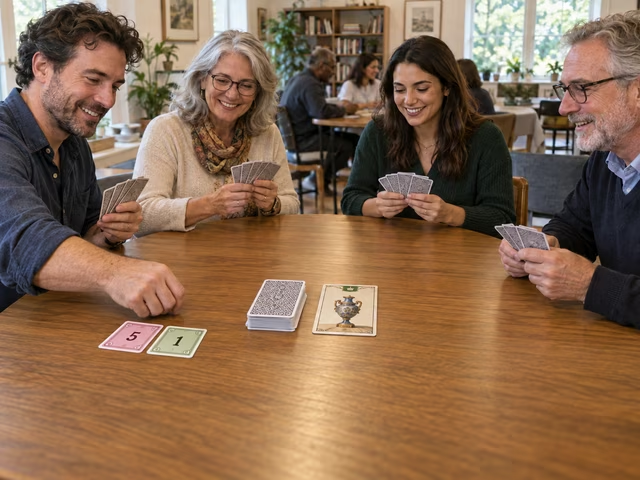
Bid with fixed money cards or pass. Positive cards go to the final bidder; negative-card auctions end at the first pass, with everyone else paying. When the fourth green card appears, eliminate the poorest players and compare the remaining status scores.
Saved on this device only — clearing your browser's cache or site data removes them (no account backup).
Keep money private and status public
Give each player one complete money set of the same color. Shuffle all 16 status cards into a face-down deck. The shuffler starts. Money remaining in hand is private; all acquired status cards stay face up. No change is available for money cards.
Raise by adding cards, or leave the auction
Reveal the top status card. For a luxury numbered 1–10 or a doubling prestige card, start with the current starting player and proceed clockwise. Bid by laying one or more money cards whose total exceeds the current highest bid. Later raises add cards; you cannot withdraw or replace a card already in your bid.
Pass to leave this auction and retrieve your own bid cards. Once everyone else passes, the remaining player pays their entire bid face down out of play and takes the status card. If nobody offered money, the last remaining player takes it free. The recipient starts the next auction.
For a disgrace card, bids instead pay to AVOID it. The first player who passes retrieves their bid and takes the disgrace; every other player loses the bid cards they have already placed. The disgrace recipient starts the next auction.
Resolve the three penalties correctly
The discard-luxury disgrace makes its owner immediately discard one numbered luxury card of their choice. If they own none, keep the penalty until their next luxury arrives, then discard both. It cannot remove a prestige multiplier.
The minus-five disgrace subtracts five from total luxury value. The halving disgrace halves final status. Prestige cards double status once each, so two multiply by four and three by eight. Apply subtraction before doubling and halving.
Check the fourth green card before bidding
Three prestige cards and the halving disgrace have green backgrounds. As soon as the fourth is revealed, stop WITHOUT auctioning it. Reveal all remaining money. Everyone tied for least remaining money is ineligible.
Among eligible players, add luxury values, apply minus five if held, multiply for prestige and halve if applicable. Highest status wins. Ties go to most remaining money, then highest single luxury. If no player remains eligible because all cash totals tie, record a shared loss as an explicit house resolution.
Teach a negative auction before starting
Use one imaginary positive and one negative auction to show who pays. Keep spent money hidden but acquired cards visible. Community comparisons praise the spending tension while differing on which small auction game they prefer. Use the original card names only to identify effects; the activity here is card valuation and budget control.
Players praise the pressure of the compact auctions. Remind everyone before bidding that the least remaining money eliminates a player at the end.
Already know the game?
Ideas & Twists
Choose a variation together before you start.
High Society · See main rules
Original STUDplay house twistOpen budgets
Keep unspent money face up throughout the game. Spent cards remain out of play. The poorest-player exclusion and all status scoring stay unchanged.
High Society · See main rules
Original STUDplay house twistForecast
After each auction, expose the next status card in a separate forecast space. At the start of the following auction it becomes the active card and a new forecast is exposed. A green forecast counts toward the end only when it becomes active; announcing this distinction before play is essential. This adds one-card planning.
High Society · See main rules
Original STUDplay house twistSmall-card reserve
Before the first auction, each player sets aside their lowest-denomination money card face up. It cannot be bid until the first green card has been auctioned. Then return it to hand. It counts as remaining money if the game somehow ends before release.
High Society · See main rules
Original STUDplay house twistSealed opening
For positive auctions only, everyone simultaneously chooses a face-down opening bid of one or more money cards, or an empty bid. Reveal together. Starting with the ordinary starter, continue normal clockwise raising or passing; a raise must exceed the largest revealed total. Equal opening highs remain in until passing or raising resolves them. Negative auctions stay ordinary.
High Society · See main rules
Original STUDplay house twistEarly exit option
Once per game, a player may declare an early exit at the START of their turn in a positive auction, before bidding. They pass and recover their current bid normally, but also turn one acquired numbered luxury card face down out of scoring. In exchange, recover ONE previously spent money card of their choice into hand. They cannot do this with no luxury or no spent money. The exchange adds a deliberate status-versus-solvency choice.
About this guide
Use the named physical base game and its supplied cards, boards and rules. Rules below are paraphrased teaching guidance. Original STUDplay house twists are optional suggestions, not publisher rules or balance-tested claims; agree one before setup.
Ready for something different?
Find another game →