

The quick version
Choose a color and keep its 11 tiles face up in reserve. One player places a tile; the other joins a tile edge to edge. Later placements touch your own color only. Place your queen by your fourth turn; until then you cannot move tiles. Each turn place one reserve tile or move one of your tiles. Keep the hive connected throughout and obey that insect's movement. Surround the opponent's queen on all six sides to win; surrounding both queens in the same move is a draw.
Saved on this device only — clearing your browser's cache or site data removes them (no account backup).
Sort the insects and choose the first player
Use the standard 22-tile Hive game with colored insect symbols and the base rules in Gen42's linked English booklet, copyright 2010. Each color has one Queen Bee, two Beetles, two Spiders, three Grasshoppers and three Soldier Ants. Set aside any Mosquito, Ladybug or Pillbug tiles. Hive Pocket, Carbon and Ultimate sets may contain extra insects or a different opening rule; this guide deliberately teaches the five-insect base game.
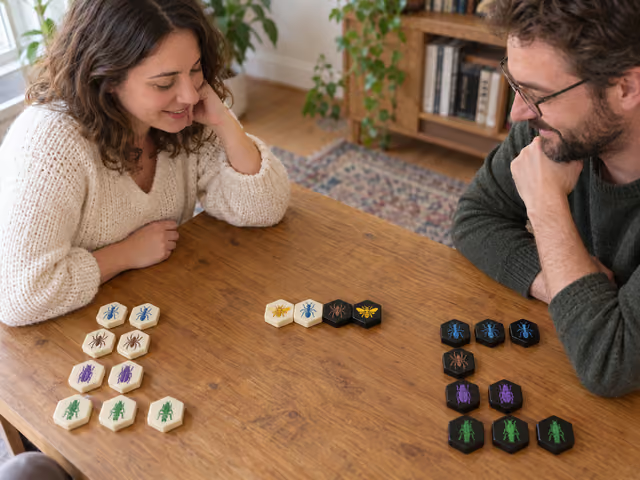
Sit opposite one another at a flat table. Choose white or black and arrange all 11 of your tiles face up near you, separated from the playing area. Reserves are public information. Leave space around the center as the hive grows. No board, dice, timer, phone or score sheet is required.
Agree who starts; the base booklet does not prescribe a selection method. A simple host choice is to let the person learning start, then alternate on a rematch. Either color can start in this casual base format. Agree before play whether to use one of the variations below. In the main game a queen may be your first tile; the separate tournament-opening variation changes that.
Place or move one tile each turn
Make the first two placements
The starter places any one of their tiles in the center. The other player places one of theirs against any edge of that tile. Pieces meet along full edges, not merely at corners. This first placement is the exception that allows a new tile to touch an opponent's color.
Bring in your queen
On your next turns, place one unused tile on an empty table space touching at least one of your own tiles and no opposing tile. Place your Queen Bee on your first, second, third or fourth personal turn. If you have not played it earlier, your fourth turn must be that placement. Count each player's turns separately. You cannot move any of your insects before your own queen is placed, even if the other queen is already out.
Choose one action
On each turn after placing your queen, either place one reserve tile under the placement rule or move one of your exposed tiles using its insect's movement. You never place and move in the same turn. You may move before emptying your reserve. Moved tiles may touch either color. Tiles stay in play; there are no captures or returns to reserve.
Check legality and both queens
Keep one connected hive during the whole move, follow the movement and gap rules below, and check the six neighboring spaces around each queen afterward. A legal move that surrounds only your queen makes you lose. If you have neither a legal placement nor a legal move, you must pass and the opponent takes another turn. You cannot pass just because you dislike your options. Having no action does not itself mean a draw.
For an unscored demonstration, put a white Ant next to a black Spider. White then puts its queen on the far side of the white Ant; black puts its queen on the far side of the black Spider. The four tiles form a straight chain: white queen, white Ant, black Spider, black queen. Explain why the central Ant and Spider cannot leave while they are the only links. Return these tiles to reserve and start the actual game afresh. This demonstration is a host suggestion, not a mandatory opening.
Give each insect its own movement
- Queen Bee: slide exactly one space to an empty neighboring position on the table, staying against the hive.
- Soldier Ant: slide any number of spaces around the hive to an empty reachable position. Trace the entire route; an Ant does not teleport, climb or jump through a blocked gap.
- Spider: slide exactly three spaces around the hive, with no backtracking. Keep contact with the hive throughout every step. Do not count two steps, circle back through an earlier position, climb or hop to another edge.
- Grasshopper: jump in one straight hexagonal direction over at least one contiguous occupied position, landing in the first empty position beyond that row. A stack is an occupied position. It cannot turn during the jump, move into an immediately empty neighbor, or skip an empty gap to jump a second group.
- Beetle: move exactly one neighboring space, either to an empty table position or onto the top of an adjacent tile or stack. It can travel across stack tops and descend on later turns. A covered tile cannot move. For new placements, a stack counts as the color of its top tile. Beetles can cover Beetles. A reserve Beetle is placed on the table like any other new tile; you cannot place it straight onto the hive.
One hive: the stationary tiles must remain connected when your tile leaves. You cannot split the hive temporarily and then reconnect it at the destination. A tile that is the sole bridge between two groups is pinned and cannot leave. A Beetle on top may leave if the tile underneath preserves the connection.
Room to slide: ground-moving tiles cannot squeeze through a narrow gate with an occupied position on both sides of the passage. Follow the actual route without shoving other tiles apart. Queen, Spider and Ant moves keep continuous contact with the hive. The Grasshopper jumps; the Beetle may climb or descend, but its body must still clear any gate at the level of its movement. For a stack dispute, compare the two flanking stacks with the Beetle's higher supporting level at departure or arrival: if both stacks rise above that level, the gate blocks it. Do not simply lift a Beetle over blocking stack walls.
Placing is different: a new tile can be lowered into an enclosed empty space if all the adjacent visible colors are yours. It need not slide into that space. Once in play, its future moves must obey movement restrictions.
Finish at the surround, including a draw
The game ends immediately when all six spaces around one Queen Bee are occupied by tiles of either color. The owner of that queen loses. Count neighboring positions, not the number of tiles in a stack. A Beetle sitting on a queen immobilizes it but does not fill a neighboring space or win by itself. The covered queen still loses if its six surrounding spaces are filled.
If the same move completes the surround of both queens, the game is a draw. The booklet also allows an agreed draw when both players are forced to repeat the same pieces endlessly with no way to resolve the position. There is no base-game three-repetition count or point tiebreak. If you need to stop for another reason, agree to end the game unscored; that is a host choice, not a rulebook victory.
You may win while tiles remain in reserve. For a rematch, clear the table, restore both complete 11-tile sets and choose the starter again. A single game has a result rather than running points; the two-game match variation supplies its own scoring.
Explain moves before they become disputes
For a first game, keep reserves visible and ask three questions before committing: does either queen face a surround, is this tile free to leave, and can its complete route reach the destination? An Ant circling toward your queen may look urgent, but developing your own mobile insects can also matter. Community players disagree about rushing a queen pin; treat this as a decision to explore, not a required winning script.
Name the insect and intended destination before moving it. Trace a Spider's three steps or a Grasshopper's straight jump with a finger beside the tiles. This helps both people follow the move without changing the position. Use the top tile's color for placement beside a stack, and distinguish placement restrictions from movement restrictions.
If a proposed move is illegal, leave the position intact and choose a legal action. For an illegal move noticed immediately, this guide suggests restoring its known starting position and replaying that turn; the base booklet does not supply a formal dispute penalty. If you discover it after more turns and cannot reconstruct the position together, agree to restart unscored rather than invent a winner. These are house remedies. An ordinary legal but regretted move stands unless you chose the teaching variation beforehand.
Keep drinks outside the playing area and leave enough space to see all reserves. Adjust seats and lighting so both players can distinguish insects and covered tiles. This seated game still requires visual pattern recognition, reaching and strategic attention. Additional friends can watch or take a later turn at a fresh game, but this game has exactly two players.
Already know the game?
Ideas & Twists
Choose a variation together before you start.
Hive · See main rules
Published Ultimate opening option for this base setTournament opening
Before starting, agree that neither player's first tile may be the Queen Bee. Each must instead place it on their second, third or fourth personal turn, and still cannot move any tile before it is placed. Use the same 22 base tiles and all other movement, passing and finish rules. This opening is printed in Gen42's 2024 Hive Pocket Ultimate rules; it is a chosen variation from the older standard booklet, not permission to add expansion abilities.
Hive · See main rules
House match suggestionTwo-game color swap
Play exactly two complete base games with the same opponent. Swap colors for game two and let the person who went second in game one start game two. A win earns two match points, a draw one point each, and a loss zero. Finish each game normally; never score partial surrounds. Compare totals after the second game. A tied match stays tied. Remember the first result aloud or optionally write it down; a score sheet is not necessary. This gives each player one first turn without changing either game's tactics.
Hive · See main rules
House learning suggestionOne takeback teaching game
Each player gets one voluntary takeback for the whole game. Immediately after their legal action, before the opponent acts and before a game-ending surround, they may announce its use, restore the exact previous position and choose a different legal action for that same turn. For a placement, return only that just-placed tile to reserve; for a move, restore it to its original position and stack level. A takeback may not rewind earlier turns, undo a completed result or move an opponent's tile. Remember whose allowance is used aloud. Rules corrections do not spend this allowance. All normal queen deadlines, legal routes and finish rules still apply.
About this guide
Main game: standard 22-tile Hive and Gen42's linked 2010 English booklet. The 2024 Gen42 Pocket Ultimate leaflet clarifies stack gates and supplies the separately labeled no-queen-first opening; its extra insects are excluded. First-player selection, demonstration, move checklist, dispute remedies, two-game scoring and takebacks are host suggestions. Community discussions informed the teaching needs rather than establishing rules or popularity. No commercial app's timing, expansion behavior or tournament result system is imported.
Ready for something different?
Find another game →