

The quick version
Give each person three matching cones: one for the score track and two for guesses. The cue giver secretly chooses one color from a drawn card and gives a legal one-word cue. Guess clockwise on empty squares. Give a new cue of one or two words, then guess counterclockwise with the second cone, or skip the second cue and guesses. Reveal the same target with the 3×3 frame, score, clear the guessing cones, and pass the cue-giver role clockwise. Finish after everyone has given cues twice with 3–6 players, once with 7–10.
Saved on this device only — clearing your browser's cache or site data removes them (no account backup).
Set out the color board
Use The Op's standard English Hues and Cues base game for 3–10 individual players: one 480-square color board, the 100 color cards, 30 cone pieces in ten sets of three, the rulebook and the four-piece scoring frame. Each player takes one distinct set of three cones; unused colors stay in the box. Use the expanded leaflet linked below, including its three-player adjustment and extra-round tie rule. Older leaflets differ; agree to follow this version throughout.
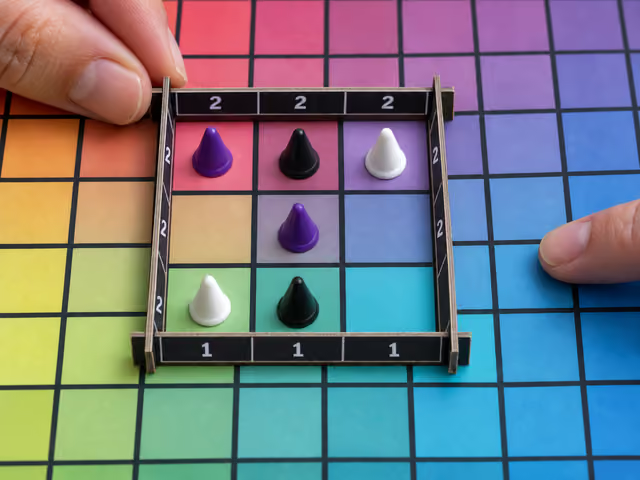
Place the board where everyone can see and reach it. Put one cone per person just before the score track as their score marker, keeping the other two for guesses. Shuffle the color cards into a face-down pile. Assemble the scoring frame with the sides labeled 2 facing inward and 1 facing outward, then set it beside the board. Its interior surrounds a 3×3 block, with the target in the middle square. No timer, phone or score sheet is needed for the main game.
Use even, neutral light and check glare from every seat before starting. Let everyone inspect the grid: distinguishing neighboring shades is a core part of play. Ask whether this color-based format works for the people present; seated play does not guarantee visual accessibility. The person wearing the most colorful outfit gives the first cues. If that is unclear, choose a willing first giver as a host agreement, then keep clockwise rotation.
Choose one target and give legal cues
The cue giver draws the top card privately and chooses one of its four color swatches. Remember that swatch's letter and number; that exact coordinate remains the target for the entire round. Do not switch to another swatch after seeing the guesses. Quietly check the target on the board before describing it: card finish, neighboring colors and lighting can affect how a shade appears. As a host courtesy, the guessers can look away while the giver checks, then all look back before the cue.
The first cue is exactly one word. Think of a familiar object, material, place or association, such as coffee. Common color words are forbidden: purple, blue, green, red, pink, yellow, orange, brown, white, black and gray. The expanded leaflet expressly permits abstract color names such as chartreuse and lavender. Do not describe the target's location, say its letter or number, refer to an object in the room, or repeat a cue already used earlier in this game. An object word does not get a free pass when it is being used as a forbidden basic color name.
After everyone's first guess, the giver may give a different cue of one or two words about the same target. Keep all the first-cue restrictions. In this leaflet, lighter or darker cannot direct players relative to their first guesses; neither can left, higher, next to Sam or two spaces away. Give a fresh association instead: coffee followed by milk chocolate illustrates the two-stage idea, but does not identify one universal correct shade. Do not explain the cue, point to a region or signal whether a guess is close. Alternatively, pass the second cue; that ends guessing for the round immediately.
Place guesses, reveal and score
Make the first guesses clockwise
Starting with the person to the cue giver's left, every other player places one of their guessing cones on the square they think the first cue describes. One cone commits to one square. A square with any cone is occupied and unavailable to later guesses. Leave every first cone where it is; the giver does not place a guessing cone.
Reverse the second guessing order
If the giver supplies a second cue, start with the person to the giver's right and go counterclockwise. Each guesser puts their remaining cone on a different, unoccupied square. The first cone stays on the board, even if the second cue changes the player's interpretation. If the giver passes instead, nobody places a second cone; proceed directly to scoring.
Reveal the coordinate
Show the chosen swatch and center the scoring frame on its printed board coordinate. Use the coordinate to settle the answer, rather than arguing about whether the card visually matches a neighboring square. A cone exactly on the target scores 3 points for its owner; each other cone inside the 3×3 frame scores 2. A cone immediately outside the frame, including diagonally adjacent at a corner, scores 1. Anything farther away scores 0. Add each guesser's two cone scores, or their single score after a pass.
Score the cue giver and rotate
With 4–10 players, the giver scores 1 point for every guessing cone inside the frame, including the exact target; the outside 1-point ring earns the giver nothing. With exactly 3 players, the giver scores 2 per cone inside instead. Move each person's score-track cone by their total. Return all guessing cones to their owners, discard the used color card, and let the next person clockwise draw a card as cue giver. Discarding after scoring is this guide's housekeeping convention.
Complete the agreed finish
With 3–6 players, finish after each person has given cues twice; with 7–10, each gives cues once. Finish the whole rotation rather than stopping when someone reaches the end of the printed score track. If scores exceed the track, continue counting beyond 50 and keep track of the extra lap; a spare paper note is an optional host aid. Highest total wins. If tied, continue extra rounds with the normal scoring and clockwise order, skipping the tied leaders when selecting cue givers, until one of those leaders takes the lead. Keep their identities fixed for this tiebreak. If everybody is tied, there is no eligible giver under that instruction: this guide's house fallback is to share the win.
For a practice target H15, H15 scores 3, G14 scores 2, F13 scores 1 at the outside corner, and E12 scores 0. A guesser with cones on H15 and G14 earns 5. The giver earns 2 for those two inside cones with four or more people, or 4 in a three-player game. Remove these demonstration cones and start everyone at zero.
Keep the associations friendly
Choose references the group can reasonably recognize, while accepting that a banana, beach or cartoon character may suggest several colors. The target is fixed, but the association is personal; explaining it after scoring is often the best conversation. Do not correct someone else's perception or promise that every person with a color-vision difference will find the game equally usable. Move a harsh lamp or change seats before treating a confusing shade as a bad guess.
Keep turn order visible: clockwise first, counterclockwise second, and no moving either cone after placement. A second guess may improve a player's result, but the giver is allowed to withhold it. Explain this before the first round so a strategic pass does not feel like a new rule. The giver scores cones inside the frame, not the number of people nearby; two qualifying cones from one person count twice.
If a clue is challenged before anyone guesses on it, this guide suggests replacing it with a legal new cue for the same target. If a prohibited cue or revealed card has already influenced guesses, abandon that round without scoring, clear the cones and let the same giver draw a fresh card. These are house remedies; the leaflet does not specify an invalid-cue penalty. Decide close word-boundary cases before play rather than inventing a penalty after scoring.
For an edge target, keep the target centered conceptually and score only squares that actually exist on the board. Do not slide the target into another part of the frame to create extra scoring squares. A player may place cones on edge squares. If the card and board repeatedly look far apart, check the printed coordinates and lighting and consult the publisher about the physical set; this guide cannot diagnose a printing defect from a story or photograph.
Already know the game?
Ideas & Twists
Choose a variation together before you start.
Hues and Cues · See main rules
Publisher variant adapted for an adult tableChoose from the whole board
Replace drawing a card with secretly choosing any board square. Before the first cue, write its letter and number on a small slip and keep it hidden; this variation requires paper and a pen. Reveal that slip when scoring so the target cannot change. Keep cue restrictions, occupied-square rule, both guessing orders, the option to skip the second cue, scoring and the normal finish. Edge targets have fewer available scoring squares; do not shift the target to compensate.
Hues and Cues · See main rules
House suggestion · shorter commitmentOne circuit
Agree before starting that every person will be cue giver exactly once, including with 3–6 players. Keep all clue, guessing and scoring rules, including the three-player giver adjustment and strategic pass. Finish only after the complete clockwise circuit; highest total wins and tied players share the win rather than playing extra rounds. This changes the small-group length and tie rule, not the score for a cone.
Hues and Cues · See main rules
House suggestion · remove abstract color namesObjects and memories
Before starting, also prohibit abstract color names such as chartreuse and lavender, which the expanded base leaflet normally allows. Use recognizable objects, places, materials or shared memories instead; keep the one-word first cue and one- or two-word second cue. Common-color, room-object, repeated-cue and location restrictions still apply. Turns, optional second-cue pass, scoring, headcount and finish stay the same. Check that the reference is shared knowledge rather than a private joke only one friend understands.
About this guide
Standard English physical base game; no app, expansion or two-player conversion. Main mechanics use the expanded manufacturer-authored leaflet mirrored by Waterloo, visually checked on October 2, 2026; its revision date and present in-box distribution are not established. It includes no repeated cues, no relative lighter/darker directions, double giver points at three players, 3–6-player two-circuit play and extra-round ties. The publisher-linked 2020 leaflet is a different version with narrower cue text, 4–6 in its finish sentence and a most-recent-giver tie rule; this guide intentionally does not mix those rules. Look-away courtesy, discarding used cards, score-lap aid, invalid-cue remedies and all-tied shared victory are host suggestions. Whole-board choice derives from the publisher variant; the other twists are house suggestions.
Ready for something different?
Find another game →