

The quick version
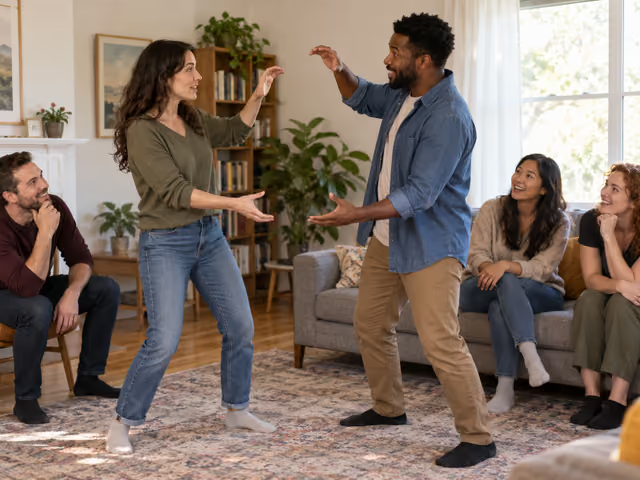
Choose an order around the group. The first two people perform; the third is the caller and everyone else watches. The caller gives a place and relationship, such as two museum coworkers before opening. One performer begins with an action and a statement; the other accepts that situation and adds a detail. Build toward a decision or change, then the caller or either performer says 'Scene!' to finish. Move the first person in the order to the back and repeat. Finish when the original order returns, offering each person two acting turns. Passing is always allowed.
Saved on this device only — clearing your browser's cache or site data removes them (no account backup).
Choose the roles and the stopping point
Gather 3–8 people where everyone can hear ordinary conversation. Leave space for two performers without moving furniture during a scene. Stay in your own space: no running, throwing or touching another person. Performers may stand or remain comfortably seated; imaginary actions can be described aloud. A stage, costume, microphone, timer and written prompt pack are unnecessary.
Agree on one circuit as the first session: with five people, that means five scenes. Choose an order and remember the starting person. In each scene, the first two people in that order act, the third calls, and the others watch. Afterward, move only the first person to the back. For three people, A and B act with C calling, then B and C act with A calling, then C and A act with B calling. That finishes a circuit; the caller is included in the headcount, not an extra person.
Anyone may pass on acting or calling without explaining why. If a listed performer passes, a watcher may volunteer to take that role; otherwise skip that scene. If the caller passes, another nonperforming person may call. Advance the order once even after a skipped scene. Keep at least two willing performers and one willing caller for any scene; if those roles cannot be filled, finish the session. Passing does not create a debt of makeup turns.
Before starting, agree to keep scenes fictional, avoid personal digs and leave out subjects anyone asks to avoid. Anyone can say 'Pause' to stop play immediately and step out or request a different prompt. Agree before recording; recording is not part of this format.
Begin with something your partner can use
The caller offers one place and one relationship: coworkers in a museum, neighbors at a community garden, or two repair technicians in an elevator. Both performers may swap the prompt before starting. There is no secret answer. The caller then watches rather than feeding continuous instructions.
Start by doing an imaginary task and saying a useful statement. For the museum prompt, try: 'Lee, our first day as museum guides and this dinosaur is facing the wall.' Your partner could answer, 'Sam, the curator wants visitors to guess its expression.' Your next response might be, 'Then we need to give it a very suspicious tail.' The two names, shared job and problem give the scene somewhere to go. These are demonstration lines, not a script to learn.
For a first try, have two volunteers speak just three lines: first performer, second performer, first performer. Say 'Scene!' and thank them. A simple exchange counts; it need not produce a laugh. Then begin the actual circuit with new prompts. The demo does not use up anyone's scheduled turns.
Listen, add and bring the scene to a close
Keep what your partner established
Treat the agreed fictional place, relationship and events as real within the scene. If your partner says the imaginary frame is enormous, respond to its size rather than declaring there is no frame. You do not have to literally begin every line with 'yes, and'. Acceptance means using their contribution, then adding yours; it never overrides someone's real-world boundaries.
Add one useful detail
Take turns responding, allowing the other person room to speak. Name something you notice, want or feel, or make a choice your partner can respond to. A question can be part of dialogue; do not make your partner invent everything by only asking 'Where are we?' or 'What happens now?' Pause to listen instead of rushing to deliver a joke.
Develop the same situation
Let a detail change how the characters behave. The museum coworkers could decide to lead the tour backward, then discover that visitors like it. Mime objects consistently and stay within your own space. No one joins the pair mid-scene in the main format. Observers listen instead of shouting lines, corrections or answers.
End and rotate
The caller or either performer says 'Scene!' when the characters reach a decision, a detail returns in a satisfying way, or the scene is repeating without moving forward. Stop there; a punchline and a fully resolved plot are unnecessary. If someone is stuck and wants to stop, end kindly rather than demanding a recovery. Thank the pair, move the first person in the order to the back, and give the next pair a new prompt.
Finish the circuit
When the starting person is first in the order again, the session ends. If everyone took their listed roles, each person acted twice and called once. Extra volunteers and passes change appearances, not the circuit's endpoint. There is no score, winner or tie. Ask whether people want to finish or agree to a new circuit; do not silently extend play.
A pair trying to hang an imaginary picture can be a complete scene. Their different opinions about where it belongs give them something to respond to. Bigger voices, risky movement and elaborate characters are optional, not requirements.
Help the pair share the scene
If you blank, notice the last thing your partner said or did. Give a direct reaction, repeat a useful fact in character, or make one ordinary choice. You can ask to end. Watchers should not judge whether a contribution was clever enough. A brief pause is allowed.
If one person dominates, the caller can end the scene and remind the next pair to leave room for replies. Offer advice between scenes only when wanted. Thank people for a concrete contribution, such as keeping the imaginary door in the same place, instead of ranking performances or counting laughs.
If fictional details contradict each other, accept the latest harmless detail and continue, or let the caller end and restart with a fresh prompt. That is a house remedy, not a penalty. Do not argue about a single correct improv technique. If a prompt or line crosses an agreed boundary, 'Pause' stops the scene; discard it, check whether the pair wants to continue, and replace the prompt or skip the turn.
This is a spoken, attentive activity. A seated option does not establish suitability for every access or language need. Check that people can hear, follow and comfortably participate before choosing it. The variations below introduce extra constraints; use only one at a time after the group understands the basic scene.
Already know the game?
Ideas & Twists
Choose a variation together before you start.
Improv scenes · See main rules
Published exercise · house rotationThree-line scenes
Give each pair only three spoken lines: A opens, B replies, A responds. The caller says 'Scene!' immediately after the third line, even if the story could continue; gestures do not add lines. Use the same spoken prompts, passing choices and one-circuit rotation. This replaces the open scene's decision-based ending with an exact line limit and keeps the focus on establishing a shared situation. There are still no points or winners.
Improv scenes · See main rules
Published game · house call limitNew choice
The pair plays the same scene, but the caller may say 'New choice' immediately after a spoken line. Its speaker replaces only that line with a different one; the original line is discarded and both performers treat the replacement as true. Earlier scene facts remain. This guide suggests at most two calls per scene, never twice on the same line, then a reply from the partner before another call. No other observer may call. A performer may decline and continue unchanged. The normal ending, rotation, pass and pause rules remain; no penalties or scoring are added.
Improv scenes · See main rules
Published Freeze Tag · house rotation and no contactFreeze and replace
Replace the separate-scene circuit with one chain. Choose an order; its first two people act and its third calls. The remaining people wait in order to enter, followed by the caller. After the current pair establishes a situation, the caller says 'Freeze' and both pause in comfortable poses. The next willing entrant names the person they replace, who steps aside; there is no shoulder tap. The entrant adopts a comfortable version of that pose and starts an entirely new situation suggested by it, and the remaining performer joins that new reality. Discard the previous characters and story. Outgoing performers become observers, not new entrants. After each person other than the starting pair has been offered one entry, the caller lets the final pair establish their new scene and says 'Scene!' to finish. A pass uses up that entry offer; if no one enters, unfreeze the current pair and continue to the next offer. End sooner if anyone requests it. With three people, the original caller has the single entry offer; the replaced performer becomes caller. With larger groups, when the original caller takes the final entry, that replaced performer becomes caller. Keep the main no-running, no-touching and pause boundaries; abandon poses that are uncomfortable. No score or winner. This changes continuity and the rotation, and is best chosen only if everyone wants to try swapping characters.
About this guide
Improv has multiple teaching traditions, not one official competitive rulebook or purchased edition. The published Hoopla exercises inform shared scene building and the three variations. This guide's 3–8 range, adjacent-pair circuit, rotating caller, prompts and demo examples, voluntary participation, no-contact boundaries, ending procedure and dispute remedies are explicit STUDplay house hosting choices. New Choice's call limit and decline option, and Freeze and replace's finite entry queue and no-touch replacement, adapt the published games. No timer, therapy claim or professional-performance standard is implied.
Ready for something different?
Find another game →