

The quick version
Put three camels and two drawn cards in a five-card market, deal five cards each, and move dealt camels into separate herds. On your turn, take one good, exchange for at least two goods, take all market camels, or sell one goods type. Keep at most seven goods in hand. End the round when three goods-token supplies run out or the deck cannot refill the market, then score tokens and the camel majority. First to two round wins takes the match.
Saved on this device only — clearing your browser's cache or site data removes them (no account backup).
Build the five-card market
Use the physical Space Cowboys Jaipur base game with Vincent Dutrait artwork, the 2019 new printing, and its English rules currently linked by the publisher. This is exactly two individual traders at an indoor table, with room for a market, token supplies, deck, discard pile and each player's hand and herd.
Bring all 55 cards: six diamonds, six gold, six silver, eight cloth, eight spice, ten leather and eleven camels. Also bring the 38 goods tokens, 18 bonus tokens, one camel token, three Seals of Excellence and printed rules. Use the matching game pieces; an ordinary playing-card deck is not a replacement.
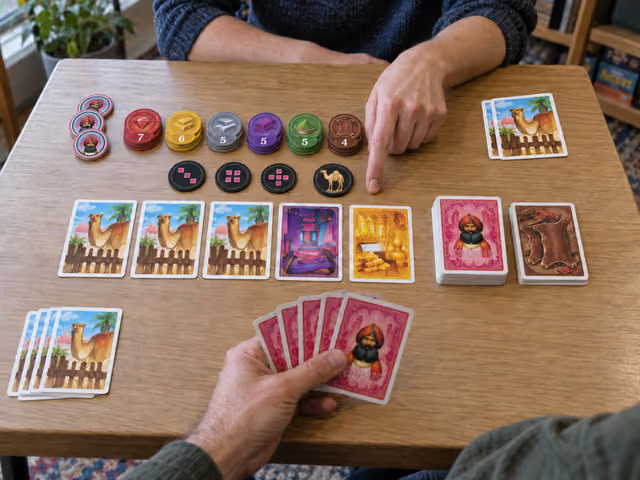
Place three camel cards face up between you. Shuffle the remaining cards, deal five to each player, and put the rest in a face-down deck. Draw two cards beside the three camels to make a five-card market; these drawn cards may also be camels. Move every camel in your dealt hand to a separate face-up stack in front of you, your herd. Do not draw replacements for those dealt camels. Only goods remain in your hand.
Sort the goods tokens into six supplies by goods type, with the highest values available first. Overlap them so both players can see all the values. Separate the bonus tokens into the sale-size groups 3, 4 and 5; shuffle each group and stack it with rupee values hidden. Set out the camel token and seals. Agree on a first player; the other player takes the next turn.
Take cards or sell one kind of goods
Choose one action
Take turns. Either take cards using ONE of the three options below, or sell goods. You cannot take and sell on the same turn. There is no pass action. Check your hand after the action: it may contain at most seven goods cards. Camels in your separate herd never count toward this limit.
Take one good
Choose one non-camel market card and add it to your hand, then fill that empty market spot from the deck. This does not cost a card. You cannot do it with seven goods already in hand, because taking and selling are separate turns.
Exchange for several goods
Choose at least two goods cards from the market; they may be different types. Return exactly as many cards to the market, using goods from your hand, camels from your herd, or both. You cannot return any goods type you are also taking. Do not take camels as part of an exchange, make a one-for-one swap, or draw new market cards after an exchange. It leaves five cards in the market. Count the completed hand: two goods taken for two herd camels would increase your hand by two.
Take the camels
If the market has at least one camel, take EVERY camel there and add them to your herd. Take no goods during this action. Refill the vacated spaces from the deck. Even a five-camel market is legal; if you cannot sell, taking all five is your action. Camels cannot be sold for goods tokens.
Sell a set
Choose one goods type and discard one or more of those cards face up. Diamonds, gold and silver require at least TWO cards in a sale, even if only one matching goods token remains. Cloth, spice and leather can be sold singly. Take one matching goods token per sold card, highest available values first, stopping if that supply runs out. For three, four, or five-or-more cards sold, also take ONE bonus token from the matching 3, 4, or 5 stack; fewer remaining goods tokens do not reduce the sale size for the bonus. Never combine goods types to reach a bonus.
Keep earned points separate
Stack earned goods and bonus tokens in your own area with their rupee values hidden from the opponent; you may inspect your own. Bonus values are 1–3 for a three-card sale, 4–6 for four, and 8–10 for five or more. The next player now takes one action. Keep unsold goods in hand and your herd separate.
If your initial hand has four goods and one camel, keep four goods in hand and put the camel in your herd. Taking a cloth from the market gives you five goods; refill its spot, then let the other trader act. You must wait for a later turn to sell.
Score the round, then race to two seals
Stop immediately when three different goods-token supplies are empty, or when there are not enough deck cards to refill the market to five. Complete a triggering sale, including its bonus, before scoring. Drawing the last card does not alone end a round if the market was fully refilled. There is no final extra turn and no sale of leftover hands; unsold cards score nothing.
Count each herd. Whoever has more camels gets the camel token worth five points; if tied, neither gets it. Reveal and add your earned goods tokens, bonus tokens and any camel token. Higher total wins the round and receives one Seal of Excellence. A points tie goes first to the player with MORE bonus tokens, then MORE goods tokens; these tie-breakers count tokens, not their values.
The rulebook gives no further tie-breaker. Agree on this house remedy before playing: if points and both token counts remain tied, award no seal, reset and replay the round with the starting player switched. Otherwise, the round loser starts the next round. Return all cards and tokens, rebuild the market and supplies, reshuffle, and deal fresh hands; keep only earned seals between rounds. The first player with two seals wins the match.
Make the tricky choices clear
Explain the three taking options separately before the first turn. Have a player point to the goods they want and the cards they will return before moving an exchange, then check equal counts, different returned goods types and the seven-card limit. Six goods in hand can become six after exchanging two hand goods for two market goods; exchanging two herd camels instead would make eight and is illegal.
You do not have to announce how many camels are in your herd. Keep the face-up herd stacked rather than spreading it as a public counter. Count it openly at the round end. Taking camels refreshes the market for your opponent, so neither a large herd nor a large sale is always best. Watch the remaining goods-token values and the three-supply ending condition before holding out for another card.
Keep a five-camel market as it is; do not replace camels just because it looks unhelpful. Selling remains an alternative if you have a legal sale. Take goods OR camels, never both. If a completed action is challenged, check the printed rule and the visible cards before the next action. This guide suggests undoing an immediately caught illegal exchange when all moved cards are identifiable; after new hidden information is revealed, agree on a remedy rather than inventing an official penalty.
If a bonus stack is exhausted, the linked rulebook supplies no explicit procedure. Agree beforehand on this house remedy: that sale earns its available goods tokens but no replacement bonus; do not reuse earned tokens or substitute a different bonus size. Quiet spoken explanation and seated card handling are enough for this format. Make sure both traders can distinguish the pictures and values, reach the market and privately hold cards; seated play alone is not an access guarantee.
Already know the game?
Ideas & Twists
Choose a variation together before you start.
Jaipur · See main rules
House learning suggestionOpen-table teaching round
For one practice round, lay each player's goods face up and spread both camel herds so counts are visible. Show earned token values too, while keeping the undrawn bonus values hidden. Discuss choices before each action. Keep the same five-card market, exchange restrictions, seven-good limit, sales, bonuses, ending and scoring. Award no seal for this practice round; return every component, deal fresh hidden hands, stack the herds and start the normal match afterward.
Jaipur · See main rules
House shorter-format suggestionOne-round contest
Play a single fully scored round instead of a match to two seals. Keep every setup, taking, selling and round-ending rule. Highest points wins the contest; break a points tie by bonus-token count, then goods-token count. If still tied, declare a shared result instead of replaying. Seals are unnecessary in this format, and there is no carryover round. This changes the commitment, not the randomness of a single round.
About this guide
Rules follow the physical Space Cowboys 2019 new printing and the English PDF linked by the publisher when reviewed. Its reminder saying one goods type each round is read in the context of the sale action: one type per selling turn, not one type for an entire round. The exhausted-bonus remedy, unresolved full-tie replay, illegal-exchange remedy and both twists are explicit house suggestions. Community questions informed the explanations; they do not replace the rulebook. Digital scoring tools and fan multiplayer formats are not part of this guide.
Ready for something different?
Find another game →