

The quick version
Agree on a slow four-beat pulse and repeat this eight-bar loop in G major: G, G, C, C, D, D, G, G. Each bar lasts four beats. Start with two loops together, then give each willing player one loop in the spotlight while the others accompany softly. Play one closing loop, followed by a final G chord held for four beats. Pause, discuss one adjustment and repeat for three passes. There are no points or winner.
Saved on this device only — clearing your browser's cache or site data removes them (no account backup).
Bring players who can hold the groove
Invite 3–6 active music makers. At least one must be able to play G, C and D major chords, switch on the agreed beat and keep a steady pulse while watching the group. Make that person the accompaniment anchor. Choose a leader who can count bars, announce turns and cue the finish; the anchor can also lead. Everyone else needs a part they can manage: those chords, a short melody, humming or a soft shaker rhythm. Instrumentalists bring instruments they can already use. This is a first-group-playing format, rather than a first lesson on how to play an instrument.
Use an indoor room where acoustic music is permitted. Arrange chairs so everyone sees the leader and chart, with space for instrument necks and clear exits. Use unamplified instruments and voices at a comfortable level. A percussion player brings a small shaker or another soft acoustic percussion instrument; a drum kit is outside this format. Ask before borrowing or touching anyone's instrument. Tune the pitched instruments together before starting, matching a reference supplied by the competent player; a tuner is optional.
Write eight numbered bars on paper: 1 G · 2 G · 3 C · 4 C · 5 D · 6 D · 7 G · 8 G. A bar is one count of 1–2–3–4. Change chord on beat 1 of the next bar, not once per beat. After bar 8, return to bar 1. These are sounding chords in G major; use no capo unless its player can produce those same sounding chords. Each player must see the chart; make extra paper copies if needed.
The leader taps and counts a slow, even pulse. Try roughly one beat per second as a starting feel, then test the chord changes and slow down until everyone can follow. Agree on that tempo before the pass and keep it throughout. Use straight, evenly spaced beats. Chord players may start with one gentle strum on beat 1 of each bar; percussion may mark the four beats quietly. More fluent players can add a simple pattern that preserves the same pulse.
Agree to three passes. A pass is one uninterrupted run of the format below, ending in a shared stop. List the willing spotlight players clockwise, starting with the person to the leader's left and ending with the leader if they want a turn. Anyone may pass and keep accompanying or listening. The anchor keeps the chords going even on their own spotlight turn; a rhythmic chord variation can be their featured contribution. If no one wants a spotlight, use the two opening loops and one closing loop only. These counts and cues are house suggestions, with no purchased edition.
Count in, take turns and land the ending
Rehearse the first action
Before the first pass, the anchor plays one loop while the leader counts all four beats in each bar and says the next chord just before its change. Others listen, then join for a second practice loop. Test the ending too: after bar 8, strike G on the next beat 1, count four beats and stop on the following beat 1. The practice is separate from the three passes. If players cannot follow, slow down or choose the one-chord variation before continuing.
Start with two shared loops
The leader says 'Ready: 1, 2, 3, 4' at the agreed pulse. Everyone enters on the next beat 1, bar 1, G. Play the eight-bar chart twice with simple accompaniment. The anchor keeps it unchanged. The leader tracks bar numbers and can say the approaching chord aloud. Do not add a surprise chord, key or tempo change.
Offer the first spotlight
During bar 8 of the second opening loop, the leader names and looks toward the first willing player: 'Sam next.' Sam starts at bar 1 of the next loop and has that entire eight-bar loop. Everyone else stays with the chart and plays more softly. A featured player can hum an original phrase, try a few notes, add a rhythm or simply make their usual part more prominent. A fast or elaborate solo is unnecessary.
Hand over at the loop boundary
In bar 8 of each spotlight loop, the leader names the next willing player. That person begins at bar 1; the previous player returns to accompaniment. Continue through the agreed list once. A nod or 'Pass' skips a spotlight; the group still plays that loop as ordinary accompaniment and offers the next player the following loop. Do not jump in over somebody else's turn or extend a solo past its eight bars.
Close together
During bar 8 of the final offered spotlight loop, the leader says 'Last loop next.' If nobody wants a spotlight, give that cue in bar 8 of the second opening loop instead. Play one more full eight-bar loop together, with no new spotlight. In bar 8, the leader says 'Final G next.' On the next beat 1, everyone lands on G: chord players strike it once, melody players may land on G, and percussion stops. Let it sound for four beats, then mute or stop on the following beat 1 together. The leader counts the four beats aloud. This extra ending bar does not start another loop.
Pause and complete three passes
After the stop, ask what would help the next pass: clearer changes, softer backup or a slower starting pulse. Agree on one adjustment, update the willing-player list if needed, and count in for the same complete format again. Finish after the third pass, or earlier by group agreement after an ending. There is no score, elimination, best-player vote or tie to break; the shared musical ending completes each pass.
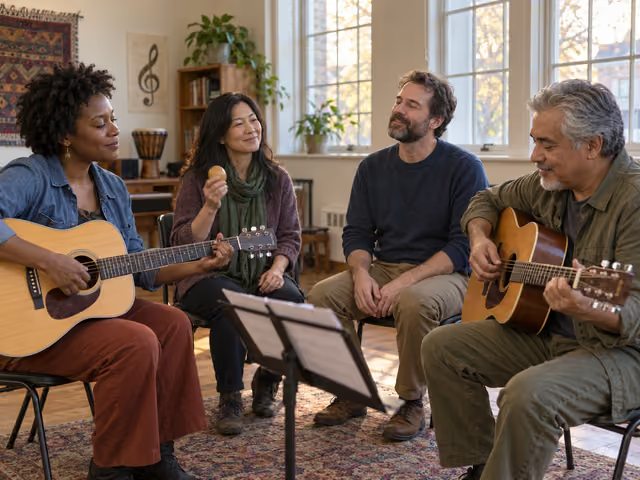
With Alex anchoring the guitar and leading, Sam on a second guitar, Jo on a shaker and Lee humming, all four play two opening loops. Sam, Jo, Lee and then Alex each get one loop if willing. One closing loop and the four-beat G ending finish the pass. That is seven full loops plus one ending bar. Lee can echo a note Alex demonstrates before playing; Jo can feature a rhythm while both guitars maintain the chords.
Make room for each contribution
For a simple melody, try notes belonging to the current chord: G–B–D over G, C–E–G over C, and D–F-sharp–A over D. A competent player can show or sing one note before the pass. Repeat a small idea and leave gaps rather than trying to fill every beat. A singer can hum or use neutral syllables; the shared groove needs no lyrics or backing track.
Keep the featured player audible. If you cannot hear them, reduce your part or stop playing briefly while the anchor continues. Save coaching and conversation for the pause between passes. A confident player can help count or demonstrate a change, but should not take over another person's spotlight. Ask what sort of help people want before offering corrections.
A missed note does not stop the pass. If you lose the chart, stop your own part, listen to the anchor and rejoin at the next bar 1 when the leader calls 'Back to G'. That call means the start of the next eight-bar loop, not a mid-bar change. Anyone may call 'Stop' for confusion, discomfort or an instrument problem; everyone stops immediately. Locate the problem, retune if needed and restart that unfinished pass from its count-in. Completed passes remain completed, and there is no penalty.
Settle chord or cue disagreements while stopped by checking the written chart and rehearsing the change. The leader's announced player is the only spotlight for that loop. If two people begin, both return to accompaniment and retry the intended spotlight on the next loop. A missed final cue also means stop, talk and rehearse the ending before starting again; do not turn the mistake into a contest.
Keep participation voluntary, including humming and soloing. Listeners do not count toward the 3–6 active-player range. A seated setup needs instruments and chart positions that work for the actual players. Agree before making any recording, and agree separately before sharing it. A phone, recording, amplifier and named song are optional choices outside this main format.
Already know the game?
Ideas & Twists
Choose a variation together before you start.
Jam session · See main rules
House suggestion · easier chord coordinationOne-chord conversation
Replace every bar of the chart with G major; keep eight bars of four beats, the agreed slow tempo, two opening loops, one loop per offered spotlight, one closing loop and the extra four-beat G ending. Use G, B and D as simple melody notes throughout. The anchor must still keep the beat and cues steady. Complete three passes with a pause between them. This lets players focus on listening and turn-taking before adding C and D; it keeps the same people, acoustic instruments and paper chart, with no score.
Jam session · See main rules
House suggestion · paired musical turnsCall and answer
Before starting, each willing spotlight player chooses an answering partner who agrees to participate; partners may repeat, but a player cannot answer themselves. Keep the G–G–C–C–D–D–G–G chart. Each offered spotlight now lasts two full loops: in the first loop the spotlight player invents a short melody or rhythm while the partner accompanies; in the second the partner answers with a related idea while the first accompanies. Everyone else, including the anchor, maintains soft backup. Cue the partner in bar 8 of the first loop and the next spotlight player in bar 8 of the second. A pass keeps the two opening loops, one pair of loops per willing spotlight player, one closing loop and the four-beat G ending. A player may pass either part; use that loop as accompaniment. Complete three passes, with no points and the same gear.
About this guide
An original bounded house format, not a universal jam-session ruleset. Berklee supports conversational improvisation and turns leading; PULSE teaches chord tones, repetition and working within a musical form. ArtistWorks supports listening, volume balance and leader cues. The G-major eight-bar chart, 3–6 active-player range, slow pulse, three-pass finish, one-loop spotlights, reset procedures and all variations are this guide's hosting choices. Jazz, bluegrass and other public sessions have their own conventions. No copyrighted lyrics are reproduced.
Ready for something different?
Find another game →