

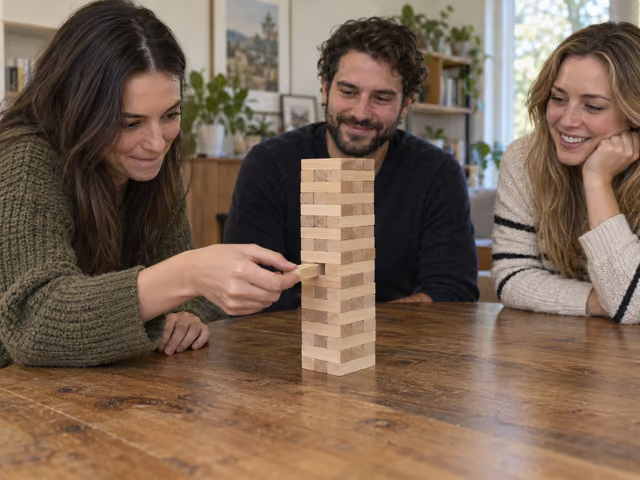
The quick version
The builder goes first, then play passes left. With one hand at a time, move one block from below the highest complete layer to the top. Finish each three-block layer before starting another. When the tower falls, the last player who successfully stacked a block wins.
Saved on this device only — clearing your browser's cache or site data removes them (no account backup).
Build the starting tower
Clear a flat, stable table with room for falling blocks and for each player to reach the tower. Keep drinks and fragile objects out of that space. Put three blocks side by side, long edges touching. Turn the next layer a quarter turn and repeat with all 54 blocks: the starting tower has 18 complete layers. The sleeve helps align it; remove it before play.
Choose one builder, who takes the first turn. Everyone else follows to the left around the table. Sit or stand where you can reach without bumping the surface. Before starting, point out the highest complete layer: initially it is layer 18, so the first block must come from layers 1–17. There are no points to track.
Remove, stack and pass
Find a loose block
Gently test blocks below the highest complete layer. You may test more than one. If you move a block and decide not to use it, restore it with one hand before touching another. You may switch hands, but only one hand may touch the tower at a time; your free hand cannot steady it.
Move one block to the top
Slide or push the chosen block free, then place it on the top layer. Blocks in a layer sit side by side in the same direction; each new layer runs at right angles to the one below. Complete the current top layer with three blocks before building higher. Do not take from an incomplete top layer or the complete layer immediately beneath it.
Finish your turn
After placing the block, release the tower. Your turn ends after ten seconds or when the next player touches a block, whichever happens first. Until then, a fall belongs to your turn. The next player takes over once the turn ends; there is no extraction time limit in this format.
Name the winner and reset
A fall ends the game. The last player to stack a block successfully before the losing turn wins, even with more than two players; the other players do not all share the win. If the first turn fails, nobody has completed a successful turn, so use the house ruling of no winner and rebuild. There is no tied score. The player who caused the fall builds the next tower and starts it.
If layer 19 has only one or two blocks, layer 18 is still the highest complete layer: remove from 1–17. Once layer 19 has three, remove from below 19. The boundary rises with the tower; it is not fixed at the original height.
Agree the close calls before play
Show a gentle test and one removal-and-placement before the game, then rebuild. If the next player wants the full settling period, count ten seconds aloud before touching a block; a phone is unnecessary. Keep everyone else's hands off the tower during a turn. A falling tower can be loud, so choose a table where the crash is acceptable.
For this friendly format, an unselected block falling ends the game even if most of the tower stays up. Dropping only the block you are moving does not: retrieve it and finish placing it with one hand. These are explicit house rulings for the instruction sheet's broad toppling language. Do not catch a falling tower to claim a successful turn.
Other house rulings: do not relocate already placed top blocks to make room; fit yours into the current layer. Do not brace the tower with a forearm, body or object. If you use two hands but the tower stands, take the extra hand away and continue under the one-hand rule; no bonus move or penalty points. If an observer bumps the table, stop and rebuild with the same opening player and no winner. If you cannot restore a tested block or make a legal move, concede: the previous successful player wins. Stop rather than forcing the tower. Explain any disagreement while hands are off; do not change a rule mid-turn.
Keep the same turn order for a whole tower. More friends can join the next game. If the group ends a game early with the tower standing, call it unfinished, not a win for whoever last touched it.
Already know the game?
Ideas & Twists
Choose a variation together before you start.
Jenga · See main rules
Suggested team house variation · 4, 6 or 8 peoplePartner relay
Make two equal teams of two, three or four. Alternate teams each turn and cycle through each team's players in a fixed order. Only the current player touches the tower; partners may suggest a block. Keep normal moves and turn endings. When a team causes the fall, the team that made the previous successful placement wins. If the opening move fails, rebuild with no winner. The losing team chooses its next builder and starts the next tower.
Jenga · See main rules
Suggested house variationOther-hand tower
Before building, each player chooses the hand they normally use less. Use only that hand for every test, removal, restoration and placement throughout this tower; hand switching is the sole rule removed. Keep the ordinary finish and winner. Use this only if everyone wants the added dexterity challenge; otherwise stay with Classic Jenga.
About this guide
Main mechanics follow the archived Hasbro 53557 sheet. Its restore-before-testing-another rule is retained; the official brand website's exception when restoration would collapse the tower is not imported. The stated dispute remedies and all three variations are house formats. The official website supplies comparison context, not a second mixed ruleset. The 2–8 hosting range is editorial; Hasbro specifies one or more players without a maximum.
Ready for something different?
Find another game →