

The quick version
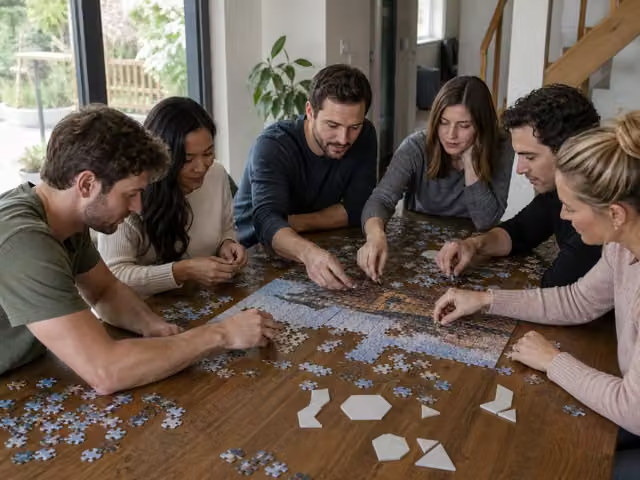
Turn pieces face up, separate the border and useful picture groups, then build sections and connect them. Anyone may place a matching piece at any time. Finish when the picture is complete or your agreed stopping time arrives; there are no individual scores or ties.
Saved on this device only — clearing your browser's cache or site data removes them (no account backup).
Choose a puzzle that fits the table
Pick a complete puzzle with its reference picture. A 300–500-piece rectangular puzzle with distinct colors is a useful starting choice for this suggested social format; it is not a finish-time guarantee. Piece count, cut and image complexity all affect difficulty. A large patch of similar sky may take longer than a more varied image.
Read the finished dimensions on the box. Leave that much uninterrupted assembly space plus room for loose pieces and elbows. Use trays, shallow lids or spare sheets of card for sorting. Place the reference picture where everyone can see it; shift the light if glare hides details.
Choose a stopping time before opening the box, such as a 75-minute session. Decide whether the assembled puzzle can stay on the table or needs a suitable puzzle board. If it cannot be stored safely, choose a smaller puzzle or agree to pack it away at the end.
Empty the pieces carefully, checking the box and bag for stragglers. Give everyone access to the shared pieces. Nobody owns a color group, and helping another person's section is welcome.
Build together and close the session
Start with sorting
Turn every piece face up. Put straight-edge pieces together for this rectangular puzzle. Group obvious colors, text or objects in separate trays; uncertain pieces stay in the shared pool. Sorting is preparation, not a contest.
Make a first connection
Try two pieces whose picture and shape appear to join. Check that their edges meet naturally and the printed detail continues. Do not press a doubtful match into place. Build the border or a recognizable small object as your first anchor.
Keep several sections moving
Anyone may search, connect loose pieces or add to the main picture; there is no fixed turn order. Use the reference to estimate where a cluster belongs. Ask before shifting a section someone is working on. Move fragile clusters on card rather than lifting them by one piece.
Check confusing fits
If a row stops lining up, inspect earlier joins instead of forcing a new one. Return uncertain pieces to their tray. Look for changes in printed detail as well as shape. When two people want the same piece, compare where it actually fits rather than awarding it to whoever grabbed first.
Finish or preserve
A finished puzzle has every intended piece in place, a continuous picture and no unexplained gaps. Everyone shares that result. At the agreed stop, end even if unfinished: photograph the layout, leave or cover it on the board and collect loose pieces into trays. If dismantling, separate joins gently and put every piece back in its box. Next time resume the saved layout or start again.
Keep it cooperative
Offer newcomers one job: find border pieces, collect letters or build an object. Shift trays for easier reach. Taking a break is fine.
If a piece appears missing, check bags, trays, the floor and mistaken joins before declaring it lost. Record the gap if it remains. Do not invent an individual winner for a cooperative evening.
Already know the game?
Ideas & Twists
Choose a variation together before you start.
Cooperative jigsaw evening · See main rules
Suggested house variationConnected-section goal
For a large puzzle, replace whole-picture completion with one named goal chosen from the reference, such as completing the entire central building and joining it to the bottom border. Mark its intended extent on a copy or sketch before play. Stop successfully when that complete section is connected and checked, or pause at the agreed time if it is unfinished. Save the remaining puzzle for another session; everyone shares the result.
About this guide
Ravensburger explains how piece count, cut, image and border shape affect difficulty. The cooperative session, suggested size, stopping time and variations are hosting choices, not manufacturer competition rules. This guide assumes a flat rectangular jigsaw; irregular, 3D and puzzle-within-a-puzzle products need their own instructions.
Ready for something different?
Find another game →