

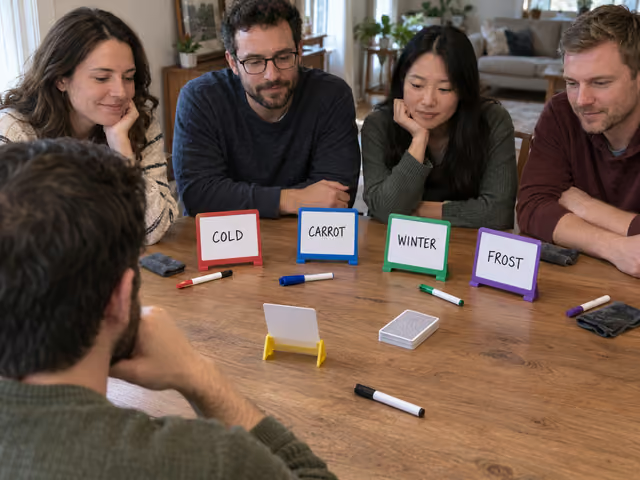
The quick version
Start with 13 cards. One person faces a card away and names a number from 1 to 5. Everyone else writes a secret clue; compare them while the guesser closes their eyes and hide every duplicate or invalid clue. The guesser gets one answer or a pass. Keep correct cards; a wrong answer loses the current card plus another. Count the cards won when the deck runs out.
Saved on this device only — clearing your browser's cache or site data removes them (no account backup).
Prepare the deck and clue boards
Use the physical English Just One Refresh set (JO-EN02), with its 2025 rulebook. Check that the writing tools work and wipe off. Seat three to seven people around a table so they can read the card and reveal clues toward the guesser. The game uses reading, private writing and a spoken answer; it needs no timer, phone or app.
Shuffle all 110 cards, take 13 at random, and put those in a facedown draw pile. Return the others to the box. Leave room beside the deck for won cards; lost cards go back into the box. With five to seven players, give everyone one easel, one matching erasable pencil and one cloth. Choose the first guesser randomly; that person is the active player.
Official three- and four-player format: give each clue writer two easels and the active player one easel to hold the card. Keep one writing tool and cloth per person; each writer will write two different clues, one on each board. Three players use five easels; four use all seven. Reassign the spare board when the guesser changes so the next guesser has one and each writer has two. Do not mix this with an older box's three-player-only variant.
Write, compare, guess and score
Choose the hidden word
The active player takes the top card without looking at its words and stands it on their easel facing everyone else. They announce a number from 1 to 5; the word on that numbered line is the target. If a clue writer does not know it, they may ask the active player to pick another number before clues are written, without saying the word.
Write independently
Every other player secretly writes one valid clue, or two different clues in the official three/four-player format. Do not coordinate your choices or show unfinished clues. Usually use a single word. Established compound words, proper names (including a recognized multiword name), numbers, sound words, acronyms and special characters are also allowed. A phrase invented to squeeze in several clues is not.
Hide duplicates and invalid clues
When all writers finish, the active player closes their eyes. Writers show their boards to one another and compare all clues, including both boards from each writer in a small group. Lay every matching board facedown; do not keep one copy. Matching includes the same word, singular/plural forms, words from the same family, and the same word with a spelling error. Hide invalid clues too. Turn only surviving boards toward the active player. If none survives, return just the current card to the box, skip guessing and end the round.
Make one decision
The active player opens their eyes and sees only the surviving clues. They may give one answer or pass. Writers give no new hints or reactions that point toward an answer. A correct guess wins the card: put it faceup beside the draw pile. A pass loses only the current card: return it to the box. A wrong answer loses the current card AND the top remaining draw card; put both in the box without playing that extra card.
Handle the last card and rotate
If an answer is wrong and the deck has no extra card left, return one previously won card to the box instead, if there is one. With none won, there is nothing further to remove. Wipe all clue boards, return any extra easels to the appropriate writers, and make the person to the active player's left the new active player. Repeat while cards remain in the draw pile.
Finish with one shared score
When the draw pile is empty, stop and count the won cards still beside it. That total, from zero to 13, is the group's result; 13 is a perfect game. There are no individual winners and no tie-break round. If you compare separate games and scores are equal, they share the record. For another game, clear the won pile and shuffle a fresh random 13-card deck.
With four cards won and only the active card left, a wrong answer leaves three won cards. A pass leaves four. If all clues cancel on that card, it is lost without a guess and the score also stays four.
Which clues stay in play?
Invalid clues: the target itself or a word from its family, a translation of the target, a made-up word, or a homophone of the target. For target garden, gardener is invalid; for sea, see is invalid. An established proper name may be useful, but a fabricated name is not a loophole.
Duplicates: if two writers choose leaf and leaves, hide both. If three choose the same clue, hide all three. Different associations with similar meanings are not automatically duplicates: soil and flower can both survive for garden. Check word-family disputes before the guesser looks, rather than debating in front of them and leaking the hidden word.
Teach the reveal and settle close calls
Before drawing the scored deck, demonstrate with an invented target such as garden: two flower clues both disappear, soil remains, and gardener is invalid. Tell everyone about cancellation before their first scored clue. This demonstration is optional hosting advice, not another card or a change to the 13-card game.
Agree these house conventions before playing: the guesser says my answer is before their final answer, and an answer must name the printed target rather than merely a related concept. This separates thinking aloud from a committed guess. The 2025 leaflet does not give a detailed policy for inflections, near-answers or accidental leaks; decide any leniency in advance and apply it consistently.
Check doubtful clue legality among the writers while the guesser cannot see the boards. In a genuinely unresolved case, this guide's house remedy is to hide the disputed clue and continue with the others. Do not invent a point penalty or let someone rewrite a canceled clue. If the target is accidentally revealed, this guide's house remedy is to remove that card, replace it with a random unused card from the box, and redo the round with the same guesser; the running score is unchanged.
Use associations the guesser might actually recognize, rather than obscure references just to avoid duplication. Keep reactions neutral until the answer is committed. Let people decide whether to guess or pass; the whole table shares the result. A confident vocabulary is not required to be competitive here, but reading, writing and shared language still affect the experience. Do not promise universal access or a fixed finishing time.
Already know the game?
Ideas & Twists
Choose a variation together before you start.
Just One · See main rules
Suggested house variationOne rescue reveal
Choose this before making the 13-card deck. After a wrong answer, a pass or a reveal with no surviving clues, keep that target in play for one rescue attempt. Writers erase their boards and write new clues; no clue may repeat or share a word family with ANY clue from the first attempt, including hidden ones. Keep the same one/two-clue allocation and cancel duplicates normally. The guesser gets one new answer or pass if clues survive. Win the card on a correct answer in either attempt. Otherwise lose just the current card, with no extra-card or previously-won-card penalty. Then rotate normally. Finish at deck empty and count successes; this easier result is separate from the standard-game record.
About this guide
Main rules follow the 2025 English refresh, not a blended older edition. Its three/four-player two-clue format is official. Answer commitment, disputed-clue handling, accidental-reveal replacement and both optional twists are explicitly house suggestions. Community discussions informed the teaching and shared-goal options, not the official mechanics.
Ready for something different?
Find another game →