

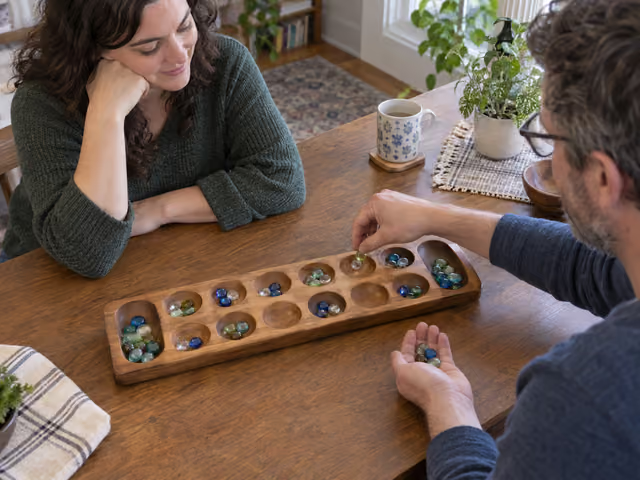
The quick version
Empty one of your pits into your hand and drop one stone per space counterclockwise, including your store and skipping your opponent's. End in your store to move again. End in a previously empty pit of your own to capture it and the stones directly opposite, if any. When either row is empty, sweep the other row into its owner's store. More stones wins; 24 each is a draw.
Saved on this device only — clearing your browser's cache or site data removes them (no account backup).
Find your row and your store
Use a stable table, one board with 12 small pits arranged in two rows of six, and a larger store at each short end. Count out exactly 48 stones. A folding board should lie flat. Check that pits and stores can hold the stones without spilling.
Sit opposite one another along the long sides. Your six pits are the row nearest you; your store is the large cup on your right. Point to both stores before starting. Put four stones in each small pit and none in either store. Stone colors have no ownership or scoring role: everything in your row is available to you.
Agree who starts. Use the rules below even if an old box sheet differs. No timer, app or score sheet is needed. Stored stones are the score, and you never put them back into play.
Sow, check the last stone, then pass
Pick up one whole pit
Choose a nonempty pit in your own row and pick up every stone in it. You cannot start from your opponent's row or either store. Begin placing stones in the next space to the right along your row, toward your store.
Follow the circuit
Drop one stone in each successive space: the remaining pits of your row, your store, then your opponent's row traveling back toward their store. Skip their store completely and continue into your row if you still hold stones. This is counterclockwise viewed from above. Keep going until your hand is empty; a long move can pass your store more than once and can refill the pit you started from. Never pick up a second pit as part of sowing.
Resolve the final landing
If the last stone enters your store, make another move from your row, unless the game has ended. These extra moves can chain. If it enters a pit of your own that was empty immediately before that final drop, check the pit directly across: if that opposite pit has stones, move all of them AND your final stone into your store. If the opposite pit is empty, leave your final stone where it landed. A capture ends the move with no extra move. Landing in an occupied pit of your own or any opponent pit also passes play to your opponent.
Finish and count
After each completed move and any capture, check both rows. If either player's six pits are all empty, stop immediately, even if the last stone entered a store. The player whose row still holds stones moves all of those stones into their own store. Count both stores: each stone is one point, and the higher count wins. A 24–24 finish is a draw; a rematch is optional. Finish the sweep rather than leaving stones uncounted.
From the starting setup, choose the fourth pit counting from your right-hand store. Pick up its four stones: put one into each of the three pits to its right, then the fourth into your store. You now move again. Try this unscored, then reset every pit to four before the game.
Keep counts and captures clear
Capture example: your final stone enters your empty pit, and the pit directly across contains three. All four go into your store. If the opposite pit contains zero, your final stone stays in its small pit. Only the final drop can trigger a capture; stones dropped earlier in the same move cannot.
Count a pit before lifting it, then place visibly one at a time. Players may count stones before deciding; keep each pit's contents separate. Identify the opposite pit by looking straight across the board, not diagonally. You cannot reverse direction, drop into the opponent's store, split a handful between routes, or keep sowing by picking up the pit where your final stone landed. That last method belongs to other Mancala formats.
Suggested house repair: if someone skips a pit, spills stones or loses the count, pause before the next move. Restore the agreed position before that move and repeat it correctly. If neither player can reconstruct the position, restart that game with four per pit; do not invent a penalty or guess a score. Total stones across the board and stores should always remain 48.
Before a rematch, reset all pits to four and swap who starts. More friends can watch or take a seat for the next game; this board still supports two active players. For a quiet table, explain the rules first, then place stones gently and use pointing for close calls.
Already know the game?
Ideas & Twists
Choose a variation together before you start.
Kalah (Mancala) · See main rules
Suggested house match formatTwo-game return match
Play two complete games with the same 48-stone setup, swapping the starting player in game two. Record each player's final store total from each game and add them. Higher combined total wins the match; equal totals are a drawn match. Reset all pits between games. This gives both people a turn as opener without changing sowing or captures. Paper and a pen are useful for this variation only.
Kalah (Mancala) · See main rules
Published Kalah variationPie-rule opening
Before setup, agree to allow one swap. The opener completes their whole opening turn, including every earned extra move. Before making any move, the second player chooses either to keep their row and play normally or to exchange rows and stores with the opener. If they swap, the original opener takes the next turn using the row and store that belonged to the second player. The stones stay where they are; exchanging seats makes ownership clear. There are no later swaps. All other rules stay the same.
Kalah (Mancala) · See main rules
Published Kalah variationEmpty-opposite capture
Change only the empty-opposite exception: when your final stone enters a previously empty pit in your own row, move that stone into your store even if the opposite pit is empty. If there are opposite stones, capture them too as usual. The capture still gives no extra move, and the row-empty finish still applies. Announce this before play; never switch capture rules midgame.
About this guide
Physical Kalah (6,4), with a nonempty-opposite capture requirement and an immediate row-empty finish, follows the Coolplay rules reviewed October 2, 2026. BGA corroborates the sowing and capture format and documents pie-rule and empty-capture options. BGA's automatic majority-win stop is not used here. The two-game match, counting advice and misplay repair are hosting suggestions. This guide does not reproduce Hasbro's different 2003 folding-board rules or Cranium Mancala Mania's special pieces and board formats.
Ready for something different?
Find another game →