

The quick version
A deflected goal hit scores 1, an unassisted outside hit 2, and a deflected disc inside 3. Unassisted entry through the slot or open top is an instant win. Otherwise reach exactly 21 with equal team turns; an overscoring throw subtracts its value instead.
Saved on this device only — clearing your browser's cache or site data removes them (no account backup).
Place the cans and pairs
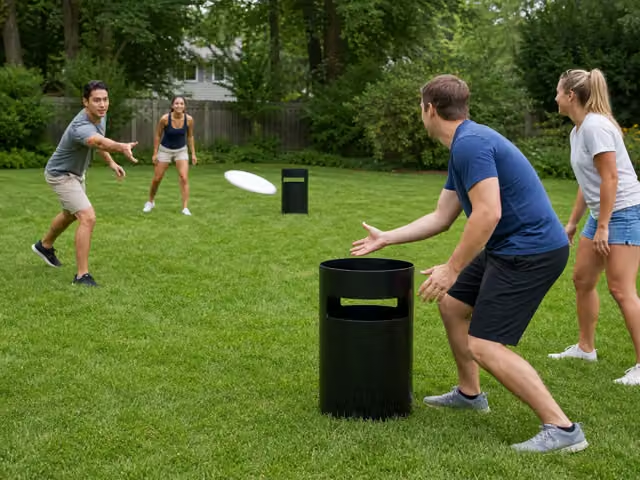
Assemble both goals with the tabs secured. Place them 50 feet apart, slots facing each other. Each pair has one player at each goal, alongside an opponent. Choose which pair takes the first team turn by coin flip.
A team turn is two throws, one by each partner in opposite directions. After both, pass the disc to the other pair. Complete equal team turns before declaring a 21-point result. An instant win is the exception.
Use a score sheet with separate lines for the two pairs. Agree that throwing is from behind the goal and deflection is one clean contact; rehearse a throw in each direction before scoring.
Throw, redirect and finish
Take the two throws
From behind your goal, send the disc toward your partner's goal. Your partner can move to redirect it, but cannot catch, carry, pinch or double-hit it. Then swap roles: that partner throws back and you deflect. The opponents do not defend the goals.
Record one outcome
Deflected contact with the outside is 1. An outside hit with no partner touch is 2. A redirected disc that stays inside is 3, including redirected slot entry. An unassisted disc that stays inside through the slot or top wins instantly, with no reply. Unassisted slot entry that comes back out is 2. A miss, ground-first throw, foot fault or illegal deflection is zero.
Handle going over
Reach exactly 21. If a throw would go over, subtract that throw's points from your existing total: 20 with a 3-point dunk becomes 17. Do not add first and subtract from 23. If you reach 21, stop your team's remaining throw and let the other pair complete its equal-turn reply if owed.
Settle equal turns
After the reply, one team at 21 wins; both at 21 means overtime. Begin overtime scores at zero, with the original opening team first. Each pair gets both partner throws. Higher overtime total wins; equal totals mean another full overtime round. An instant win still ends play immediately.
The manufacturer awards the throwing pair 3 points for defensive interference and an automatic win if it already has 19 or 20. Give the active thrower and deflector room rather than trying to protect the can.
Make the result easy to call
Say the total after each throw, then identify whose return throw comes next. At 18 or more, ask the thrower to name the result they want before throwing. That is a helpful conversation, not a required called-shot rule.
Show the difference between a quick deflection and carrying the disc by demonstrating one gentle unscored throw. Use an open palm or another single clean body contact. If a can shifts, restore it between throws rather than moving a target during flight.
Retrieve only once the disc has stopped and nobody is throwing back. For a rematch, reset scores; let the losing pair choose first or second. A game has a scoring finish, so its length depends on accuracy, exact-21 setbacks and possible overtime.
Already know the game?
Ideas & Twists
Choose a variation together before you start.
KanJam · See main rules
Suggested house variationCloser cans
Move the goals to 30 feet apart before the game. Keep throwing behind them, one-contact deflections, the 1–2–3 chart, exact 21, equal-turn replies and instant wins. Shorter throws give a new pair more chances to practise placement. Do not change the distance while scores are live.
KanJam · See main rules
Suggested house variationFive-round placement match
Each pair takes five full two-throw turns. Add points without an exact-21 reset; an unassisted entry is worth 5 rather than ending the game. All other values remain 1–2–3. Higher total after equal five turns wins. If tied, each pair takes one extra two-throw turn, repeating until totals differ.
About this guide
The full-size manufacturer's pages support 50-foot setup, scoring, equal turns, instant wins and legal deflection. Its current web summary omits the over-21 subtraction example; the manufacturer's Mini instruction sheet supplies that explicit rule and two-throw turn sequence. Only those shared mechanics are used from Mini, not its different distances or tabletop rules. Variations are house formats.
Ready for something different?
Find another game →