

The quick version
Choose monsters, set each to 10 life and 0 points, and reveal three Power cards. On your turn, roll the six black dice up to three times, keeping or rerolling any dice between rolls. Resolve the final symbols, enter an empty Tokyo space if required, then buy powers with energy. A monster in Tokyo attacks everyone outside; monsters outside attack those inside. Hearts heal only outside Tokyo. At the end of the turn, check for a surviving 20-point monster or a sole survivor.
Saved on this device only — clearing your browser's cache or site data removes them (no account backup).
Choose monsters and prepare the table
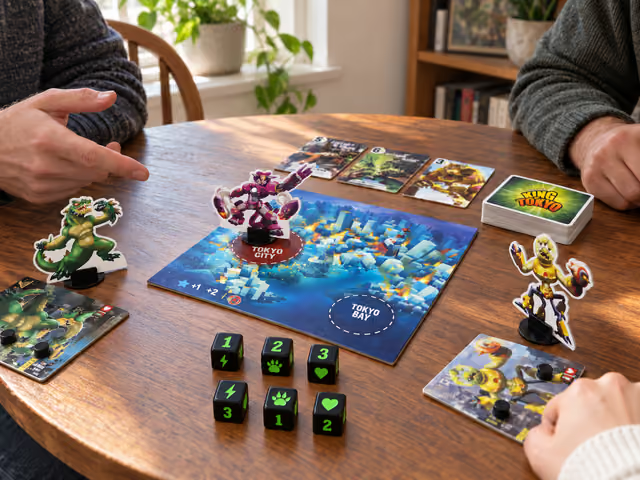
This guide uses IELLO's 2016 base edition with its English November 2023 rulebook. Use its six monster boards and matching cardboard figures with bases, Tokyo board, six black custom dice, 66 Power cards and energy cubes. Keep the two green bonus dice and all 28 tokens nearby: three Smoke, one Mimic, 12 Shrink and 12 Poison. Those extras are used only when a Power card calls for them. Leave expansion components out. Origins, Dark Edition, Duel, Godzilla and King of New York have their own component or rule differences.
Each of the 2–6 players takes one monster board and its matching figure. Set life to 10 and victory points to 0; everyone starts outside Tokyo with no energy or purchased cards. The base monsters have no individual starting powers. Put the Tokyo board, energy supply, dice and card deck within shared reach on a stable table. Leave room for each player's monster board, bought cards and energy.
Shuffle the Power cards and reveal three beside the deck. Keep a separate discard pile. With 2–4 players, only Tokyo City is available. With 5–6, Tokyo Bay is available too. Each space holds one monster. No one starts in either space.
To choose the first player, everyone rolls the six black dice once; the most claw symbols starts. Tied players reroll until one wins that comparison. These selection rolls earn nothing. Play proceeds clockwise. Before beginning, tell everyone that reaching zero life eliminates a monster for the rest of this game.
Roll, resolve, enter and buy
Collect Tokyo's start reward, then roll
If your monster starts its turn in Tokyo, add 2 victory points. Normally roll all six black dice. Apply any owned card that changes the dice or triggers before rolling; green dice join only through an appropriate card. You may stop after the first roll or take up to two rerolls. Each time, choose any dice to reroll, including ones you previously kept. Nothing is earned from a face until the final roll is resolved.
Score numbers and take energy
Resolve all final dice; you choose the order of symbol groups. At least three identical number faces score that number in points: three 1s score 1, three 2s score 2, three 3s score 3. Each additional matching die adds 1 point. Four 3s therefore score 4 points; a pair of 3s scores nothing. Each lightning symbol gives 1 energy cube. Keep unspent energy between turns.
Apply claws and healing
Each claw deals 1 damage to every monster on the other side of the Tokyo boundary. From outside, hit all monsters in Tokyo City and Tokyo Bay; from inside, hit all outside. Monsters inside do not hit one another, and outside monsters do not hit one another. If Tokyo is empty, claws hit nobody. Apply damage before a damaged monster chooses to yield. Outside Tokyo, each heart restores 1 life, normally up to 10. Inside, hearts cannot heal; a Power card may still provide healing. Resolve purchased abilities alongside these results according to their text.
Let wounded occupants stay or yield
A living occupant wounded by another monster's rolled claws may leave Tokyo or stay. Leaving never cancels that damage. If both spaces are occupied, each wounded occupant decides separately. Ordinary card damage does not grant a yield choice. A monster at zero life is eliminated immediately: remove its figure, discard its Keep cards and return its energy to the supply. It cannot choose to escape after lethal damage, unless a specific card changes the elimination.
Enter an available Tokyo space
After all dice resolve, an outside active monster must enter Tokyo City if it is empty, even if no claws were rolled. With 5–6 survivors, enter Tokyo Bay instead if City is occupied and Bay is empty. Enter only one space; gain 1 point for entering either. If both are occupied, remain outside. An occupant does not enter a second space. As soon as only four monsters remain, close Bay: its occupant leaves immediately, or moves to City if City is empty. That relocation is not a fresh entry reward.
Buy powers, finish effects and pass
During the buying step, you may buy any face-up card for its printed energy cost. Refill its slot immediately; the new card can also be bought. Keep cards stay face-up with you and provide their stated effect; Discard cards resolve at once, then leave play. You may also pay 2 energy to discard all three market cards and reveal three new ones. Repeat buying or sweeping while you can pay, or save your energy. Resolve end-of-turn effects, check the finish below, then pass the dice clockwise to the next surviving player.
With Tokyo empty, the first player's claws damage nobody. After resolving every die, that player must enter City and gain 1 point. Explain that future claw damage may force a painful choice: stay for the next start reward or leave while still alive.
Survive the turn to win
Check for the end after the active player's turn is complete, including its card effects. A surviving monster with at least 20 victory points wins; the sole surviving monster also wins. Reaching 20 during a roll or entry does not let you skip the remaining turn. A monster eliminated during that turn cannot win through its points. If every monster is eliminated together, everyone loses.
There is no equal-turn round or routine tie-break. If a rare card interaction leaves multiple survivors qualifying together and the included cards and rulebook do not settle the result, this guide suggests agreeing before play to share that win. That is a house fallback, not a published tie rule. For another game, return cards, cubes and tokens to their supplies, reset life and points, shuffle, empty Tokyo and choose a new first player.
Make powers and Tokyo decisions clear
Say the final results aloud before changing dials or taking cubes. Keep rerolled dice separate from retained ones, and count only their final faces. Let each wounded Tokyo occupant answer stay or yield after damage; do not move their figure for them. Before a new player commits to staying, remind them that ordinary heart dice will not heal them there. This is a risk reminder, not a promise of safety.
Read a Power card aloud when it is bought and follow its precise timing and exceptions. The printed card can change a normal rule; the rulebook's card clarifications resolve named edge cases. Poison and Shrink tokens remain even if their source card disappears. A heart spent to remove one of those tokens does not also heal, and those tokens cannot be removed with hearts while inside Tokyo. Mimic copies a Keep card as though newly played; if the copied card disappears, its effect stops. Moving the Mimic marker costs 1 energy at the start of your turn, before rolling. Consult page 7 for further card-specific cases.
If a bought card removes the last occupant after the entry step, Tokyo may stay empty until the next player's entry step. Do not repeat entry automatically after buying. A card that expressly takes control of Tokyo still does what it says. Card damage alone does not allow yielding, and energy from early rolls cannot be collected before rerolling those dice.
Eliminated players are out until the next game. Invite them to watch or help read unfamiliar cards if they wish, and include everyone in the next reset. Do not quietly add respawns: they change the survival victory condition and the value of printed powers. Keep dice rolls on the table, give every player a view of the market, and use ordinary quiet conversation if the setting calls for it. The dials, small symbols and printed cards still require reading and handling; a seated game is not a universal access guarantee.
Already know the game?
Ideas & Twists
Choose a variation together before you start.
King of Tokyo · See main rules
Official optional rule · exactly two playersTwo-player energy Tokyo
Replace Tokyo's entry reward of 1 victory point with 1 energy cube. Replace its start-of-turn reward of 2 victory points with 1 energy cube. Keep number-dice scoring, the three-card market, card costs, healing restrictions, yielding, elimination and the end-of-turn 20-point or sole-survivor finish unchanged. Use City only. Choose this version before setup; the main guide otherwise uses the standard point rewards.
King of Tokyo · See main rules
House suggestion · more buying choicesFive-card market
Reveal five Power cards at setup instead of three, refill each bought slot immediately, and pay the usual 2 energy to sweep all five and replace them with five new cards. Keep every other cost, starting resource, dice rule, Tokyo reward and finish unchanged. This offers more choices and reveals more cards per sweep; it is not an official balance improvement. Keep it separate from the other variations unless everyone agrees to combine them before play.
King of Tokyo · See main rules
House suggestion · earlier power purchasesOpening energy
Give every monster 3 energy cubes from the shared supply during setup instead of starting with none. Reveal the normal three-card market. Keep the full deck, printed costs, one-cube lightning results, ordinary Tokyo point rewards and standard end-of-turn finish. Everyone receives the same starting amount; first turn is still chosen by the claw roll. This lets affordable powers enter play sooner, but does not guarantee a shorter or fairer game.
About this guide
Main rules follow the 2016 base edition and the English November 2023 rulebook currently linked by IELLO. Its optional two-player energy rewards are separate from the main format. The five-card market and opening energy are house suggestions informed by individual community reports, not proven balance changes. Shared simultaneous qualification is an explicitly suggested fallback because the opened rulebook gives no general tie rule. No expansions, newer standalone variants or numerical play-time promise are imported.
Ready for something different?
Find another game →