

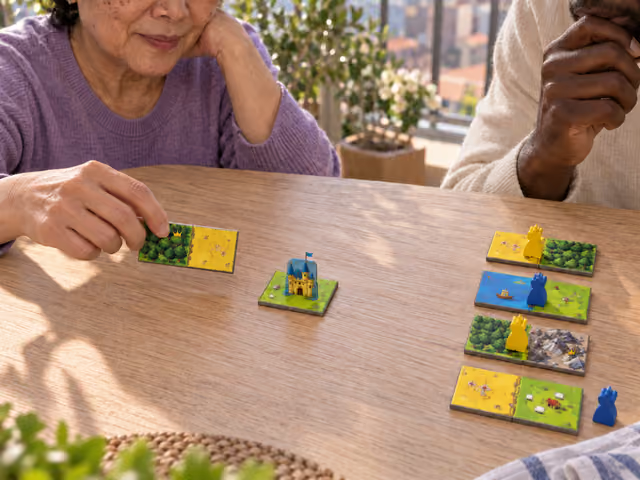
The quick version
Give everyone a starting tile and castle. Build a kingdom that fits within five rows and five columns. Claim dominoes from a numbered draft line. In line order, place your claimed domino and move its king to an unclaimed domino in the next line. Match at least one terrain edge or touch your starting tile. After the last placements, score each connected terrain area as squares times crowns. Highest total wins; break ties by largest area, then total crowns.
Saved on this device only — clearing your browser's cache or site data removes them (no account backup).
Give everyone a kingdom and prepare the draft
Use the original Blue Orange European base game, following the multilingual rulebook linked below, whose English rules occupy printed pages 2–4. This guide uses its three-player setup with 36 dominoes and three choices per draft. Some U.S. second-edition sets instead offer four choices and discard the unclaimed domino at three players; use one complete setup consistently. Kingdomino Origins, Duel, Queendomino and expansions have additional or different rules.
Each person chooses a color and takes its square starting tile and matching castle. Put the castle on the tile. Leave space around each starting tile for a five-by-five-square kingdom, plus two shared draft lines. At three or four players, each person uses one king of their color. At two players, each uses both kings of their color, but still builds only one kingdom.
Mix all 48 dominoes without looking at their landscape faces. For two players, randomly set aside 24 and play with the other 24. For three players, set aside 12 and play with 36. For four players, use all 48. Keep the unused dominoes out of this game. Put the playing supply in the box insert as a shuffled draw pile, numbers visible and landscapes hidden.
Draw four dominoes at two or four players, or three at three players. Arrange them in a line from lowest to highest number, then turn them landscape-side up without changing their order. Mark which end is the low-number end by keeping it nearest the box. This is the first draft line; numbers determine order, not points.
Claim the first dominoes
Randomize the starting selection by hiding the active kings in a hand and revealing them one at a time. Whenever a king appears, its owner puts it on an unclaimed domino in the first line. Only one king may occupy each domino. At two players, each person makes two choices as their two kings appear. The final king claims the remaining domino.
These claims reserve dominoes; nobody places a domino in their kingdom yet. Once all are claimed, draw and sort another line of the same size, then reveal its landscapes. You now have a claimed line and a fresh line. The king on the lowest-numbered domino in the claimed line takes the first actual placement turn.
Match one edge and keep the kingdom compact
Each domino is two joined squares. Rotate the whole domino to any right-angle orientation and place both squares flat in empty grid positions. At least one of its squares must share a full edge with an existing square of the same terrain, or with the starting tile. The starting tile accepts any terrain. A corner touch alone does not connect a domino. Only one matching edge is needed: other edges may touch different terrain.
The whole kingdom, including the starting tile, must always fit inside five rows and five columns. There is no fixed board to fill, and the castle need not be central. As you grow, check the furthest occupied rows and columns rather than measuring five squares in every direction from the castle. Leave placed dominoes and the starting tile where they are; do not move them later to make room.
If no orientation and position meets both the connection rule and the five-by-five limit, discard that entire domino. It earns nothing and is not replaced. You must place a domino when a legal position exists; discarding is not a way to refuse an inconvenient tile. Gaps are allowed, but may make later placements impossible.
Place this choice, then reserve the next
Resolve the lowest remaining king
Follow the claimed line from its low-number end. The owner of its first king lifts that king and adds the domino beneath it to their kingdom using the placement rules. If it cannot fit legally, discard it. Either way, that king still makes the next choice.
Move the king into the fresh line
Immediately put that same king on any unclaimed domino in the fresh line. You are reserving it for your next turn, not placing it now. Continue through the old line in order, each king placing its old domino and claiming one new domino. At two players, both kings take separate turns in their actual line positions; a person may act twice consecutively.
Make the next line
When the old line is empty and every fresh domino has a king, that fresh line becomes the claimed line. Draw, sort and reveal a new fresh line. Repeat. Seating order does not matter: the positions of the kings determine the order each time.
Take the final placement turns
When the supply is empty, resolve the last claimed line in order, placing or discarding each domino. There is no new line to claim. Everyone has then resolved twelve dominoes: twelve draft lines at three or four players, or six lines with two turns per person at two players. A kingdom with every domino placed has 24 terrain squares plus its starting tile.
If the claimed line has blue, yellow, yellow, blue kings from low to high, blue places and chooses first, yellow takes the next two separate turns, and blue takes the fourth. The order in the new line may be completely different. This spoken example needs no extra equipment.
Multiply each area, then compare totals
An area is a group of same-terrain squares connected through full edges. Diagonal touches do not join areas. Two separated forests are scored separately, even though they share a terrain type. The starting tile scores nothing and does not join terrain areas through the castle.
For each area, count its squares and every printed crown within those squares. Multiply squares by crowns, then add all area scores. For example, a forest of six squares containing two crowns is worth 12. A separate forest of two squares with one crown adds 2, for 14 from those forests. Five connected lake squares with no crown score zero. A square bearing several crowns contributes all of them; you are counting crown symbols, not just squares with crowns.
Highest total wins. On equal totals, compare the tied players' largest single connected terrain area by number of squares, even if that area has no crown. If still tied, compare the total crowns across their whole kingdoms. A remaining tie is a shared win. Start another game by gathering and shuffling all 48 dominoes before applying the player-count reduction again.
Make the next choice easy to follow
Point out two things before play: a large crownless area scores zero, and a claimed tile changes when you choose next. On a first turn, ask each person to show where their reserved domino could fit before they move their king. This is teaching help, not a promise that a later tile will fit. Leave visible terrain edges available instead of enclosing every useful terrain behind the castle or a narrow gap.
When choosing, look at fit, crowns and position in the next line together. You can see the other kingdoms, so a tile another person wants may also be worth considering. Take turns making your own choice; helping a newcomer identify legal placements should not become making every decision for them. A two-player game uses two kings each even though there are only two kingdoms.
For a disputed placement, check an edge match, both empty squares and the five-row/five-column limit before confirming it. For a disputed score, trace each connected area and count its crowns together. As a house suggestion for a casual first game, allow an illegal placement to be corrected immediately if the next king has not acted and no new tiles have been revealed. Otherwise follow the printed rules rather than inventing a penalty mid-game; agree on any broader take-back policy before starting.
Keep the draft lines separated so nobody claims from the wrong line. At the finish, score one kingdom aloud together before everyone totals their own. The small personal puzzles suit a calm table session; interaction mainly comes from taking shared draft choices. For two people who want more planning room after learning the base game, try the Mighty Duel below.
Already know the game?
Ideas & Twists
Choose a variation together before you start.
Kingdomino · See main rules
Official two-player optionMighty Duel
Use all 48 dominoes and expand each kingdom limit to seven rows by seven columns. Each person still has two kings and follows the same four-domino draft, with a separate place-and-claim turn for each king. Resolve twelve draft lines, so each person receives 24 dominoes and can fill 48 terrain squares plus the starting tile. Connection, compulsory placement, discards, area scoring and tie rules stay the same. Reserve more table space; this is a larger puzzle, not an extra-player format.
Kingdomino · See main rules
Official scoring optionMiddle Kingdom
Agree before the first draft to award 10 extra points for a castle in the center of the kingdom's five-by-five layout: the third row and third column, with two rows and columns on either side. Keep that position in mind while placing, but do not move the starting tile or existing dominoes. All draft, placement and normal area scoring rules remain. Add the bonus before comparing totals, then use the usual tiebreakers. If combined with Mighty Duel, the central position is the fourth row and fourth column of the seven-by-seven layout.
Kingdomino · See main rules
Official scoring optionHarmony
Agree before drafting to award 5 extra points for a complete kingdom with no discarded dominoes. In the base game this means all twelve dominoes and the starting tile fill the five-by-five grid with no gaps. In Mighty Duel, all 24 dominoes and the starting tile must fill seven by seven. Add the bonus to normal area scores before comparing totals; the ordinary tiebreakers remain. This can be combined with Middle Kingdom, in which case a qualifying kingdom receives both bonuses.
About this guide
Main rules follow the original European base game, including the 36-domino three-player setup and total-crowns second tiebreaker. The U.S. second-edition leaflet differs in three-player drafting and shares a tie after the largest-area comparison. The three variations are the publisher's optional rules. The spoken turn-order example, placement coaching, scoring walkthrough and limited take-back suggestion are host advice. Rules from other Kingdomino titles are not mixed into this format.
Ready for something different?
Find another game →