

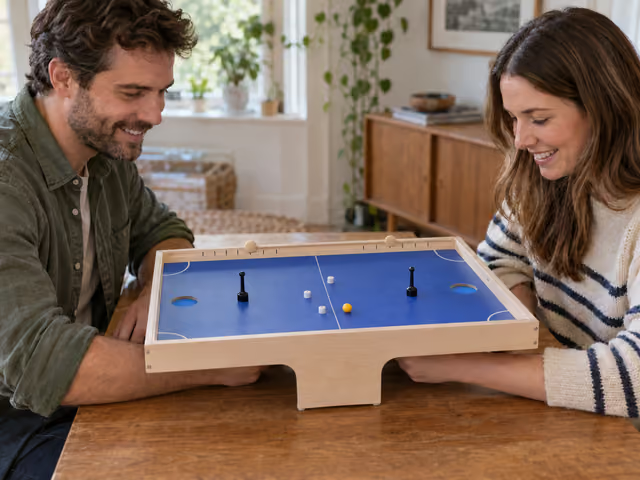
The quick version
Connect each striker to its magnet below the board. Put three biscuits on the center marks and both score discs at 0. The younger player serves from a marked corner. Score when the ball stays in the opponent's goal, they pick up two biscuits, lose unrecoverable control or drop their striker into their own goal. Stop after each point, reset all biscuits and let the player who conceded serve. First to 6 wins.
Saved on this device only — clearing your browser's cache or site data removes them (no account backup).
Set the board between two players
This guide uses the standard rectangular two-player KLASK set and the manufacturer's English two-player booklet with its current casual rules. KLASK 4 uses a different board and scoring system. Use one ball and three biscuits in play; the boxed set's second ball and fourth biscuit are spares.
Seat one person at each short end of a level table. Place the raised board between you, with enough room underneath for both steering hands to move freely. Check for drift by placing the ball on the surface. Reposition the board or table if the ball keeps rolling one way. Keep drinks and loose belongings away from the playing area and allow space to retrieve pieces that leave the board.
If your set's PTFE glide stickers are not fitted, follow the booklet: fit them underneath both strikers and on top of both steering magnets. Place one black striker upright on each player's half. Hold its matching steering magnet beneath it, under the board; move the lower magnet gently and watch the upper striker follow. Keep the steerer below the board and your striker on your own half.
Set the three white biscuits on the three white center marks with their magnetic ends facing up. Place each wooden score disc at 0 in its scoring track. The younger player takes the first serve by placing the ball in either marked starting corner on their own side.
Serve, defend and score
Start the rally
The server uses their striker to hit the ball from the corner toward the other half. Both players may then move and hit the ball whenever they can; there are no alternating turns. Use the side walls to change the ball's angle. Move the steering magnet rather than touching the upper pieces during play.
Watch four ways a point can end
You earn 1 point if the ball enters the opponent's goal and stays there; if two or three biscuits attach to their striker at once; if they lose control and cannot reconnect their striker with the steering magnet under the board; or if their striker falls into their own goal. A ball that immediately bounces out of a goal does not score. A striker dropping into its own goal scores immediately, even if it escapes.
Stop and reset
On a point, stop both strikers, advance the scorer's disc by one and return all three biscuits to their center marks. Remove attached biscuits only now, while play is stopped. Reconnect the strikers on their own halves. The player who conceded puts the ball in a chosen corner on their side and serves the next rally.
Finish at six
The first player whose scoring disc reaches 6 wins immediately. A score of 5–5 continues to the next awarded point; there is no win-by-two rule. For another game, reset both scores to 0, set out the three biscuits again and choose ends before the opening serve.
As an unscored host demonstration, each person moves their connected striker slowly, then tries a gentle shot. Show a single attached biscuit, then explain that a second ends the point. Reset all pieces and scores before starting the actual game. This demonstration is a suggestion, not an extra scoring rule.
The biscuits change the rally
One attached biscuit is legal: continue playing with it. If it falls off naturally, continue. Do not deliberately shake it loose or remove it with your hand. You may knock biscuits with the ball or your striker to move them toward the opponent; you may not manipulate them with the steering magnet.
A biscuit that leaves the board stays out until the point ends. A biscuit in a goal is not a scored ball; leave it during the rally and recover it at the next reset. If the ball leaves the board, pause, put it in the marked corner nearest where it exited and resume from there. An escaped ball itself gives no point, and the biscuits are not reset merely because the ball went out.
Try a controlled shot before a hard one. Watch where the biscuits move as well as where the ball goes. Defend from in front of your goal rather than sliding backward into its hole. These are host suggestions: players can choose their own tactics.
Agree on what happened, then move on
A rally awards only one point, even if one player causes several scoring events. If each player scores through a different event, award the point to the event that happened first. If you cannot agree which event came first, leave the score unchanged, reset the rally and replay it. As a house procedure for that replay, use the same server as before.
A momentary disconnect is not automatically a point if the player can reconnect using the steerer underneath. A striker off the board cannot be recovered that way and gives the opponent a point. Do not retrieve or stand up a disconnected striker by hand during a live rally. If a rule dispute persists, pause and check the linked manufacturer rules before serving again.
Play seated only if both people can comfortably reach the under-board controls and see the field. The game needs hand control and quick visual tracking; seated play does not establish accessibility for every person. Strikes and the KLASK sound can be loud. Take turns between whole games if others are waiting, or use the explicitly different four-person relay below. Never put spare strikers on this two-player board to turn it into KLASK 4.
Already know the game?
Ideas & Twists
Choose a variation together before you start.
KLASK · See main rules
Boxed match format with a house side-swapBest-of-three match
Play a match won by the first person to win two games. Every game still starts at 0 and ends at 6 using all four scoring events. For this guide's house arrangement, swap ends between games and alternate the opening server, starting with the younger player in game one; after a point the conceding player still serves. A 1–1 match goes to a third game. The booklet supplies best-of-three; the side-swap and opening-server arrangement are house suggestions.
KLASK · See main rules
House suggestion · two playersBiscuit-free control duel
Remove all three biscuits before starting and keep them off the board for the whole game. The double-biscuit scoring event disappears; goals, own-goal KLASK and unrecoverable control still award 1 point. Use the same opening serve, out-of-board ball rule and conceding-player restart. First to 6 still wins. This gives both people space to practice shots and control. Restore all three biscuits before returning to standard play; this is not official KLASK.
KLASK · See main rules
House suggestion · four players in two teamsFour-person point relay
Use four people, two per team, with the same two-player set. Only one person per team controls a striker during a rally; teammates wait clear of the controls. Pick each team's first player. Use the ordinary opening serve and all four scoring events. After every awarded point, stop, update the team score, reset the pieces and have BOTH teams switch to their other player. The next player on the team that conceded serves. Do not switch during a rally or an unscored replay. Teams share one score each and first to 6 wins. No extra magnets are needed. This is alternating participation on the rectangular board, not KLASK 4 or simultaneous doubles.
About this guide
Main play follows the manufacturer's standard two-player casual rules, with booklet setup and opening server. The older 2018 competitive regulations corroborate keeping strikers on their own halves and an off-board striker conceding a point; their flick-off and service restrictions are not imported. For an escaped ball, this guide uses the current casual nearest-corner rule, rather than the older tournament either-corner rule. Same-server disputed-rally replay, the control demonstration, side-swap arrangement, biscuit-free game and four-person relay are house suggestions. A main game is exactly two players; relay requires four. No measured whole-game minutes or universal access suitability are claimed.
Ready for something different?
Find another game →