

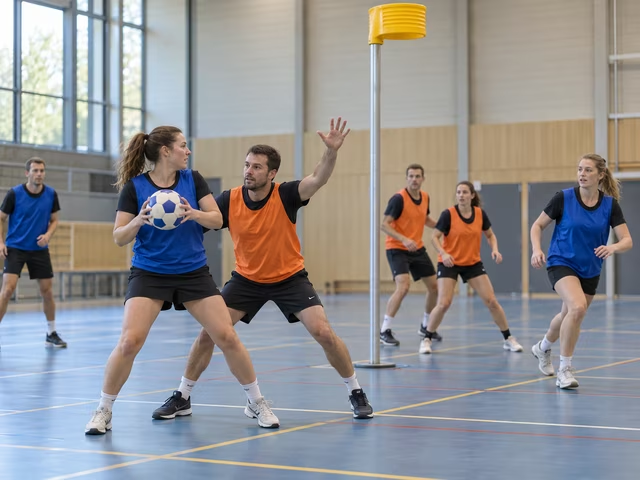
The quick version
Play eight per team, with four attacking and four defending in separate halves. Stop when holding the ball and pass to move it. An undefended basket earns one. After every two goals scored by either team combined, each team’s attackers and defenders exchange halves and jobs.
Saved on this device only — clearing your browser's cache or site data removes them (no account backup).
Get the game ready
Book a club session with a marked 40 m by 20 m court divided into two zones, secured freestanding baskets and clear space around their bases. Split sixteen adults into two teams of eight; each team puts four in each zone. In regulation mixed korfball each zone has two men and two women per team and same-gender marking. For this recreational house session, the coach instead pairs comparable opponents by consent and ability, irrespective of gender; each defender marks only their assigned opponent.
Choose a team to start by coin toss. Play two ten-minute halves with a two-minute rest, no shot clock, and a running clock except for safety or coaching. The referee actively stops deliberate stalling. This is a club introduction, not a regulation mixed-team competition.
Play the first game
Pass into attack
Start with a pass from the center line in the starting team’s attacking half. Defenders keep an arm’s distance away. Players may run without the ball but stay in their assigned zone. On catching, stop promptly; do not run or dribble while holding it. Pass across the center line to your attacking teammates.
Create an open shot
Only players in their attacking zone may shoot. A shot is defended when the assigned defender is closer to the basket, faces the shooter, is within arm’s reach and actively tries to block the ball. If all four apply, pass instead; a made basket from that position does not count. Do not use a teammate as a blocking screen.
Rebound without contact
A legal basket from above earns one. A missed shot stays live and either side may catch it. Do not snatch a held ball, push, hold, kick the ball or grab the post. In this house version, a contested loose ball that risks collision is stopped and given to the side that did not last possess it.
Reset and change roles
After a basket, the conceding team passes in from the center line in its attacking zone. After the combined score reaches 2, 4, 6 and so on, all players change zones and attacking/defending roles first. Pair up with the corresponding opponents again. Out-of-bounds or any playing fault gives opponents an uncontested pass at the spot, at least 2.5 m from the basket; no direct shot from the restart.
Two ten-minute halves
At halftime swap the baskets each team attacks; keep the same current attack/defense groups until the next two-goal change. The team that did not start the first half starts the second. Highest score at the final whistle wins and ties stand. For this house match, the ball must pass through before the whistle.
Help everyone get started
Before scoring begins, demonstrate one defended shot and the same shot after a pass has moved the defender away. The distinction is the heart of this game. The referee should explain close calls briefly. Keep all bases padded or protected as the club requires and do not allow players to collide beneath a rebound.
Already know the game?
Ideas & Twists
Choose a variation together before you start.
Korfball · See main rules
Suggested house variationDifferent scorer
After a goal, its scorer cannot score the team’s next goal, even across a role change. Track one restricted name per team. They can pass and rebound. An attempted goal by that player gives opponents a restart. The next teammate to score replaces the restriction; keep the normal match finish.
Korfball · See main rules
Suggested house variationTwo-pass opening
After each turnover, restart or offensive rebound, complete two passes in the attacking zone before shooting. Count aloud; passes across halfway do not count. An early shot gives opponents a restart. Keep the defended-shot rule and the timed finish.
Korfball · See main rules
Suggested house variationOne-basket four-a-side
Use eight adults around one basket on one safe half-court. Each team has four. Mark a clearing line 8 m from the basket. After gaining possession, complete a pass beyond that line before attacking. No role changes are needed; coach-assigned marking and defended shots still apply. Play ten minutes, most baskets wins.
Korfball · See main rules
Suggested house variationRotate the matchup
At every two-goal role change, the coach shifts each group’s assigned defenders to the next comparable opponent in a prewritten rotation. Everyone must know their new marker before the restart. Keep the usual score and clock. This changes which movement and passing combination opens a shot.
Korfball · See main rules
Suggested house variationAssist bonus
In each half, track the last passer before every made basket. The first basket assisted by each different teammate earns two points; later baskets they assist earn one. Still change zones after every two actual baskets, not every two points. Highest points wins after the usual halves.
About this guide
Short halves, ability-matched marking, no shot clock, contested-ball resolution and unified restarts are explicit editorial house changes. They do not describe sanctioned competition eligibility or penalties. All five twists are house formats.
Ready for something different?
Find another game →