

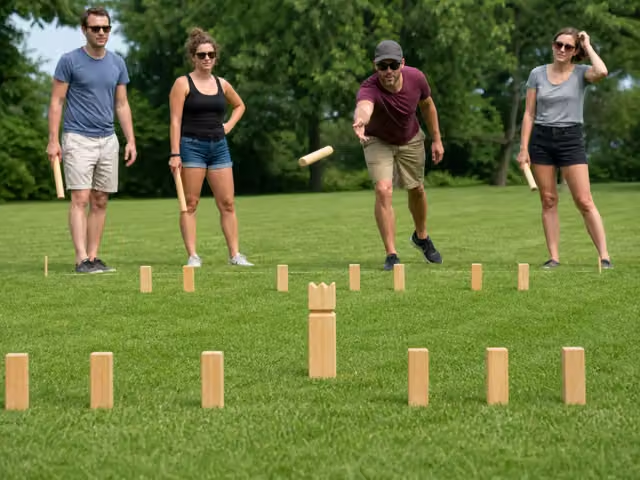
The quick version
Clear every field kubb before attacking baseline kubbs. Once all opposing kubbs are down, use a remaining baton from your original baseline to topple the king and win. Toppling the king early loses immediately; there is no points target.
Saved on this device only — clearing your browser's cache or site data removes them (no account backup).
Build the pitch
Mark a 5-meter-wide, 8-meter-long rectangle, with markers at the corners and midway along both long sides. Stand the king at its center. Place five kubbs across each short baseline, leaving at least a baton length from the corner markers.
Split into two sides, one to six people each. Choose the opener by coin flip. Use the 2–4–6 opening: first side throws two batons, second side four, then each side six per turn. For this recreational game, share batons as evenly as possible and rotate any extra throws each turn; the championship's minimum team size and player limits are not used.
Keep everyone off the pitch while throws are live. Wait for an explicit all-clear before retrieving or raising blocks.
Clear the field and finish with the king
Throw your opening batons
Throw one at a time underarm toward the opponent's five baseline kubbs. Keep your support points behind the throwing line and inside the extended sidelines. Batons rotate end over end, within 30 degrees of vertical, rather than spinning sideways like a helicopter.
Return fallen kubbs
After the turn, the other side gathers every kubb just toppled, including previously returned field kubbs. From its original baseline it throws them underarm into the opposite half. Leave standing field kubbs where they are. Finish every kubb throw before raising any or throwing batons.
Raise or retry
The defending side raises each thrown kubb by pivoting it onto an end where it landed, without twisting or relocating it. At least half its base must be in bounds. After all first throws, retry kubbs that cannot be raised in bounds. A second failure lets the defenders place that kubb in their half, at least one baton length from the king and pitch markers.
Attack in order
Now throw your batons at field kubbs first. Only once all are down may you attack baseline kubbs. If a baseline kubb falls while any field kubb still stands, raise it back in place. A legal throw can topple several blocks. Fallen field kubbs keep returning; they are not permanently removed.
Use an earned forward line
If your opponents left field kubbs standing in your half, you may throw batons from behind a line through the one nearest the center, parallel to the baselines. This advantage applies to kubb attacks only. Returned kubbs and every king attempt still come from your original baseline.
Win, or pass the turn
With all kubbs in the opponent's half down, a remaining baton may attack the king from your baseline. A legal king hit wins immediately. If your batons run out first, pass the turn and repeat the return–raise–attack sequence. Any early king topple by a baton or thrown kubb loses immediately. Reset all ten kubbs on their baselines for a new game.
Explain the returning blocks once
Demonstrate a fallen kubb being tossed across, raised, and attacked before the back row. Name the phases: return, raise, attack. Fallen field kubbs are not removed.
Agree whether a raise is in bounds before moving the block. Settle wobbling kubbs upright without shifting their footprints. Reset blocks toppled by an illegal baton and spend that throw. A completed game cannot tie; an unfinished game has no winner.
Already know the game?
Ideas & Twists
Choose a variation together before you start.
Kubb · See main rules
Suggested house variationThree-block learning game
Start with three baseline kubbs per side instead of five. Keep six batons after the 2–4 opening, returning field kubbs and the king-last finish. Fewer opening targets make it easier to learn the changing field; an early king hit still loses. Reset six kubbs for each rematch.
Kubb · See main rules
Suggested house variationBaseline-only kubb
Keep five baseline kubbs each and the king, but remove toppled kubbs instead of throwing them back. Alternate six-baton turns; there is no forward line. Clear the opposing five, then topple the king with a remaining baton from the baseline. Early king still loses. This removes the inkasting phase for a simpler accuracy contest.
About this guide
The championship overview and V4.0 rulebook support the core mechanics. Flexible teams, shared throws, coin-flip opening and variations are recreational choices. Tournament enforcement and rare obstruction cases are not reproduced.
Ready for something different?
Find another game →