

The quick version
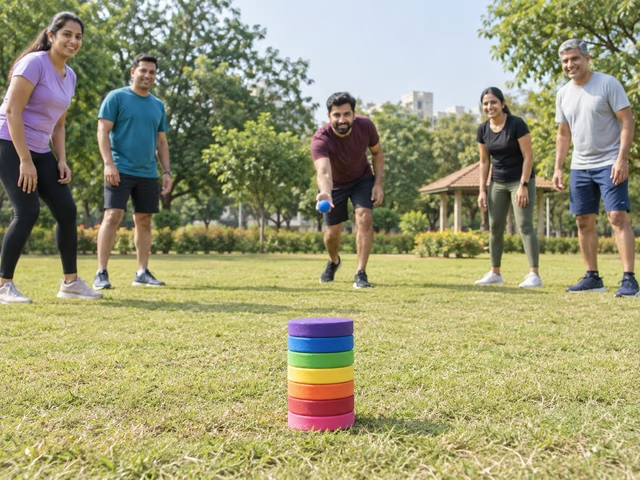
Two equal teams alternate attacking. From five metres away, attackers get three total throws to knock down seven stacked discs. Once they succeed, they have two minutes to rebuild while defenders try to hit them below the knees with a soft ball. Defenders cannot run holding the ball. A complete stack earns one point; then swap. Most points after three attacks each wins.
Saved on this device only — clearing your browser's cache or site data removes them (no account backup).
Build a stack in a clear court
Mark a flat rectangle about 15 by 20 metres, with open run-off. At its center mark a one-metre stacking circle. Stack seven lightweight foam or purpose-made game discs largest to smallest. Do not use jagged stones or hard improvised projectiles. Mark a throwing line five metres from the stack.
Make two equal teams of three to six. Toss for the first attackers. Defenders spread out, with one at least three metres behind the stack; everybody stays clear of the opening throw. Agree the complete house rules below before play. They deliberately resolve differences between traditional accounts.
Topple, scatter and rebuild
Take the opening throws
Attackers choose three throwers; with three players, each throws once. They throw underarm from behind the line, one attempt each, stopping as soon as any disc leaves the stack. An opening catch does not cancel a knockdown in this version. Three misses finish the round with no point.
Start the chase
When the stack falls, start two minutes. Attackers enter the area and may gather or stack the discs. Defenders retrieve the ball and try to eliminate attackers with a gentle direct hit below the knees. The ball must not bounce before hitting. Hits higher than the knee do not eliminate; stop for unsafe throwing.
Pass to improve the angle
A defender holding the ball may pivot but may not run. They may pass to teammates or throw at an attacker at least two metres away. Defenders cannot enter the stacking circle, touch the discs or physically block attackers. They must release the ball within five seconds or put it down for another defender to collect.
Handle an elimination
A legally hit attacker raises a hand and leaves by the nearest edge. They place any held disc gently where they were standing. Leaving the court voluntarily also eliminates an attacker. A catch by an attacker simply makes the ball dead; hand it to the nearest defender and allow everyone three steps of space before restarting.
Finish the rebuild
Attackers score one by restoring all seven discs upright inside the circle and calling 'Lagori' before time runs out or everyone is eliminated. Hands must be off and the stack must stand for a count of three. If it falls naturally during that count, rebuilding can continue if time remains.
Give both teams three attacks
Every round ends after a successful rebuild, all attackers are eliminated, two minutes expire or three opening throws miss. Swap roles and fully reset. After three attacks per team, the higher point total wins; share a tie. A round interrupted for safety is replayed without a point.
Keep the rebuilding task playable
The ball is a soft tag tool, not a power throw. A builder should be able to concentrate on stacking without someone throwing from point-blank range. Stop if players crowd the center. The challenge comes from defenders' passes and attackers' teamwork, rather than hard impacts.
A recent Mumbai community post specifically seeks adults for Lagori and other outdoor games. That is a concrete invitation signal, not evidence of broad popularity. Federation accounts disagree on some eliminations, so this guide names its house choices instead of hiding the differences.
Already know the game?
Ideas & Twists
Choose a variation together before you start.
Lagori · See main rules
Suggested house variationDesignated builder
Before each attack, name one builder. Only that player may place discs in the stack; teammates can collect and deliver them to the circle's edge. If the builder is eliminated, one active teammate takes the role immediately. Keep all main limits and scoring. Decoys and safe delivery now matter more.
Lagori · See main rules
Suggested house variationCatch to rescue
An attacker who cleanly catches a defender's direct throw may bring back the earliest eliminated teammate. The catch also makes the ball dead; hand it to a defender and reset with three steps of space. No attacker is eliminated for dropping a ball unless it first legally hits below the knee. Keep three attacks per team.
Lagori · See main rules
Suggested house variationTwo possible homes
Mark a second stacking circle at least five metres from the first. After the opening knockdown, attackers may rebuild all seven discs in either circle, but only one finished stack scores. Defenders must stay out of both circles. Keep two minutes and normal eliminations. Attackers can change destination while defenders decide which route to cover.
Lagori · See main rules
Suggested house variationRelay stacking
No attacker may place two consecutive discs in the stack. A different active teammate must add the next disc; gathering and passing discs remain unrestricted. If only one attacker remains, they may complete the stack alone. Keep the ordinary finish. The group must coordinate handoffs instead of assigning every placement to its quickest builder.
Lagori · See main rules
Suggested house variationRolling defense
Defenders must roll the foam ball along the ground to hit an attacker's foot or lower leg. Bounces are now allowed; any ball lifted above knee height is dead and gives attackers a safe three-second reset. Keep stationary ball holders, the two-metre release distance and all other main rules. This changes escape timing and passing angles while removing airborne throws.
About this guide
The traditional knockdown/rebuild identity and stationary ball-holder idea come from the federation description. That page contains conflicting elimination statements; this guide explicitly selects a complete soft-equipment house format, not purported tournament law. A current community invitation supports adult interest only at an anecdotal level.
Ready for something different?
Find another game →