

The quick version
Use the five-expedition board and 60-card deck. Deal eight cards each. On your turn, play one card onto your own matching-color expedition or discard it onto that color's shared pile, then draw one card from the deck or a discard pile. Numbers must increase; multiplier cards go before numbers. You cannot take back the card you just discarded. Stop immediately when the last deck card is drawn. Score each started expedition: subtract 20 from its number-card total, apply its multiplier, then add 20 if it has at least eight cards. Add three rounds; higher total wins.
Saved on this device only — clearing your browser's cache or site data removes them (no account backup).
Prepare five expeditions
This guide uses the original two-player base game in Thames & Kosmos item 691821, the English card-game edition whose manual is marked 691821-02-280618. Its box has a double-sided board and 72 cards. Set aside all 12 purple cards and put the board's five-space side up. The older 60-card item 691820 also supports this five-expedition format. Lost Cities: The Board Game, Rivals and Roll & Write are separate games.
Bring the card-game board, the 60 base cards, paper and a pen to record three rounds. The five colors are yellow, white, blue, green and red. Each color has one card of every number from 2 through 10 and three non-numbered multiplier cards: nine numbered cards plus three multipliers. The printed rules call the multipliers wager cards; here they affect game points only.
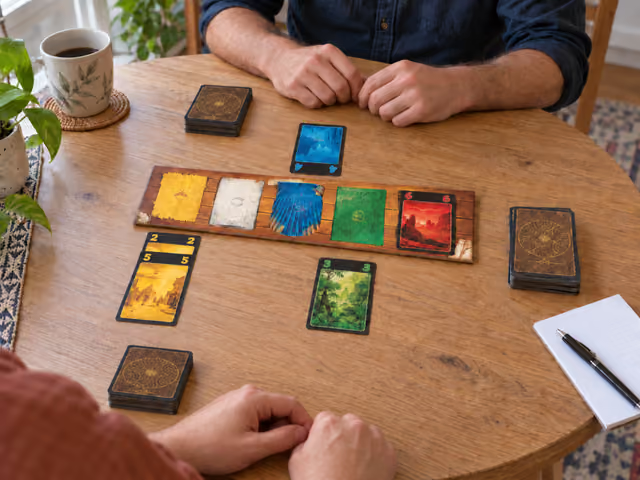
Sit opposite each other at a stable indoor table. Leave room beyond both long sides of the board for five overlapping card columns per player, with all played numbers visible. The board's five spaces are shared discard piles, initially empty. Shuffle the 60 cards, deal eight face down to each player, and put the remaining 44 face down beside the board as the draw pile. Keep your hand private; played expeditions and the top discard cards are public. The older player takes the first turn.
Play one card, then draw one
Choose a card from your eight-card hand
First play exactly one card. Start or extend one of your own expeditions, or discard a card onto its matching-color space on the central board. Discarding is a legal turn choice even if the card could be played. You may not pass or draw first.
Build a column in one color
On your own side, place the card under that color's board space. A first numbered card may be any value. Later numbers must be strictly higher than the last number in that column: after a 5, a 7 is legal but a 3 is not. Gaps are allowed, but you cannot insert missing numbers later. You may start a column with one or more matching-color multipliers, one per turn. Once its first number is played, no more multipliers can join that column. You cannot move or remove played cards.
Or give a card to the shared discard pile
Put it face up on top of its matching-color discard pile. Only that pile's top card is available to draw; covered cards are unavailable until exposed. Do not add discards to an opponent's expedition. Your opponent may later pick up a useful card you discarded.
Refill your hand and end your turn
Draw exactly one card: the top face-down deck card, or the visible top card of any nonempty discard pile. You may not draw the same card you just discarded. If you discarded on a color this turn, that top card blocks taking an older card from that pile. You may draw from that pile on a later turn if its top card is then available. You finish with eight hand cards; the other player now takes a turn.
If you have yellow 2 and yellow 5, you can start yellow with 2, then draw one card. On a later turn you can add the 5. A subsequently drawn yellow 3 can no longer join that column.
Stop at the last draw and score each color
The round ends immediately when either player draws the last face-down deck card. That drawn card is not played, hands score nothing, and the other player gets no final turn. Do not recycle discards or finish playing your hand. By agreement, you may count the remaining deck cards near the end without revealing their faces. Drawing from a discard pile leaves the deck unchanged and can delay the finish.
For each of your five colors, score your own played column. An untouched color is worth zero. For a started column, add its numbered cards and subtract 20. Then multiply that result by 1, 2, 3 or 4 for zero, one, two or three multiplier cards respectively. Negative results stay negative. Finally, add a flat 20-point bonus if the column contains at least eight cards, including its multipliers. Apply that bonus after multiplication, only once per qualifying column.
Examples: numbers 4, 7 and 10 total 21, so they score 1 with no multiplier. One multiplier followed by 3, 5 and 7 scores (15 minus 20) times 2, or minus 10. A lone multiplier scores minus 40 because it starts an expedition with no numbered value. Two multipliers plus numbers 2, 3, 5, 7, 8 and 10 make eight cards: (35 minus 20) times 3, plus 20, equals 65.
Add your five column scores for the round and record both players' results, including negative totals. Collect every card from both hands, both displays and all discards; shuffle the full 60-card base deck and deal eight each again. The manual says the player with most points starts the next game, without expressly distinguishing the latest round from the accumulated score or giving a tie procedure. For a clear restart, this guide's house clarification uses the higher score from the round just completed; the older player starts after a tied round. Play three rounds and add each player's three scores. The higher combined total wins; winning two rounds does not automatically win the match. If the combined totals tie, this guide calls it a shared result because the reviewed manual supplies no tie-breaker.
Make the tradeoffs clear
Before the first turn, explain the 20-point cost and score one positive and one negative example aloud. Starting an expedition with a multiplier still incurs that cost. New players do not need to pursue all five colors: inspect the cards already in your hand before committing, then watch what an opponent could gain from your discards. Holding every useful-looking card can also prevent you from placing your good cards before the deck ends. These are choices to weigh, not guaranteed winning tactics.
Keep column numbers uncovered and shared discard piles separate from private expeditions. If a player proposes a lower number or a late multiplier, explain why it is illegal before they draw; they can choose another legal play or discard. For a mistaken turn discovered after drawing or later turns, the printed manual supplies no rewind penalty. Agree on a house remedy before play: correct a clearly recoverable mistake together, or restart that round unscored if hidden draws make a fair repair impossible. Never invent a points penalty mid-round.
Use color symbols and expedition illustrations as well as color names, and arrange cards so both people can read the public information. Ask about readable numbers, comfortable reach and card handling before beginning; a seated game is not a blanket accessibility guarantee. Allow quiet thinking and conversation, but keep private hands hidden in scored play. If one person wants advice, use the open-hand teaching variation rather than making their competitive choices for them.
Already know the game?
Ideas & Twists
Choose a variation together before you start.
Lost Cities · See main rules
Official longer-game optionSixth expedition
Use item 691821's six-space board side and include all 12 purple cards, making 72 cards. Deal eight each; the draw pile begins with 56. Both players now have six possible expedition columns and six shared discard piles. All play restrictions, expedition scoring, eight-card bonuses, immediate deck-exhaustion finish and three-round total remain the same. The older five-expedition set does not contain the required extra cards or board side.
Lost Cities · See main rules
House suggestionOne-round duel
Agree before dealing to play one round instead of three. Use the normal 60-card base setup, eight-card hands, legal turn order and scoring. The last deck draw ends play immediately; higher round score wins, with a shared result if tied. There is no next-round starter or cumulative score. This changes the official match length and leaves more of the result to a single shuffled deal.
Lost Cities · See main rules
House learning suggestionOpen-hand teaching round
Use the complete 60-card base setup, but display each player's eight-card hand face up on their own side and discuss the options before each play. Follow normal ascending columns, multiplier timing, play-then-draw order and discard restrictions. End on the last deck draw and calculate scores together, but record no competitive winner or match points. Collect and reshuffle all 60 cards, then return to private eight-card hands for a fresh three-round match; teaching-round scores do not carry over.
About this guide
Main play is the original two-player, five-expedition card game, verified against the manufacturer-hosted English item 691821 manual (2018, code 691821-02-280618) currently linked in its manual register. The sixth expedition is its official optional format. One-round and open-hand formats, mistake remedies, next-round starter clarification and shared final tie are explicit house suggestions. Multiplier cards change game points; no money or token setup is part of this guide. Community reports inform the scoring explanation and host advice, not official mechanics. Separate Lost Cities games and four-player/solo variants are outside the main format.
Ready for something different?
Find another game →