

The quick version
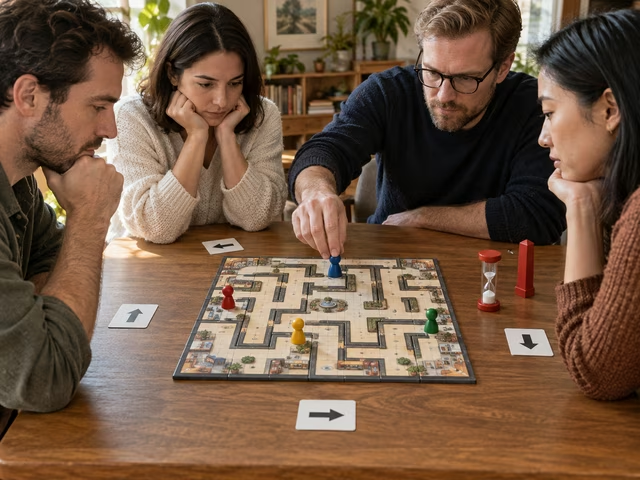
Start on tile 1A and shuffle tiles 2–9. Give each person the action tile for your group size. Move any hero using only your own allowed actions, explore matching-color doors, and get all four heroes onto their matching item spaces together. Flip the theft tile, then get all four through the purple exit before the hourglass empties.
Saved on this device only — clearing your browser's cache or site data removes them (no account backup).
Learn your action, not one character
Put tile 1A in the center, with one hero on each of its four starting spaces. Shuffle tiles 2–9 face down. Keep other maze tiles in the box. Place the theft tile on side A and put out-of-order markers nearby. Ignore loudspeaker icons in this introductory scenario.
Select action tiles marked for the exact number of players and deal one each. Align every north arrow with the starting tile’s north arrow and keep them aligned all game. Explain each action before timing. Everyone must be able to see the map and reach its pieces without leaning across another person.
Act together while the sand runs
Turn the sand timer. There are no turns: you may use only the actions printed on your own tile, on any hero, whenever useful. A directional move travels any number of clear corridor squares in that direction. Stop before walls or other heroes; no passing through them, diagonal movement or sharing a square.
An escalator action moves a hero between the two ends of an escalator. A vortex action moves a hero from anywhere to a vortex of its own color; it need not begin at another vortex. The explore action reveals and attaches the next tile when a hero stands at an unexplored door of its matching color. Align the new tile’s white arrow with that door. Once open, anyone may use the passage.
Keep silent and do not point or make coded gestures. You may place the attention pawn in front of someone to suggest they have a useful action; they decide what to do. Moving a hero onto an unused hourglass space immediately flips the timer, even if that leaves less time. Cover that space with an out-of-order token so it cannot be used again.
After a timer flip, people may talk while the sand keeps running, but no pieces may move during that discussion. The first resumed action ends permission to talk. A rules error may be corrected aloud and reversed, with the timer still running; a legal unhelpful move must be undone through legal movement actions.
When all four heroes are simultaneously on their own matching item spaces, flip the theft tile to B. Vortex movement is now unavailable. Move every hero to the purple exit and remove them as they leave. All four out before the sand empties is a shared win. The sand emptying first is a shared loss. Unused hourglass spaces still work during escape.
Choose the level of pressure
Play one complete attempt, then decide together whether to retry. The first scenario officially permits unrestricted talking as a teaching option; announce that option before timing. Do not use a phone countdown instead of the sand timer, because flipping the partially filled hourglass is part of the game.
Already know the game?
Ideas & Twists
Choose a variation together before you start.
Magic Maze · See main rules
Published scenario-one optionTalking introduction
Allow conversation throughout the attempt. Keep simultaneous actions, the real hourglass and normal objective. Nobody gains another person’s action; suggestions still depend on its owner choosing to act.
Magic Maze · See main rules
House suggestionUntimed rehearsal
Set the hourglass aside and solve the same first scenario at your own pace. Keep directional ownership and silence except for a mutually agreed pause to discuss. This is a learning puzzle, not a timed victory; finish when all four heroes exit.
Magic Maze · See main rules
Published later-scenario rule · house use in scenario onePass the action tiles
Whenever an hourglass space flips the timer, pass every action tile left before resuming. Keep north arrows aligned with the board. Use the first scenario’s tiles and purple exit, making this a house combination of published rules.
Magic Maze · See main rules
House suggestionNo attention pawn
Remove the attention pawn. Players must notice available moves from the board alone. Normal silence, hourglass discussions and shared finish remain.
Magic Maze · See main rules
House suggestionVortex-to-vortex challenge
A vortex move must now begin on a vortex of the same hero color. Ordinary rules allow teleporting from anywhere; this restriction is deliberately harder. Vortices still shut down after the theft, and the standard first-scenario result remains.
About this guide
Main play is published scenario 1, explicitly separated from later multi-exit and character-power scenarios. Talking is an official scenario-one option; tile passing comes from scenario 3 but its use here is a house combination. Untimed and restricted-vortex play are house changes.
Ready for something different?
Find another game →