

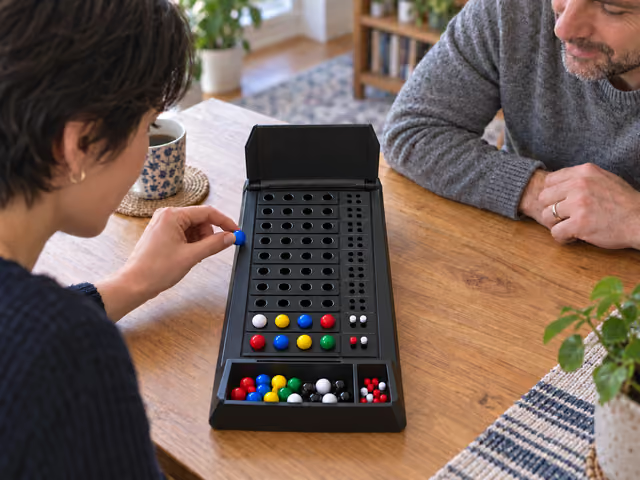
The quick version
Sit opposite each other and choose the first codemaker. Hide four large pegs using any of the six colors; repeats are allowed. The codebreaker fills one four-peg guess row. Give red key pegs for exact color-and-position matches and white ones for additional correct colors in wrong positions, without identifying which peg they describe. Keep guessing, up to ten rows. The codemaker scores one point per row used, or 11 if the code stays unbroken; switch roles for a new code. After each has set one code, higher total wins.
Saved on this device only — clearing your browser's cache or site data removes them (no account backup).
Hide the code and agree the finish
This guide uses Goliath's 2025 The Original Mastermind classic peg edition, product 934423.0, manual 934423.0-10-V02-2412. It has four code positions, six code colors, ten guess rows, 108 large code pegs and 30 small red/white key pegs, with a hinged shield, built-in storage and score tracks. Travel, Junior, Advanced, Code Breakers cards and rotating multiplayer versions need their own instructions.
Bring the complete console, shield, all supplied code and key pegs, one sheet of paper and a pen. Sit at opposite ends of a small stable table with room to reach the rows and see the six colors clearly. Separate large code pegs from small key pegs. Face the shielded end toward the codemaker; establish the codebreaker's left-to-right order and use it throughout.
Choose who sets first. Play two codes, one set by each person; this is the guide's short session within the official equal-role series format. Write both names and start totals at zero. Paper keeps totals clear and can preserve a row if you run short of a peg color. No timer, phone or app is required.
The codemaker raises the shield, secretly fills all four code holes with any combination of the six colors, then conceals the code. A color may appear two, three or four times, and both secret codes and guesses may repeat colors. Leave no code holes empty in the main game. Keep that code unchanged until the round ends.
Count matches without pointing to positions
After a complete four-peg guess, the codemaker compares it with the secret code. First count pegs whose color and position both match: give one small red key peg for each. Then consider only the unmatched pegs on each side. Pair equal colors wherever they occur, once per peg, giving one white key peg per pair. Unmatched leftovers earn nothing. The total can never exceed four key pegs.
For example, let the secret code be red, red, blue, yellow and the guess be red, blue, red, green. The first red is exact. Of the remaining pegs, the guess's blue and second red each match a remaining secret color in another place. Give one red and two white key pegs. If the guess instead is red, green, green, green, give only one red: repeated green guesses cannot earn clues for a color absent from the code.
Place these small pegs in the feedback holes beside that guess in any order. Their positions never tell the solver which large peg was correct. A red clue and a white clue cannot both count the same peg. If a color occurs once in the secret but twice in the guess, it can earn at most one clue, with an exact match taking priority. Small red feedback pegs describe a match of any color; they do not mean a large red code peg was found.
Guess a full row, then read the clues
Make the first guess
The codebreaker chooses four large pegs and fills the first guess row nearest them. Think freely while arranging it; say 'ready' to commit the complete row. The codemaker waits for that signal before placing the counted feedback. This commitment signal is a host suggestion, not an extra clue.
Use all earlier rows
The codebreaker reads the feedback and fills the next row with a new complete guess. The codemaker gives its feedback, and the sequence repeats toward the shield. Leave earlier guesses and clues visible: they remain true simultaneously. The codemaker supplies only the prescribed counts, without revealing colors, pointing to exact positions or changing the code.
Reveal the result
Four red key pegs mean the entire code is exact; reveal the hidden pegs and stop that round. A correct tenth guess still succeeds. If the tenth guess is incorrect, reveal the code after its feedback; there is no eleventh guess.
Score and switch
For a solved code, give the codemaker one point for every guess row used, including the successful row. Solving on row 4 gives the codemaker 4 points. If all ten guesses fail, the codemaker receives 11. Record those points, clear the board and switch roles for a fresh secret code. After the two agreed codes, compare totals: the higher total wins. The manual gives no tie procedure; this guide leaves equal totals as a shared result. If both want more, agree another pair of codes before starting it, so each sets once again.
Before hiding the first real code, lay out the red-red-blue-yellow example openly and score red-blue-red-green together. Verify one red and two white clues, then clear it. This teaches duplicate counting and the feedback colors without using a scored guess.
Keep the evidence reliable
Agree the red-exact, white-misplaced meanings aloud before starting. Older boards and online puzzles may use black instead of red; follow the key colors for this edition. Ask everyone to name the code colors they see in the light. Color discrimination and placing small pegs are part of this physical version; seated play is not a promise that it fits every access need.
The solver can ask the codemaker to recheck the feedback count without seeing the code. If the solver demonstrates incorrect feedback, the official remedy is to replay that code-setting turn: award the codebreaker 3 points, give the codemaker no points for the faulty code, and start a fresh code with the same roles. Then resume the agreed sequence. Do not silently change a past clue after the solver has relied on it.
If a peg supply runs short, use this explicit house aid: write down an earlier row's four colors in order and both clue counts, let both players verify that record, then return that row's pegs to the supply. Keep the written record beside the board and mark its row number. The information, ten-guess limit and scoring stay the same. Do not remove history without recording it or use a differently colored peg without a clear record.
If the shield is accidentally lifted or the hidden code spills, this guide suggests a house remedy: void that unfinished code without points, clear it and make a fresh code with the same roles. For a mistaken verbal explanation, stop and resolve it before another guess. The exact-match counts settle deduction disputes; confidence, memory of another edition or the physical position of a key peg does not.
Quiet conversation is enough. Give the solver space to reason; a guess can test a possibility without being an attempted final solution. After the reveal, compare one useful deduction from the retained rows, then switch roles. You do not need a memorized solving algorithm to begin.
Already know the game?
Ideas & Twists
Choose a variation together before you start.
Mastermind · See main rules
Official alternative gameEmpty holes become a seventh color
Allow one or more holes in the secret code to stay empty; an empty hole acts as a seventh color. The codebreaker may also leave holes empty in a committed guess. Count exact empty-hole matches first as red clues, then unmatched empty holes as white clues, just as for other colors. Say 'ready' so an intentional blank cannot be confused with an unfinished guess. Keep all four positions, ten guesses, role swap, points and finish unchanged.
Mastermind · See main rules
House suggestionFour different colors
Before both codes, agree that each secret must contain four different colors from the same six-color set. Guesses may still repeat a color to gather information; they do not have to satisfy the secret's restriction. Keep four code positions, no empty holes, ten guesses, ordinary duplicate-aware feedback and the same codemaker scoring. Use the restriction for both players' codes, then finish after each has set once.
Mastermind · See main rules
House teaching formatExplain the next test
Play the same two-person game and two-code finish, but before committing each guess the codebreaker says what question that row will test. The codemaker stays neutral and returns only the usual peg counts; they cannot confirm a theory or offer strategy. No extra time limit or clues are added. This makes the reasoning discussable while preserving the hidden code, repeats, ten rows and competitive scoring.
About this guide
The main physical mechanics and empty-hole alternative come from Goliath's 2025 Original edition, manual 934423.0-10-V02-2412, visually read in French and checked against the English 2018 Pressman classic manufacturer text. The two-code session chooses an official equal-role series length. Ready signals, open practice, peg-short paper records, exposed-code restart, shared ties and the two labeled house variations are host suggestions. No Junior, Advanced, multiplayer-console, app or Code Breakers card rules are imported.
- Goliath · 2025 The Original Mastermind manufacturer manual, French rules pp. 4–5 ↗
- Goliath · official rules index linking Original, Travel, Junior and Code Breakers separately ↗
- Goliath · current The Original Mastermind product and components ↗
- Pressman · English classic manufacturer instructions, third-party mirror ↗
Ready for something different?
Find another game →