

The quick version
Deal six word cards each. On your turn, your left neighbor plays a card and you add one from your hand. Both think of a connecting idea, then reveal it together. Match on attempt one, two or three for 3, 2 or 1 shared points; each miss supplies the next two words. Refill hands, move clockwise and finish after three complete circuits. Highest-scoring neighboring pair wins.
Saved on this device only — clearing your browser's cache or site data removes them (no account backup).
Give each pair a place to score
Choose one fewer numbered set of Medium word cards than there are players, shuffle them together and deal six to each person. Players may look at their hands. Set all special cards and printed scoring tokens aside. Draw a score row for each neighboring pair, including the last and first seats.
Choose a starter and mark that seat. Agree three full circuits, so every neighboring pair gets exactly three turns. These fixed points and endpoint are a house version; they make the shared connections easier to follow.
Move from two ideas toward one
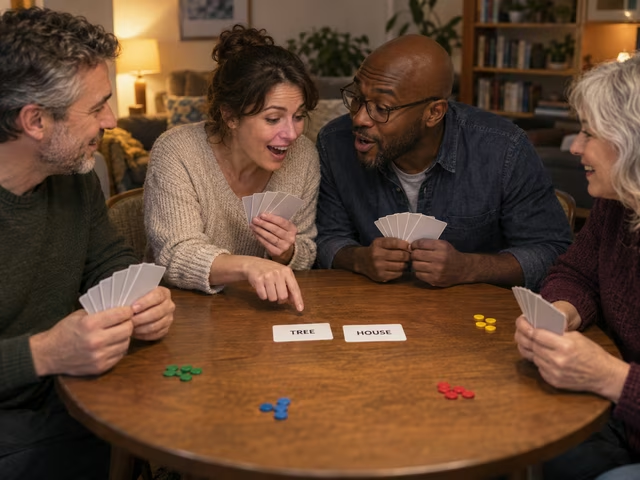
The current player’s left neighbor selects and reads one card. The current player selects and reads a second. Both silently choose one idea connecting them. For example, “storm” and “music” might suggest “thunder.” It need not be a literal compromise, and a familiar multiword term is allowed.
Confirm both are ready, count down together and say your answers simultaneously. A match earns 3 points for that pair. If different, those two spoken answers replace the original cards as the next clues. Repeat for 2 points, then a third and final attempt for 1. You cannot reuse any earlier word from this turn as your new answer. Three misses score zero.
Observers stay quiet until the turn ends. If matching is uncertain, the other players decide whether the expressions clearly mean the same thing; a mere thematic relation is not a match. If someone says nothing after agreeing they are ready, the turn ends for zero, as in the published rules.
Discard the two physical cards and both players draw back to six. If the deck empties, shuffle discarded word cards into a new draw pile as this house format’s refill rule. The left neighbor becomes current player. Stop after the third complete circuit. Add each pair’s points independently: do not add your left pair to your right pair. Highest pair total wins; equal totals share the win.
Leave the pair room to think
A short pause before agreeing to count is fine. Do not pressure a pair into a countdown before both have an answer. After a surprising match or miss, hear a quick explanation, then move on. Choose only one optional change at a time.
Already know the game?
Ideas & Twists
Choose a variation together before you start.
Medium · See main rules
House suggestionOne circuit
Each neighboring pair plays once, then compare the fixed 3–2–1 totals. This is a complete shorter game; do not stop mid-circuit.
Medium · See main rules
House suggestionRandom opening cards
Replace the neighbor’s chosen card with the top word card of the draw pile. The current player still chooses their response from six. Refill only the player who spent a hand card. Three attempts and three circuits remain.
Medium · See main rules
House suggestionWritten reveal
Add one paper slip and pen per person. Partners write their answers secretly and show them together when both are ready. A mismatch still becomes the next pair of clues. This removes spoken overlap; all other house rules remain.
Medium · See main rules
House suggestionCooperative table
Pool every pair’s points instead of ranking pairs. Complete three circuits and record the shared total out of nine times the number of players. Compare only sessions with the same count and card format.
Medium · See main rules
Published partnership idea · house scoringFixed partners
With four, six or eight people, form permanent pairs. Pairs take turns around the table, alternating which partner plays first. Give each pair three turns and use the fixed 3–2–1 points. Highest pair total wins, with shared ties.
About this guide
Word selection, successive connecting attempts, hidden hands and neighboring partnerships are published. Fixed 3–2–1 points, three circuits and reshuffling replace the standard random tokens and Crystal Ball finish. The player review incorrectly describes combined individual scoring; this guide follows the rulebook’s pair-based result.
Ready for something different?
Find another game →