

The quick version
Set aside double-twelve as the engine, mix the rest face down, and give each player twelve tiles. Keep leftovers as the boneyard. Take clockwise turns playing one matching tile on your own train, the shared Mexican Train, or any marked public personal train. If you cannot play, draw one; if still stuck, mark your train public and pass. A double must be covered before ordinary play resumes. Emptying a hand ends the round; otherwise stop when the empty boneyard and a full circuit of passes show that nobody can play. Count leftover pips. Repeat with double-eleven and double-ten; lowest total wins.
Saved on this device only — clearing your browser's cache or site data removes them (no account backup).
Choose the engine before drawing hands
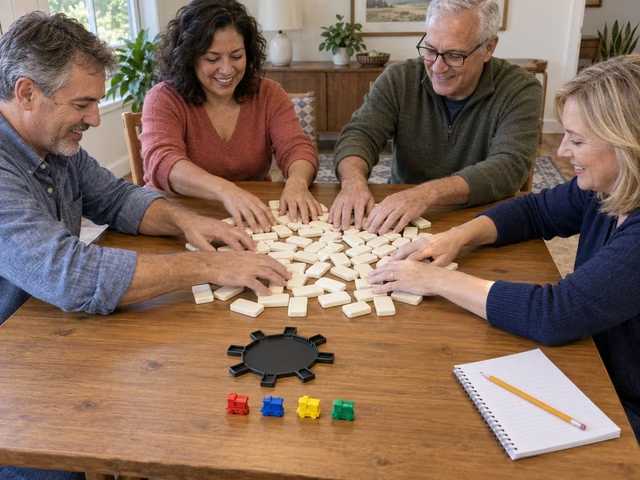
Count a full double-twelve set: 91 different tiles. Find double-twelve and place it at the center as the first engine. Mix the other ninety face down. Each of 2–6 players draws twelve and keeps them concealed; the rest remain face down as the boneyard. Twelve each is this guide's single hosting rule, not the manufacturer chart for every player count.
Reserve one personal train position per player around the engine. Keep a separate line to one side for the Mexican Train and mark it as always public. That line begins with a tile matching the engine number but need not physically attach to the hub. Personal trains are private until marked. Choose a first player and proceed clockwise. No one lays a whole opening train at once in the main game.
Play one tile, draw one if stuck
Start or extend an eligible train
Your first tile on a new train must match the engine number at one end. Later tiles match the exposed end of that train. Play on your own train, the always-public Mexican Train, or any opponent's marked train. You may start the public train on your turn if nobody has yet. One ordinary tile ends your turn.
Draw only when no legal play exists
If you cannot play anywhere eligible, draw one boneyard tile. Play it if possible; otherwise keep it, put your marker on your personal train, and end your turn. With an empty boneyard, mark and pass. A train can be marked even before its owner has started it.
Close your own public train
Your marker stays when you play elsewhere or someone else uses your train. Remove it only when you personally play on your own train. Existing tiles stay in place. Other players can no longer use it while unmarked, except to satisfy a pending double.
Cover a double before anything else
Place a double crosswise. Unless it empties your hand, immediately play a non-double matching its value on that same train. If unable, draw one and cover if possible; otherwise mark your personal train and pass. The next player must cover that double, even on a normally private train. If unable after one draw, they mark and pass too. Continue until covered; that covering tile ends the player's turn.
Resume the ordinary choices
Once the double is covered, all normally eligible trains become available again. This guide permits only one double during a turn and requires covering on that double's train. Those are simpler house choices than the publisher's multiple-double and alternate-train follow-up options. Announce when you have one tile left; use words rather than an electronic sound.
Score the tiles left in your hand
The round ends immediately when someone plays their last tile, including a double. No extra covering tile is required after that finish. If the boneyard is empty and everyone passes in an uninterrupted circuit, the round is blocked and ends, even if a double remains uncovered.
Each person totals every pip in their own remaining hand; a blank half is zero. The player who emptied their hand scores zero. Record those penalty points. Retrieve and remix all tiles for the next round, selecting double-eleven as engine, then double-ten. Rotate the starting player clockwise each round. After three rounds, lowest cumulative total wins; ties share the result.
The three-round match is a house finish. A complete descending-engine match continues to double-blank and is much longer. Do not mistake a quick turn for a promised short session.
Make public tracks and pending doubles obvious
Give each player a visibly different marker and point out whose train each line belongs to. Keep the always-public line apart from personal trains. Turn a pending double crosswise and announce its value. Confirm all train ends before someone draws: having no move on your own line does not mean there is no legal move.
Allow a moment to organize the twelve tiles privately before the first turn. Correct a mistaken match before the next play when possible; this guide adds no surprise penalty tiles. Agree on any variation first. The Fort Morgan club account specifically describes house-rule differences, which is a reason to state the rules rather than assume everyone remembers the same game.
Already know the game?
Ideas & Twists
Choose a variation together before you start.
Mexican Train · See main rules
Suggested house variationPersonal trains only
Remove the shared Mexican Train entirely. Players may use only their own train and marked personal trains. An uncovered double still overrides privacy and must be satisfied. Keep twelve tiles each, one-tile turns, markers, three rounds and pip scoring. With one fewer escape route, choosing when to open or reclaim a personal train matters more.
Mexican Train · See main rules
Suggested house version of the fast openingLay your opening chain
Before regular turns, everyone builds the longest chain they choose to lay from their own engine position, using their starting hand. A double may appear only when immediately followed by a matching non-double; leave other doubles in hand. Do not use other trains during this opening. Anyone unable to start marks their train public. If someone empties their hand here, finish the simultaneous opening for everyone before scoring; otherwise begin ordinary turns with the chosen starter. Keep three rounds and pip totals.
Mexican Train · See main rules
Publisher-style follow-up with one-double house limitDouble, then choose another track
After playing a double, your required extra non-double may go on any normally eligible train, not necessarily on that double. Draw one if you have no legal extra tile, and mark your train if still unable. If the double remains uncovered at the end of your turn, subsequent players must cover it before anything else. Still allow only one double in your turn. Everything else, including the immediate last-tile finish, stays unchanged.
Mexican Train · See main rules
Suggested house variationCover doubles only when ready
A double is legal only if you can immediately cover it from your hand with a matching non-double, unless the double is your last tile. You cannot use a draw to find its cover. If a held double is your only apparent move and you lack its cover, treat it as unplayable and use the ordinary one-tile draw rule. This removes pending doubles that interrupt other players while preserving their two-tile opportunity. Keep all markers, scoring and the three-round finish.
About this guide
A complete, explicitly selected house format based on Puremco's train, marker, draw and blocked-round mechanics. Twelve tiles per person, three rounds, spoken one-tile notice, one double per turn and same-train covering are choices here; the publisher permits different starts and double handling. The 2013 Fort Morgan report describes named players' fellowship and differing house rules, not a current schedule or a representative survey. Its displayed combined byline is not treated as multiple independent reports.
Ready for something different?
Find another game →