

The quick version
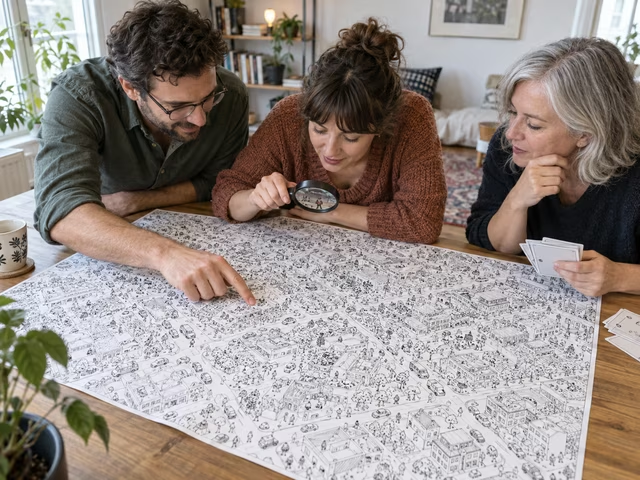
Spread the matching map and select one case. Read its introduction, then the first question without looking at the answer. Find a specific scene supporting your answer before the lead investigator checks the reverse. Correct means read the explanation and move to the next question. Incorrect means keep searching, with the informed checker stepping back. Finish after the case’s last question.
Saved on this device only — clearing your browser's cache or site data removes them (no account backup).
Give everyone a clear view
Use a map and case cards from the same box. Keep each case sorted by its printed number and icon. Choose one whose subject the host has screened as suitable; use a low-difficulty case for a first session. Avoid unsuitable settings and content rather than reading them aloud and trying to redirect afterward.
Spread the full map in bright light, with room to view all sides. Keep case cards, snacks and other objects beside it, never covering city scenes. Choose a lead investigator to read and check cards. Make the magnifier available to anyone; the game depends on tiny visual detail.
Find evidence for each answer
Read the start card’s introduction and inspect its pictured character. Then read the next task face without turning it over. Search together for a scene on the map that answers the question. A guess about what probably happened is not enough: point out the actual supporting illustration.
When the group agrees, only the lead investigator turns the task over to compare its answer and coordinates. If correct, share the answer text and picture with everybody, set that card aside and read the next task. If wrong, hide the answer again and continue searching. Because the lead investigator now knows the solution, they step out of solving that task, offering only a small hint if the others become stuck.
Some cards instruct you to keep a question beside the deck and reveal another. Follow that instruction so the listed tasks can be explored together. Preserve any marked clue card for later reference. Continue until every task in the selected case is resolved; that completes one shared investigation, with no individual score or speed requirement.
Help everyone see the story
When somebody finds a scene, give others time to find it too before checking. Describe a distinguishing feature or nearby landmark instead of covering the character with a finger. Coins beside relevant scenes can serve as temporary markers; never draw on the map.
After the final answer, retrace the characters’ route and sequence once together. A solved case loses much of its mystery, so choose a new case for the same group. Somebody who remembers the solution can host a later group while keeping their knowledge out of its search.
Already know the game?
Ideas & Twists
Choose a variation together before you start.
MicroMacro: Crime City · See main rules
Published advanced versionWhole-case deduction
Read only the case introduction, then reconstruct the whole story before opening its question sequence. Once ready, answer every question in order and check. If stuck, reveal the next question as a hint and continue, recording that assistance rather than pretending it was unaided.
MicroMacro: Crime City · See main rules
House suggestionChanging lead investigator
After each correctly solved task, pass the checking role clockwise. If a check is wrong, that same checker stays out of solving until the task is resolved. This distributes the responsibility while protecting hidden answers.
MicroMacro: Crime City · See main rules
House suggestionSilent search interval
Begin every task with one minute of quiet looking. Then discuss normally and agree an answer. Add a timer; it measures only the opening interval, not a deadline to solve.
MicroMacro: Crime City · See main rules
House suggestionClue before pointing
When you spot the answer, give one visual clue such as a nearby building or clothing feature, allowing others a short chance to find it themselves. Then show the location and check normally. Avoid revealing answer text you have not yet earned.
About this guide
Core question/check/search flow and advanced variant follow the original rulebook. The clean-case selection and remaining four variations are house hosting choices. No puzzle solution or map artwork is reproduced.
Ready for something different?
Find another game →