

The quick version
Give each player 1,500 in game money and put their token on GO. Highest opening roll starts; take turns to the left. Roll two dice, move clockwise and resolve the space. Buy an unowned property at its printed price or let the Banker auction it to everyone. Pay requested rent, follow cards, trade for color sets and build evenly. If selling buildings and mortgaging cannot cover a debt, that player is out; the last remaining player wins.
Saved on this device only — clearing your browser's cache or site data removes them (no account backup).
Set up the Bank and agree to the commitment
This guide uses Hasbro's U.S. Monopoly Classic refresh, product G0009, with the 2025 game guide PN00094207_e. It supports 2–6 individual players even though the box contains eight token choices. The older C1009 edition and regional or themed sets can have different player counts, cards and mortgage rules. Use the matching leaflet for your purchased set; this guide does not cover Junior, electronic banking, the Speed Die or Longest Game Ever.
Bring the gameboard, eight-token set, 28 Title Deeds, 16 Chance cards, 16 Community Chest cards, 32 green houses, 12 red hotels, two dice, game-money pack, storage tray and game guide. Only one token per player enters play. Use a table with space for the board, Bank and each person's cash and deeds, and seats where everyone can read and reach the game.
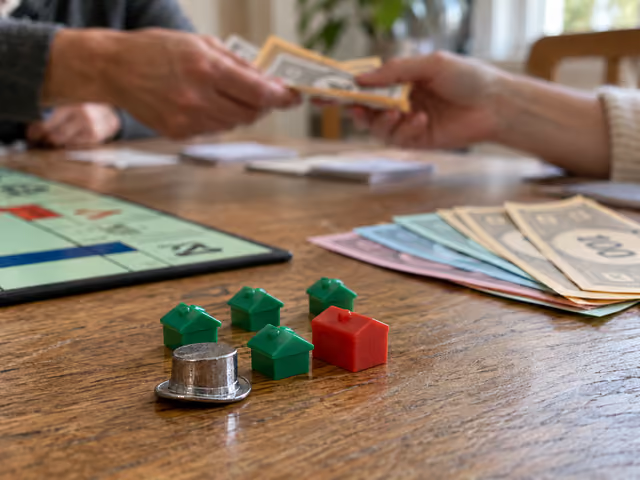
Choose a Banker to manage the Bank's money, deeds, buildings and auctions. The Banker may also play, keeping personal assets separate. Give each player 1,500: five 1s, five 5s, four 10s, four 20s, three 50s, two 100s and two 500s. Keep remaining money and all deeds and buildings in the Bank. Shuffle Chance and Community Chest separately and put each deck facedown on its marked space. Everyone chooses a token and places it on GO.
Before starting, explain that auctions are required, Free Parking gives no money, loans between players and rent-immunity deals are not allowed, and eliminated players stop playing. There is no promised short session. Arrange a pause if needed or choose the agreed-deadline variation before starting. Everyone rolls both dice; highest total starts, then play moves to the left. If the highest opening total ties, this guide suggests those tied players reroll until one is highest; the leaflet does not specify that tie procedure.
Roll, move and resolve the space
Take the first turn
The starting player rolls both dice, moves clockwise by their total and resolves the destination. You may buy on your very first trip around the board. When you pass or land on GO, collect 200 from the Bank, once for that passage; landing exactly there does not double the payment.
Buy or auction
On an unowned street, railroad or utility, either pay the printed board price to the Bank and take its deed, or have the Banker auction it immediately. Any player may bid, including the person who declined it. Start at 10; raises may be as small as 1. Bidding need not follow turn order. The Banker closes when nobody wants to raise; highest bidder pays the Bank and takes the deed. If nobody bids, nothing is paid and the deed stays in the Bank. A host suggestion is to have the Banker repeat the current high bid and ask for any raise before closing.
Pay the owner
On someone else's unmortgaged property, pay rent when its owner asks before the next player rolls. If they miss that deadline, that rent is not owed. Read street rent from the deed; owning the whole color set doubles its undeveloped street rent. Railroads charge 25, 50, 100 or 200 for one, two, three or four owned. For a normal utility landing, this edition instructs you to roll the dice to determine rent: multiply that total by four if the owner has one utility, or ten if they have both. Follow a movement card's specific rent instructions instead when it changes the calculation.
Resolve cards and other spaces
On Chance or Community Chest, draw the top matching card, do what it says and return it to the bottom after resolving it. Keep a Get Out of Jail Free card until used or traded; when used, return it to its original deck's bottom. Pay tax to the Bank as printed on the space. Free Parking does nothing. Merely landing on the Jail corner is Just Visiting; it does not imprison you.
Handle doubles
After resolving a normal doubles roll, roll again and take another turn. Count consecutive doubles within this turn sequence. On the third doubles roll, go directly to Jail without moving by that roll or resolving its destination. Any instruction sending you to Jail ends your turn, even if you had rolled doubles. Otherwise, when your turn ends, pass the dice left.
You decline an unowned property priced at 200. The Banker opens at 10; one person offers 40, you offer 50 and nobody raises. You pay 50 to the Bank and receive the deed. The printed 200 is not a minimum auction price, and declining the direct purchase does not exclude you from bidding.
Jail stops movement, not property business
When sent to Jail, move directly to its In Jail area and end the turn. Do not collect 200 for passing GO on that move. You may still collect rent, bid in auctions, trade, mortgage and buy buildings while jailed.
At the start of your next turn, either pay 50 and then roll and move normally, or use a Get Out of Jail Free card and then roll and move normally. You may buy that card from another player. Return a used card to its proper deck.
Alternatively, try rolling doubles instead of paying. Doubles free you; move by that roll, resolve the destination and end your turn without the usual extra roll. You may try on up to three jailed turns. If the third attempt fails, pay 50 and move using that third roll. If you cannot pay, use the debt rules below.
Trade for sets and build evenly
You may negotiate purchases, sales or exchanges of property and Get Out of Jail Free cards at any time. Deals may exchange cash, other property and those cards, at an agreed price; nobody has to accept. Do not lend money or promise immunity from rent. Keep the exchange explicit and hand over the agreed cash and deeds together. Before trading a street, sell every building in its color set back to the Bank. Buildings cannot be traded or sold directly to another player.
Once you own every street in a color set and none of that set is mortgaged, you can buy houses from the Bank at the deed's house price, even outside your turn. Build evenly: put one on every street before putting a second on any, and continue that pattern up to four houses per street. With four houses on every street in the set, you may upgrade a street to one hotel by paying its hotel price and returning that street's four houses. A hotel is the maximum; do not add houses to it. Railroads and utilities do not take buildings.
The physical supply matters. If several players want the last house or hotel, the Banker auctions it, opening at 10 with raises of at least 1; only an otherwise legal building purchase can be completed. The payment goes to the Bank. With no buildings left, you must wait until some return: do not use substitutes, buy directly from another player or skip straight to a hotel.
Sell houses back for half their purchase cost, removing them evenly across their color set. Sell a hotel back for half its cost and exchange it immediately for four houses as the leaflet instructs. The leaflet does not explain a hotel downgrade when fewer than four houses are in the Bank. Before play, this guide suggests this house ruling: in that situation sell the entire hotel development back for half the paid hotel-and-four-house cost and leave the street bare, removing other buildings as necessary to retain even development. Agree to that exceptional ruling before play; it is not a printed G0009 procedure.
Raise cash and keep mortgage ownership clear
To mortgage a street, first sell all buildings in that entire color set to the Bank at half cost. Turn the deed facedown and collect its printed mortgage value from the Bank. A mortgage raises cash but does not transfer ownership. A railroad or utility can also be mortgaged. To lift a mortgage, pay the unmortgage cost printed on that deed and turn it faceup; do not guess the amount from memory.
No rent is collected on a mortgaged property. In this edition, unmortgaged streets in a complete owned set still collect their increased color-set rent even if another street in the set is mortgaged. Likewise, use the increased ownership-count rent on unmortgaged railroads or utilities when others in that owned group are mortgaged. Buildings cannot be bought anywhere in a color set while any street in it is mortgaged.
You may trade a mortgaged deed at an agreed price, telling the recipient it is mortgaged. G0009 lets its new owner either pay the printed unmortgage cost immediately or leave it mortgaged and pay on a later turn. This leaflet does not charge an immediate transfer-interest fee for leaving it mortgaged. Older Monopoly leaflets have a different interest procedure; do not combine the two editions.
Pay debts or leave the game
If you owe rent, a tax, a card payment or a Jail fee and lack cash, raise money by selling buildings back and mortgaging properties. You can also negotiate a legal property trade, but nobody must rescue you. Pay the debt if you can. The game does not use negative balances or loans from other players to keep someone in.
If those assets still cannot cover the debt, you are bankrupt and eliminated. Against another player, pass the available payment proceeds, all your remaining mortgaged properties and any Get Out of Jail Free cards to that creditor. The recipient may unmortgage now or on a later turn under this edition's rule. Against the Bank, return your properties; their mortgages are canceled and the Banker immediately auctions those deeds. Return any Get Out of Jail Free cards to the bottom of the correct decks.
The others continue until only one player remains; that person wins. There is no running points score or ordinary final-wealth tie because the full game has a single survivor. If everyone agrees to stop early, record it as an unfinished game unless you chose a different finish in advance. For a pause, keep the board secure and note turn order, the next roller, token positions, cash, deeds, mortgages, buildings, held Jail cards and Jail-attempt counts; do not shuffle the decks.
Make the negotiation easy to follow
Keep deeds visible and mortgaged deeds facedown; count money privately if preferred, but make payments and trades clear. Announce purchases and building changes before moving pieces. Let an auction or trade finish before the next roll, and leave enough cash for possible rent instead of assuming a trade will happen.
Agree on one edition and any selected variation before money is dealt. Use its deed, space, card or leaflet to settle the specific question; a remembered family rule is not automatically the classic rule. If someone remembers a different mortgage-interest rule, check their edition rather than adding its fee to G0009. The main game never awards Free Parking cash, doubles GO money, delays buying until one circuit or removes required auctions.
House suggestion: if a mistake is noticed before the next roll, correct the payment or movement from the agreed rules. Once later turns have changed the position, pause and agree a fair correction rather than inventing an official retroactive penalty. The missed-rent deadline still applies. Invite eliminated friends to watch or take a break; do not promise everyone stays involved to the end. Soft-spoken negotiation is possible, but reading cards, handling small pieces and reaching the table may need individual arrangements.
Already know the game?
Ideas & Twists
Choose a variation together before you start.
Monopoly · See main rules
House finish for a bounded eveningAn agreed deadline
Before setup choose a stopping time and a physical clock, plus paper and pen for final accounting. At that time finish the current round so each surviving player has had the same number of turns, including any doubles sequence, then stop. A normal sole-survivor win ends earlier. Otherwise value each survivor's cash, unmortgaged properties at their printed purchase prices, mortgaged properties at their printed mortgage values, and buildings at half their purchase costs (a hotel includes its four replaced houses). Get Out of Jail Free cards count zero. Do not sell, trade or unmortgage after the cutoff. Highest total wins; equal totals share the win. All movement, auctions, rent, building and debt rules stay unchanged. This is this guide's house method, not an official tournament or G0009 timed-game rule.
Monopoly · See main rules
House change to property allocationAuction every first purchase
When anyone lands on an unowned street, railroad or utility, remove their right to buy it directly at the printed price. Instead the Banker immediately runs the standard open auction: opening bid 10, raises of at least 1, all players including the landing player eligible, highest bidder pays the Bank. If nobody bids, the deed remains unowned. Existing-property rent, trades, mortgage and building rules are unchanged, as is the sole-survivor finish. Agree before setup; the main game only auctions when a direct purchase is declined.
Monopoly · See main rules
House team game for exactly four adultsTwo partnerships
Make two pairs before setup. Each pair is one player for rules purposes: share one token, one cash supply of 1,500 and all deeds and buildings. The two partnerships alternate turns; within each pair alternate who rolls and moves each time that partnership's turn begins. Partners can discuss every purchase and trade; a deal with the other partnership requires both pairs to agree. Doubles keep the same partnership's turn sequence, and Jail attempts belong to its shared token. Auctions are between partnerships using their shared funds. Elimination removes a whole partnership; the other partnership wins. No loans or rent immunity between partnerships. This is not a four-individual game or an expanded headcount for the main format.
About this guide
Main rules follow the U.S. G0009 2025 leaflet PN00094207_e, inspected in full on October 2, 2026. Monetary figures are game money. Opening-roll tie rerolls, auction administration, the rare hotel-supply remedy, pause and error handling are explicit host suggestions. All three variations are house formats. Older C1009 counts and mortgage-transfer interest rules are not imported. No fixed game duration is asserted.
Ready for something different?
Find another game →