

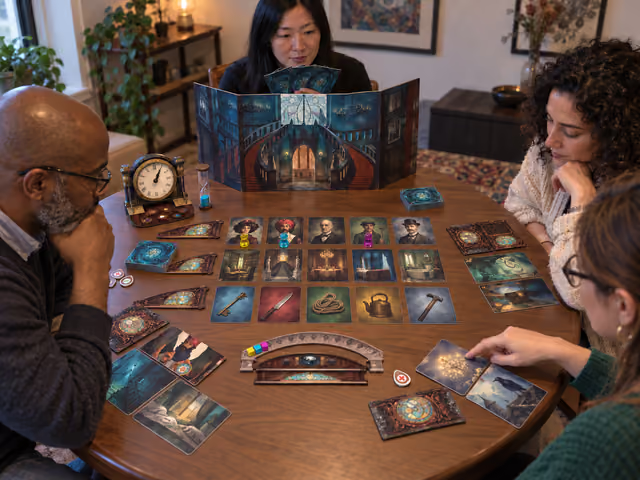
The quick version
Choose one ghost and 3–6 psychics. Set up the original game's Easy layout; secretly assign a different character, location and object to each psychic. The ghost gives each unfinished psychic one face-up vision of one or more cards, refilling to seven after each recipient. Once everyone has a vision, start the two-minute hourglass. Guess your current category and optionally predict other psychics' guesses with clairvoyancy tokens. Correct guesses advance one stage next round. Everyone must finish by round seven to reach the final secret vote.
Saved on this device only — clearing your browser's cache or site data removes them (no account backup).
Choose the original set and prepare the cases
This main game uses 4–7 people, including one ghost, on Easy in the original 2015 Libellud English/international Mysterium edition with a clairvoyancy track, check/cross prediction tokens and crow markers. The publisher's newer refreshed edition uses a different setup and ending; do not use these instructions with that box. Mysterium Park, Mysterium Kids, the app and the earlier Polish/Ukrainian game are also separate formats. Two or three people use the complete variation below.
Have the full original base set: 84 vision cards; 54 psychic cards and 54 matching ghost cards, each deck containing 18 characters, 18 locations and 18 objects; one ghost screen; six colored intuition pawns, six character sleeves and six clairvoyancy level markers; 36 clairvoyancy tokens, six per color; six ghost tokens and six culprit tokens; three crow markers; the assembled clock board with its hand; the two-minute hourglass; the character, location and object progress boards; and the final/epilogue board with the clairvoyancy track. Components beyond the active colors stay in the box. The original printings may count the attached final board separately.
Use a table where everyone can inspect the pictures without seeing inside the screen. Choose the ghost first; someone who understands the flow can explain it before becoming silent. Every other person chooses a different psychic color and takes its pawn, sleeve and level marker. With 4–5 total people, take that color's clairvoyancy tokens numbered 1–4, including two checks and two crosses. With 6–7, take all six, three checks and three crosses. Put the markers at 0 on the correct 4–5 or 6–7 side of the track. Those counts include the ghost.
Place the progress boards in character, location, object, final order. Put each pawn on the character board and the clock at I. Keep the hourglass and clock within reach. On Easy, deal five of each psychic-card category for four people; six of each for five or six people; seven of each for seven people. Shuffle each category separately, select that number, and lay the cards face up by its progress board. Put unused psychic cards aside for another game.
For every face-up psychic card, give the ghost the matching ghost card by its printed number. Behind the screen, the ghost shuffles each matching category separately and randomly assigns one card of each type to each active color's column. Return surplus ghost cards to the box secretly. Each psychic now has a hidden character, location and object to discover in that order; the face-up extras are decoys. Put each active colored ghost token by its column to track vision delivery. Keep the culprit tokens behind the screen for the ending; the ghost does not choose the true case yet.
Shuffle the vision deck behind the screen and draw seven. Easy allows one crow redraw per round: keep one crow ready to place on the screen when used. No phone, soundtrack, writing supplies or additional timer is needed. The clock's hours count rounds, not real hours or a promised whole-game duration.
Give visions, guess and reveal each round
The ghost sends the first vision
Choose any unfinished psychic. Look at that color's hidden character card in round one, or the location/object card for their current stage later. Give one or more vision cards together, face up, to suggest that single target through pictures. Slide the matching ghost token against the screen to mark that recipient. Refill the hand to seven immediately, then choose another unfinished psychic. If the draw pile empties, shuffle discarded visions into a new pile. A recipient gets only one delivery this round; no later top-up, even if their discussion reveals a misunderstanding.
Discuss while clues arrive
Psychics may examine their own and other people's face-up visions and start discussing as soon as the first vision arrives. The ghost can listen but supplies no verbal hints, meaningful gestures, pointing or approving reactions. On Easy, the ghost may discard any selection of their hand and replace the same number once per round, at any time, including the final phase. Mark that use with the crow; recover it at the round's end. Do not search through the deck for the perfect card.
Start the hourglass and commit guesses
After every unfinished psychic has received a vision, flip the two-minute hourglass. Each psychic places their intuition pawn on one face-up card of their current category. The pawn's owner decides; teammates may suggest alternatives. Move it as often as needed before time expires. Several psychics may guess the same card, but a category's hidden assignments are distinct, so they cannot all be right. Lock all guesses when the sand runs out.
Use clairvoyancy tokens if you wish
Before time expires, you may point a check token at another psychic's pawn to predict a correct guess, or a cross token to predict an incorrect one. Use that token's printed symbol; do not flip a cross into a check. You cannot predict your own guess or place two of your tokens on the same pawn. You may predict several different pawns, or none. Tokens can be moved or withdrawn before time expires; point clearly at a particular pawn, especially when several share a card.
The ghost answers yes or no
After time expires, the ghost resolves the locked guesses in any order, using one soft knock for correct and two for incorrect. Confirm only accuracy; do not explain a failed clue or identify its intended card. Each correct check prediction or correct cross prediction moves its owner's level marker forward one space; a mistaken prediction earns nothing and loses no points. Put every used prediction token on the clock's discard area, correct or not. All spent tokens return once, at the start of round IV.
Advance only after a correct guess
For a correct guess, the ghost turns that target ghost card over behind the screen. The psychic takes the matching face-up card into their sleeve, discards all visions from that stage and places their pawn on the next progress board. Their next category starts next round, not immediately. For a wrong guess, leave the target cards available, keep that psychic's existing visions and return their pawn to the same progress board. Next round they receive a new vision to add to those retained clues. Move that color’s ghost token away from the screen so it is ready for next round.
Keep finished psychics involved and check the deadline
After finding the object, place the pawn on the final board and set that color’s ghost token aside until the finale. Add one clairvoyancy space per investigation round still unused: finishing in IV adds three; finishing in VII adds none. That psychic gets no more personal visions, but helps others and may use remaining prediction tokens. If everyone has all three cards, proceed to the final phase immediately. Otherwise advance the clock and repeat. If anyone remains unfinished after resolving VII, everyone loses and there is no final phase.
Before shuffling, show one available character picture and one vision card. Invite the group to name a shared shape, color, object or mood, then return the demonstration cards before random setup. This is an unscored teaching example: there need not be one obvious interpretation, and the ghost cannot explain the connection during the game.
Use the shared vision to choose the true case
Only after every psychic finishes, remove the unused face-up cards and the three investigation progress boards. Each psychic takes their character, location and object out of their sleeve and arranges that trio as one case. Place numbered ghost tokens beside the cases, using consecutive numbers 1 through the number of psychics. Color no longer identifies a case for voting; use its displayed number. Recover every clairvoyancy token, including those spent after IV. The ghost turns hidden cards face up again inside the screen.
The ghost chooses one of those complete cases that can be suggested by three cards in their current hand. One vision must relate to that case's character, another to its location and another to its object. The permitted crow redraw remains available. Secretly put the matching numbered culprit token face down in the culprit space. Shuffle the three chosen vision cards and place them face down together. The ghost must not tell which image refers to which category.
From this point the psychics cannot discuss or signal interpretations. Reveal one shared vision. Every psychic in the track's one-card/low band must now put the clairvoyancy token bearing their chosen case number into their sleeve and hand it to the psychic with the highest level; tied highest levels use the eldest psychic. Reveal a second vision, and the two-card/intermediate band votes after seeing both. Reveal the third, and the three-card/high band votes after seeing all three. Use the printed bands on the correct 4–5 or 6–7 side of the original track. Each person has one vote, kept hidden and irrevocable once submitted; earlier voters may see later cards but cannot change their choice.
After all votes, the highest-level psychic opens the sleeves and places each vote by its case number. The case with more votes than every other case is the group's answer; it need not exceed half of all votes. If no case leads outright, the highest-clairvoyancy psychic's submitted vote determines the answer; if that highest level is shared, use the eldest of those psychics. The rulebook does not restrict this deciding vote to the tied leading cases. This player does not cast a new vote.
Reveal the committed culprit token. If its number matches the group's chosen case, everyone, including the ghost, wins. Otherwise everyone loses. Clairvoyancy is useful information access and a tiebreak, not an individual victory score. To play again, return cards and tokens to their decks, randomize new cases, reset the clock and track, and offer the ghost role to someone else.
Keep uncertainty friendly and decisions clear
Ask psychics to explain what they see to one another. Their discussion keeps the table involved while the ghost chooses cards, and gives the ghost something to listen to without answering. Start with a visible shared feature rather than expecting literal illustrations of the crime. A color, texture or mood can be a real connection; an unsuccessful clue is part of the game, not proof that someone played badly. Wait until the end to hear what the ghost intended.
Keep the face-up delivery and refill sequence intact; hiding all visions until the timer begins creates unnecessary waiting and prevents the intended discussion. The hourglass limits final interpretation, not the ghost's clue selection. Let each psychic own their pawn instead of having the loudest person dictate every guess. Give a rules explanation before the ghost takes the silent role, or let a psychic consult the printed book during play.
For timing disputes, this guide suggests agreeing before play that an unplaced pawn when time expires counts as an incorrect guess; ignore predictions aimed at a pawn with no committed card. This is a house procedure for a pawn left unplaced when time expires. Lock placed pawns and predictions at expiry and do not accept retrospective moves. If the ghost accidentally exposes hidden assignments, abandon that game and reset with fresh random cases as a house remedy rather than trying to erase what people saw. Neither suggestion is an official penalty.
Use the hidden matching card to resolve whether a guess was right, not whether a vision seemed reasonable. Do not replace the ghost's hand by searching the deck, add a second delivery to one psychic, restore prediction tokens every round or open discussion during the final vote. These changes alter the main game. A seated setup still requires picture inspection, handling small pieces and conversation; arrange lighting and reach together and do not treat it as a universal access guarantee.
Already know the game?
Ideas & Twists
Choose a variation together before you start.
Mysterium · See main rules
Official difficulty optionMedium investigation
Keep 4–7 people and the entire turn, clairvoyancy and final-vote procedure. Before setup, deal six of each psychic-card category for four people; seven for five; eight for six or seven. Use matching ghost cards as usual, randomly assigning one of each category per psychic. Replace Easy's once-per-round redraw with three crow redraws total for the entire game, including the final phase. Place a crow on the screen each time and do not recover it between rounds. All seven-round and cooperative win/loss rules stay the same.
Mysterium · See main rules
Official difficulty optionHard investigation
Keep 4–7 people and the original complete rules, but deal seven of each psychic-card category for four people; eight for five; nine for six or seven. Select their matching ghost cards and randomly assign the cases. The ghost gets only one crow redraw for the entire game, including the final phase; once used, it stays on the screen. The hourglass, prediction-token recovery in IV, progress bonus, secret staggered voting and finish are unchanged.
Mysterium · See main rules
Official small-group optionTwo or three people
Use one ghost; each other person controls two differently colored psychics, each with its own pawn, sleeve and three-card assignment. Put away the clairvoyancy track/level markers and prediction tokens: no prediction scoring or completion bonus. Use Easy; with two total people, lay out four of each psychic-card category and secretly assign two cases; with three total people, lay out five of each and assign four cases. This follows the original table's total human-player count, not the number of controlled pawns. Give each unfinished controlled psychic its own one-or-more-card vision and refill to seven after each; the hourglass starts after all deliveries. Each case advances character, location, object separately; everyone must finish by VII. For the final phase, two people add two randomly assembled decoy trios from set-aside psychic cards to the two completed cases, making four numbered cases. Three people already have four completed cases, so add no decoys. The ghost chooses one of the four cases, commits its culprit token and gives exactly three category-linked visions as usual, but reveals all three together. With two people, the sole psychic player picks one case using one intuition pawn. With three, the two psychic players discuss openly and must agree on one case, placing a pawn from each on it. There is no secret or staggered voting. Reveal the culprit token for the same shared win/loss.
About this guide
Main rules and the three official variations follow the original 2015 Libellud English/international clairvoyancy edition. Its English book is mirrored below; the later publisher-hosted original-format book corroborates the mechanics but phrases a tied final vote differently. This guide follows the 2015 book's submitted-highest-level vote, including its eldest-player fallback. Easy is the exact 4–7-person main format. Fully silent clue delivery with yes/no knocks follows the original supported approach; the newer refreshed game is identified only to prevent edition mixing. Host teaching and discussion advice are suggestions. The late-pawn procedure and exposed-assignment reset are explicit house remedies. Expansions, Mysterium Park, Kids, digital rules and earlier Polish/Ukrainian editions are not imported.
Ready for something different?
Find another game →