

The quick version
Build your four work columns downward in alternating colors and the shared foundations upward by suit from ace to king. An empty Nertz pile lets you call the end of the deal. Score 1 per card you placed in the center, minus 2 per card left in your Nertz pile. Highest running score wins after a complete deal takes someone to 100 or more.
Saved on this device only — clearing your browser's cache or site data removes them (no account backup).
Give each player a deck and a clear layout
Use a complete 52-card deck for each person, removing jokers and extra advertising cards. Each deck needs a different back design or color so you can return and score mixed cards afterward. With four players, two red decks and two blue decks are insufficient unless the designs also distinguish their owners. Choose decks of similar size and condition.
Sit around a table with space for each person's four growing columns, a Nertz pile, a stock and a waste pile, plus a shared center everyone can reach. Keep drinks and other objects off the playing area. If the center cannot be reached comfortably, change the table or seating before dealing.
Shuffle your own deck. Deal thirteen cards into one Nertz pile: twelve face down, with the final card face up. Beside it, lay four separate face-up cards to start four work columns. Hold the remaining thirty-five cards face down as your stock; reserve a place beside it for the initially empty face-up waste pile. The center starts empty. Keep the Nertz pile separate from the stock throughout play.
Write each name and a starting total of zero on the score sheet. Agree to play to 100 or more, checked after scoring a whole deal. In this house match agreement, equal highest totals at the finish share the win. There is no caller bonus. Wait until every layout is ready, then have the host say Go.
Play simultaneously, then count the center cards
Start with the cards already visible
There are no turns. Look at your face-up Nertz card and four work cards: an available ace can start a center foundation immediately. Otherwise make a legal work-column move or begin drawing from your stock. You may wait rather than make a move. Use one hand to move cards; the other may hold your stock. Move one card at a time, except for a legal sequence moved between your own work columns.
Build your own four work columns
Overlap cards downward by exactly one rank, alternating red and black: a black 8 accepts a red 7. Move a card and the ordered sequence overlapping it together onto a fitting exposed card in another work column. Any available card or legal work sequence may fill an empty column; it need not be a king. Only the exposed end card of a work column may go to the center. The top Nertz card and top waste card may go to a fitting work column or empty column. After playing your Nertz card, expose the next one; do not look farther into the pile.
Build the shared foundations
Every available ace starts its own center pile, even if that suit already has a foundation. Add exactly the next rank of the same suit, such as the 6 of clubs on the 5 of clubs. Anyone can contribute to any foundation from their exposed work-column end, top Nertz card or top waste card. Keep hands out of opponents' layouts. Do not remove center cards for use elsewhere. When a foundation reaches king, turn the whole pile face down and set it aside together for scoring; do not return it to a player yet.
Cycle the stock without selecting buried cards
Turn the next three stock cards onto your waste in order, one after another; the third ends uppermost. Only the waste's top card is available. Playing it exposes the card beneath, which can then be used. If you draw again, the new cards cover the existing waste. With one or two stock cards remaining, deal just those. Once the stock is empty, turn the entire remaining waste face down as the next stock without shuffling or rearranging it. You may cycle again; never skip ahead or fish out a covered card.
Handle a table that is stuck
A player who is stuck waits or continues cycling; a new center play may open a move. Do not alter your stock order alone. When everyone agrees there are no moves, or everyone chooses to stop making moves, pause together. Finish cycling any remaining stock to the waste, turn each waste face down into stock, then move its top card to the bottom. Resume together. Leave the Nertz piles untouched. If everyone remains blocked through the available stock orders and agrees nothing will play, end the deal and score it with everyone's remaining Nertz penalty. The shared pause and confirmation are hosting procedures; the stock shift and blocked-deal scoring come from Bicycle.
Call the stop and score the deal
Once your Nertz pile is empty, you may call Nertz! immediately or keep playing for more center points before calling. Emptying the pile alone does not stop play. At the call, stop starting moves; cards already in the air may finish a legal move. Count every player's remaining Nertz cards, including face-down ones, before collecting them. Sort all center cards, including completed foundations, by deck back. Each player earns 1 per center card of their deck and loses 2 per remaining Nertz card. Work, stock and waste cards neither score nor incur penalties. Negative deal and running totals are allowed.
Finish the match or deal again
Add deal scores to the written totals. The caller does not automatically win: 14 center cards with no Nertz cards scores 14, while 22 center cards with 3 Nertz cards scores 16. If anybody reaches or passes 100, the highest total after the whole deal wins; tied highest totals share the win under the stated house agreement. Otherwise return every card to its owner, verify each deck still has 52, shuffle independently and prepare the same layout for the next deal.
Bicycle permits a space-saving move only when you have an empty work column: an available card may slide beneath the head of another work sequence if it is exactly one rank higher and the opposite color. A black queen can go beneath a red jack-led sequence. This is equivalent to putting the queen in the empty column and moving that sequence onto it; it does not create a fifth column.
Teach the two directions and settle close plays
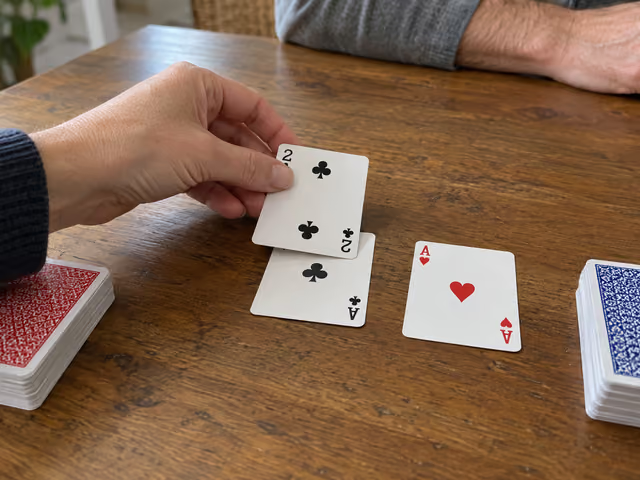
Before scoring a real deal, demonstrate a black 8 taking a red 7 in a work column, and a center ace of clubs taking the 2 of clubs. Show how three stock cards become a waste and why only its top card is available. Then run an unscored practice deal at a deliberate pace, answering questions before shuffling for the match. Avoid rushing someone through a rule they have not understood.
Two people play the same card: Bicycle gives the foundation position to the card placed first, normally the lower of the two. Return the later card to exactly where it came from. If nobody can distinguish which arrived first, Bicycle allows both cards to remain. Treat that as one duplicated rank in the foundation and continue with the next rank; both owners count their card at scoring. This exception is not permission to add duplicates deliberately. Do not grab a rival's hand or argue by pushing cards around.
A wrong rank, suit or early call: use this friendly house procedure. Pause all play. Restore an illegal card and any dependent moves to their known previous positions. If the prior state cannot be reconstructed by agreement, discard that deal's score, return cards, shuffle and replay. An incorrect Nertz call does not earn a bonus or end the deal: check the pile, explain the error and resume from the paused position. These remedies are house agreements, not Bicycle penalty rules.
Different familiar rules: confirm four single-card starting columns, thirteen Nertz cards, draw-three in the stated order, minus two per leftover and no caller bonus before starting. Do not quietly add a fifth column, move Nertz cards to the bottom during a block, or substitute Dutch Blitz cards. Named local traditions can be fun, but everyone needs to know which version is on the table.
Already know the game?
Ideas & Twists
Choose a variation together before you start.
Nertz · See main rules
Suggested house variationDraw one
Turn one stock card at a time instead of three. Keep the thirteen-card Nertz pile, four work columns, foundation rules and normal scoring. Stock recycling and the all-player block agreement still apply. This exposes every stock card on each pass and changes which moves are available; it is not Bicycle's main draw-three format.
Nertz · See main rules
Suggested house variationOne-deal match
Replace the running race to 100 with one scored deal. The deal still ends on a valid Nertz call or an agreed terminal block. Use the usual center points and remaining-pile deductions; the highest deal score wins, even if the caller scored less. Tied highest scores share the win. This limits the number of deals, not the number of minutes.
About this guide
Main mechanics follow Bicycle's published Nerts format, reviewed October 2, 2026; this is a standard-deck game, not a purchased proprietary edition. A 100-point target is its customary target, not a time promise. Shared match ties, synchronized block confirmation, illegal-move and mistaken-call remedies, practice coaching and fixed partner roles are explicitly authored house or hosting agreements. Pagat supports partnership play and draw-one/single-deal variants. Other first-person rules use different setups, stock shifts and bonuses; those are not merged into the main game. No monetary settlement is part of this guide.
Ready for something different?
Find another game →