

The quick version
Put on position bibs and check where each player may go. Toss for first centre pass or goal end. On the whistle, the Centre passes to someone landing wholly in the centre third. Catch, keep a legal landing foot and release within three seconds. Pass towards GS or GA for a one-goal shot inside the circle. Alternate centre passes after every goal, change ends each quarter and compare goals after four quarters. A level score is a draw.
Saved on this device only — clearing your browser's cache or site data removes them (no account backup).
Prepare the court and the group
This guide uses the World Netball 2024 rules for an outdoor social seven-a-side match, with simplified staffing rather than a full international event crew. Bring 18 people: two teams of seven, two nonplaying umpires who know the rules, one scorer and one timekeeper. The helpers stay off the playing court. Before inviting players, arrange how the group will respond to injury or illness and who will get assistance; staffing and care requirements of a booked venue or league also apply. There are no bench substitutes in this main format.
Book a level, firm netball court, 30.5 m long by 15.25 m wide, divided into three equal thirds. It needs a 0.9 m diameter centre circle and a 4.9 m radius goal semicircle at each end. Use secure, fully padded goalposts on the middle of each goal line, rings 3.05 m high, with open nets and no backboards. Check the posts, surface and clear run-off space; regulation surround is 3.05 m. Keep bags and drinks outside it. Use a size-5 netball inflated as its maker directs, not a basketball.
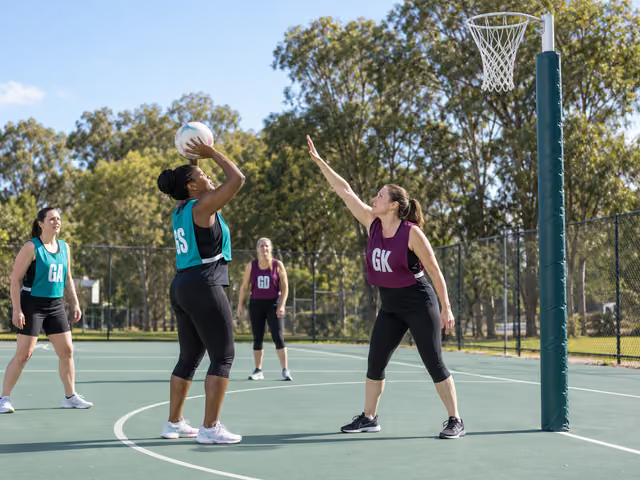
Give each team a contrasting set of GS, GA, WA, C, WD, GD and GK bibs, with letters visible front and back. Wear court-appropriate sports shoes, remove jewellery and piercings, keep nails short and smooth, and tie hair securely. Warm up with easy movement, passing and controlled landings. Let people choose suitable roles and explain the areas before starting.
The scorer records each team's goals and the next centre-pass team. The timekeeper has a stopwatch, stops it when the umpire holds time, and signals the end of each quarter to the umpires. A mechanical stopwatch works; a phone is optional. Plan four 15-minute playing quarters with four-minute breaks after quarters one and three and a 12-minute half-time. The standard eight-minute half-time alternative needs agreement from both teams and the organiser before play. End on a draw unless you choose the extra-time variation in advance.
Know the areas on your bib
Your attacking third is the end where your team shoots; your defending third is the other end. Everyone's attacking direction reverses when teams change ends. Restrictions apply even when you do not have the ball.
- GS — Goal Shooter: attacking third, including its goal circle.
- GA — Goal Attack: centre third and attacking third, including the attacking goal circle.
- WA — Wing Attack: centre third and attacking third, excluding the goal circle.
- C — Centre: all three thirds, excluding both goal circles.
- WD — Wing Defence: centre third and defending third, excluding the goal circle.
- GD — Goal Defence: centre third and defending third, including the defending goal circle.
- GK — Goal Keeper: defending third, including its goal circle.
WA helps feed the shooters from outside the circle; WD tries to disrupt that feed and helps move the ball back towards attack. GS and GA are the only shooters. Stepping onto a dividing line is permitted from an allowed area, but stepping over it into a forbidden area is offside. A player can reach for a ball across that line if no part of their body touches the ground in the forbidden area.
Start, pass and score
Choose the first pass and direction
Each team names a captain. Toss a coin: the winner chooses either the first centre pass or which goal to attack; the other captain chooses the remaining option. Tell the umpires and scorer. Before the starting whistle, the Centre with the ball has at least one foot wholly inside the centre circle. The opposing Centre is in the centre third; everyone else waits in a legal goal third.
Make the centre pass
At the whistle, the other players may enter the centre third if their position permits. The Centre releases within three seconds, observing footwork. The first pass must be touched or caught by someone standing wholly in the centre third, or landing with the first foot or both feet wholly there. It can be intercepted. Do not pass directly to someone grounded in a goal third. Run one unscored rehearsal of this start before beginning the match.
Move without dribbling
When you do not have the ball, run to an open passing space within your areas. Once you catch it, pass or shoot within three seconds. Do not dribble, hand the ball to a teammate, kick it, punch it or roll a pass along the floor. Leave enough room between passer and receiver for an opponent to deflect or intercept. The ball must be caught or touched in every third it travels through: no direct throw from one goal third across the entire centre third into the other.
Keep your landing foot
If you catch with one foot grounded, or land on one foot first, that is your landing foot. Step or pivot with the other foot; you can lift the landing foot, but release before it touches down again. If you catch with both feet grounded or land on both together, moving one foot makes the other your landing foot. Do not slide, drag or hop on it. A jump shot is legal if the shot comes from inside the goal circle and you release before the footwork rule is broken.
Take a shot or keep passing
GS or GA shoots from inside the attacking goal circle, including its line, with no ground contact outside it. A ball passing above and completely down through the ring scores one goal. Every goal is worth one, wherever in the circle it was shot. A miss stays live: eligible players can rebound, and the shooter can catch a ball that has rebounded from the goalpost. A pass or shot you released cannot otherwise be touched by you again until another player touches it or it rebounds from the goalpost.
Restart after a goal or turnover
The scorer adds the goal. Both teams reset for the next centre pass, which alternates between teams after every goal regardless of the scoring team. After an interception, possession changes immediately and play continues towards the new team's goal. After an infringement or out-of-court ball, use the restart below rather than a centre pass.
Have a receiver move into clear space and face the passer, rather than standing behind a defender. The passer looks for a teammate in a permitted area; one controlled pass is more useful than a rushed long throw. Practise catch, identify landing foot, pivot and pass before adding defenders.
Defend fairly and use the right restart
To defend a player holding the ball, establish at least 0.9 m between the nearest part of their landing foot and your nearer grounded foot before attempting to block or intercept. If they lift that landing foot, its former position remains the reference point; adjust when a pivot changes the nearest part of the grounded landing foot. A player can stand closer without trying to defend or interfering with the pass, so three feet is not a blanket separation rule for everyone. You can mark a player without the ball more closely, but cannot spread your arms to stop their movement. Do not push, grab, lean on players, slap a ball held in their hands or move into an airborne player's landing space. Incidental contact that does not interfere with play can be a fair contest.
- Free pass: for footwork, held ball, offside, illegal ball handling and passing infringements. The umpire indicates the spot; any opponent allowed in that area takes it. Offside is restarted where the player entered; a short pass is restarted where the teammate received it; over-a-third is restarted by the transverse line where the ball first entered incorrectly. You cannot shoot directly from a free pass, even inside the circle. No opponent has to stand beside the taker.
- Penalty pass: for contact or obstruction. Normally take it where the offender was standing, or where the affected player stood if the first spot would disadvantage their team. The offender moves promptly beside but away from the taker and stays silent and out of play until release. GS or GA taking it inside the attacking circle can pass or shoot. The correctly positioned taker may choose to release before the offender has finished standing out; the offender must still refrain from participating until release.
- Throw-in: if the ball touches ground outside the court, or someone grounded outside touches it, the team that did not touch it last on court gets the ball. Stand outside at the indicated exit point, with at least one foot within 15 cm of the line; that is the landing foot. Release within three seconds, observing footwork, before stepping on the court. A goal-line throw-in enters that goal third; a side-line throw-in enters the nearest or adjacent third. The taker must be allowed to return onto court at that point. Boundary lines are in.
- Simultaneous infringement: use the umpire's possession award to the team that had the ball immediately before it, at the place the ball was when play stopped. There is no toss-up under these rules. An eligible GS or GA awarded possession inside the attacking circle may shoot.
After a whistle, the umpire identifies the team, spot and restart. Put a foot at that spot, respect footwork and release within three seconds once set. Players in allowed areas remain available for a pass. The umpires may allow advantage when stopping would disadvantage the team that was fouled. Let their call decide whether to stop; do not invent an extra turnover during continued play.
Change ends and finish the match
Change ends after every quarter. Keep the score and continue the centre-pass sequence across quarters; do not toss again or automatically give the new quarter to the other team. If the previous quarter ended before a centre pass was taken, that same team still has it. The scorer and umpires check the sequence before restarting.
At the end of quarter four, the team with more goals wins; equal goals are a draw. If a legal shot left GS or GA's hands before the umpire's ending whistle, it can still count if it goes in. A penalty pass already awarded in the attacking goal circle before the timekeeper's ending signal is completed after the ending whistle, including further infringements at that penalty. Defenders cannot move the goalpost to interfere with a shot or deflect a shot travelling down towards the ring. Resolve any resulting penalty before agreeing the final score.
At an interval, players may swap positions within their team: exchange bibs and tell the umpires before restarting. The 2024 rules also allow prompt tactical changes just after a goal when an on-court player requests a hold for that purpose. Keep time stopped during that change and preserve the next centre pass. These are position changes for the same seven players here, not rolling substitutes. If a player is injured, stop time, get help and resume only when safe; use the existing throw-in or sanction if one was due, otherwise possession goes to the team last holding the ball, at the stopped location. A team must still have its Centre and at least five players to continue. If it cannot, the umpires award the match to the other team; an emergency can instead end the whole social session without further play.
Make a first match easier to follow
Walk everyone through their allowed areas and one centre pass. Point out the two shooters and show the difference between a free pass and a penalty pass. Ask the scorer to say the next centre-pass team after each goal; record it before play resumes. This prevents a common disagreement when one team scores several goals in a row.
Keep calls short and explain unfamiliar terms at the next break. Captains can ask an umpire to clarify a ruling during an interval; debating while the ball is live makes the next passage harder to follow. If the scorer and umpires disagree about a centre pass, check the written sequence before taking it. Do not settle it by whichever player argues loudest.
Give developing players a clear passing option and a chance to try a different bib between quarters. A defender can help by closing a passing lane even without making an interception; a wing player can be useful without shooting. Netball involves running, jumps, quick stops and contested catches. Ask about participation needs when arranging the game, and choose the venue and roles together.
For unfair or repeated infringements, umpires can advance a sanction, escalate it to a penalty pass and warn the player. Continued foul play can lead to suspension; dangerous play requires suspension or immediate ordering off for a serious intentional or highly reckless act. A suspension lasts two minutes of playing time from the restart, with no replacement; the player waits off court under a helper's supervision and returns at the next break after the timekeeper confirms completion. If C is suspended, another teammate takes that bib temporarily. An ordered-off player cannot return to the match. This roster has no substitute, so that team remains short and keeps a Centre; stop if fewer than five can play. The official four-minute replacement option needs a registered bench substitute, which this main format does not have.
Already know the game?
Ideas & Twists
Choose a variation together before you start.
Netball · See main rules
House schedule using the permitted shorter-quarter optionShorter social match
Before the coin toss, agree to four eight-minute playing quarters, with two-minute breaks after quarters one and three and five minutes at half-time. Stop the clock for the same holds, change ends each quarter, and preserve centre-pass alternation. All scoring, positions, penalties and ending-shot rules stay the same. Compare total goals after quarter four; a tie remains a draw. This is a shorter match, not a promise of its total elapsed time.
Netball · See main rules
House practice format; not FAST5Five-a-side practice
For 14 people, put five players on each team plus the same four nonplaying helpers. Each team uses GS, GA, C, GD and GK; leave WA and WD bibs out. Keep the full court, each remaining position's standard areas, three-second hold, landing-foot rules, one-goal shots only from inside the circle, and alternating centre passes. Play four eight-minute quarters with two-minute quarter breaks and five-minute half-time; switch ends every quarter. Keep a Centre on each team. Because each starts with only five, stop the practice if either loses a player; do not continue with four. Compare goals after quarter four, with a draw if level. There are no FAST5 long-range points, power plays or altered centre-pass rules.
Netball · See main rules
Official extra-time option, selected before playExtra-time decider
Agree before starting that a full-time draw needs a winner, with two five-minute extra-time halves. After the fourth quarter, take a four-minute interval; play the first half, take a one-minute interval and change ends for the second. Keep the running score and next centre-pass entitlement through both halves. Apply the usual clock holds and ending-shot or outstanding-penalty rules. If one team leads after both halves, it wins. If still level, continue immediately with the same directions and centre-pass sequence until a team leads by two goals; the first such lead ends the match. Do not substitute sudden death at one goal.
About this guide
The main on-court mechanics follow World Netball's 2024 seven-a-side rules. This guide chooses an outdoor court, 14 players without substitutes and four nonplaying helpers; that social staffing plan is a host adaptation, not the full international event specification. The unscored rehearsal and host advice are suggestions. Shorter scheduling and the five-a-side practice use the explicit house terms above. The five-minute extra-time halves use the official option. Domestic league staffing, mixed-team restrictions and competition variations require their organiser's rules; FAST5 and enclosed indoor-netball rules are separate formats.
Ready for something different?
Find another game →