

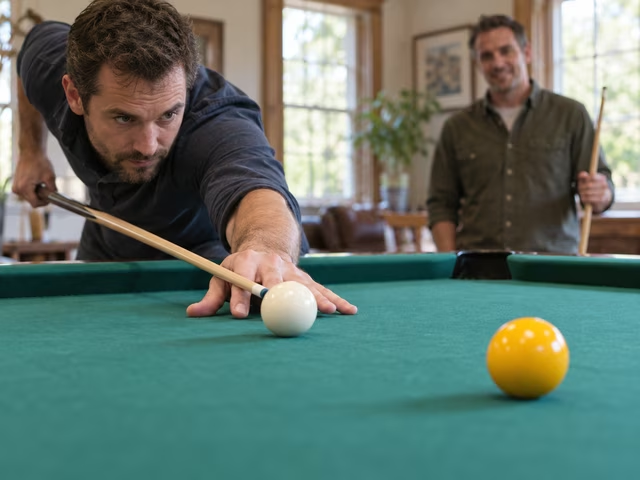
The quick version
Rack 1–9 in a diamond and break from behind the head string. On every ordinary shot, hit the lowest remaining ball first, then pocket a ball or send any ball to a cushion. A legal pot continues your visit; a legal 9 wins the rack. Fouls give the opponent cue-ball in hand. Play the explicit social rules below and alternate breaks until someone wins three racks.
Saved on this device only — clearing your browser's cache or site data removes them (no account backup).
Agree the rack and the social rules
Use only balls 1–9. Make a tight diamond with the 1 at its forward point and the 9 in the middle. Following current WPA positioning, put the 9 on the foot spot, the marked point at the racking end. Place the remaining balls without a deliberate pattern. Identify the head string across the second diamonds at the opposite end.
Toss for the first break and alternate breakers each rack. This introduction keeps lowest-ball contact, legal early 9s and ball-in-hand fouls, but deliberately omits the tournament three-ball break requirement, push-outs and three-foul loss. Announce these house simplifications before play. You do not have to call pockets.
Find the lowest number before every shot
Make the break
Place the white behind the head string and strike the 1 first. Pocket an object ball or drive at least four object balls to cushions. A legal pot keeps your visit; a legal dry break passes the turn. An illegal break is a foul: leave object balls as settled and give the opponent ball in hand anywhere. A legal 9 on the break wins.
Take a scoring or safety shot
From where the white lies, contact the lowest-numbered ball first. After that contact, some ball must enter a pocket or touch a cushion. You may use the lowest ball to knock another ball, including the 9, into a pocket. Any legal pot keeps your visit; a legal shot without a pot hands over the layout.
Recognize the foul
A scratch, wrong first contact, no pocket or cushion after contact, a ball driven off, improper ball touching, a push or double hit, shooting while balls move, or no foot on the floor is a foul. End the visit and let the opponent position the white anywhere on the cloth. Do not subtract rack wins.
Re-spot only the 9
If the 9 falls on a foul or leaves the table, put it back on the foot spot. If occupied, put it as close behind that spot on the long centerline as possible without touching another ball. Other object balls pocketed or knocked off stay out. A 9 with a scratch does not win the rack.
Record a legal 9
The shooter wins when the 9 is legally potted. Record one rack win, restore all nine object balls and change the breaker. If both players agree the layout is stalemated, re-rack with the same breaker and no rack win.
Win three racks
First to three rack wins takes the match; a single rack cannot end drawn. A shot hitting the 2 first and caroming the 9 into a pocket wins if 2 was the lowest remaining ball and the shot was otherwise legal. Hitting the 9 first while 2 remains is a foul, even if the 9 drops.
Help the first game run smoothly
Ask the venue helper to explain a ball frozen against a cushion and to watch a close hit before the stroke. Keep room for cues and use the rest for difficult reaches. League sources show an established amateur nine-ball community, but scoring systems differ: some leagues count individual balls, so this rack-win house match must be named clearly when inviting friends.
Already know the game?
Ideas & Twists
Choose a variation together before you start.
Nine-ball pool · See main rules
Suggested house variationCall the winning pocket
Keep normal play but require a named pocket for the 9 before the stroke. If the 9 falls legally in another pocket, re-spot it and end the visit; leave the white where it rests. A 9 on the break is re-spotted and the breaker continues if another ball was legally potted. First to three racks still wins. Early combinations remain possible, but the finish must be planned.
Nine-ball pool · See main rules
Suggested house variationNine goes last
The 9 wins only when it is the sole object ball remaining. If potted earlier on a legal shot, re-spot it and continue the visit; on a foul, re-spot it and give ball in hand. Keep lowest-number contact and first to three racks. This removes shortcut wins and makes the route through every ball matter.
Nine-ball pool · See main rules
Suggested house variationAlternate-shot partners
Four people form two teams. Partners alternate every shot, including continuing visits, and keep that order after a miss or foul. Alternate breaking teams each rack and breaking partners within a team. One team wins a rack with a legal 9; first team to three wins. Discuss position before the active shooter settles into the shot.
Nine-ball pool · See main rules
Suggested house variationOne banked finish
Call the 9's pocket and require the 9 itself to touch at least one cushion after the first legal object-ball contact and before entering that pocket. Other balls use ordinary rules. A legally potted 9 that misses either condition is re-spotted and ends the visit. Fouls still give ball in hand. First to two racks wins; this is a house bank finish, not standard nine-ball.
About this guide
Current WPA rules supply the rotation identity and foul principles. The omission of push-outs, three-ball break and three-foul loss, along with the match structure and variations, are explicit house choices. Do not silently substitute older one-on-the-spot racking for the stated current-WPA nine-on-the-spot layout.
Ready for something different?
Find another game →