

The quick version
Book nine holes, agree the tee set and write each hole's cap at twice par. Each person plays their own ball, counting strokes and penalties. Play safely when ready, putt out or pick up and record the cap. After all nine holes, add the nine capped scores; the lowest total wins, with tied totals shared.
Saved on this device only — clearing your browser's cache or site data removes them (no account backup).
Book the round and make the scorecard
Reserve a nine-hole tee time and confirm the exact starting hole and nine-hole sequence with the course. It may be a dedicated nine-hole course or an approved half of an eighteen-hole course; do not assume you can start at hole 10. Ask about check-in time, fees, rental clubs, dress requirements, walking or cart rules, the expected pace and any course restrictions. These are venue decisions, not guaranteed inclusions. Keep this guide to one course-approved group of two, three or four; a larger party needs separate bookings and groups.
Choose a tee set everyone can manage, preferably the same set for a direct gross-score comparison. Ask staff about forward tees and shorter courses. If friends use different tees, record each person's tees and pars and enjoy individual totals; this guide does not supply a handicap adjustment to make those totals equivalent. Decide whether everyone wants a contest before starting. Choose the personal-round twist if comparison would discourage someone.
Each player needs their own suitable clubs, including a putter, and clearly distinguishable balls with spare balls, tees and a small ball-marker. Carry at most 14 clubs under the Rules of Golf; a full 14-club set or a driver is not required. An iron, wedge and putter can serve a shorter course if their distances suit it. Confirm any rental contents. Take one paper scorecard for the group and a pencil, plus clothing, water and sun or weather protection suited to the venue. A cart, phone, rangefinder and scoring app are optional; a cart does not make every course or swing accessible.
Write all names, tees and the nine hole numbers. Beside each printed par write its maximum score: par 3 caps at 6, par 4 at 8 and par 5 at 10. This is the group's chosen limit within the published Maximum Score format, not ordinary unlimited stroke play or the handicap system's net-double-bogey adjustment. Use gross scores: no handicap strokes, free replays or conceded short putts. Agree a starting order and the shared-tie finish.
From the first tee to the cup
Start one ball each
Find the correct tee markers and hole direction. Wait until the group ahead is safely beyond the reach of a shot, including a mishit. The first player puts their marked ball on a tee or the ground between the markers, no farther than two club-lengths behind their front line, and makes a stroke toward the hole. Everyone else stays clear of the swing. Each player starts their own ball; do not all move to the best drive.
Keep counting and keep your lie
Count every intentional attempt to strike the ball, including a complete miss, and add applicable penalty strokes. A practice swing that does not hit the ball is not a stroke. After the tee shot, play your own identified ball where it rests unless a Rule permits relief; do not tee it up again, kick it out of rough or improve the grass behind it. Say your count when it helps: after two strokes and one penalty, your next stroke is your fourth.
Move safely through the hole
Normally the ball farthest from the hole is played first. In this stroke-play format, use ready golf when it is safe and considerate: someone ready may play out of order to save time. Do not hit over friends, advance in front of someone preparing a shot or distract a player. Prepare your club while others play. The lowest previous-hole gross score normally has the next tee's honour, but safe ready golf remains available. Ready golf is not simultaneous hitting.
Putt or take the cap
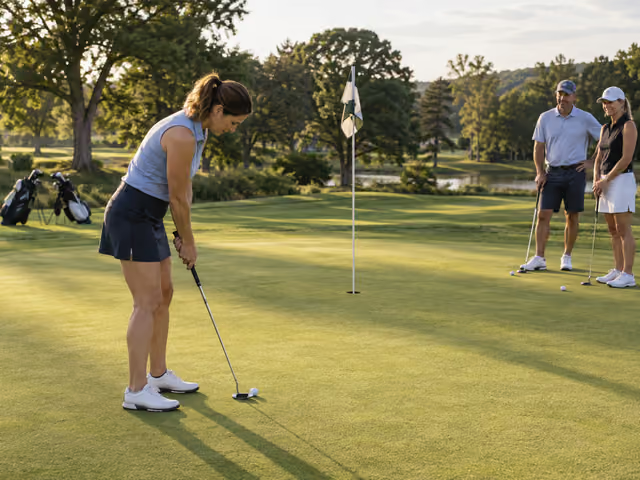
On the putting green, roll the ball toward the cup with a putter. Mark its spot before lifting it to clean it or clear another person's line, then replace it on that spot and remove the marker. Decide before putting whether to leave the flagstick in or have it removed. Short putts still count and must be played for a score below the cap. A ball resting near the cup is not automatically holed. Once your strokes plus penalties reach the hole's cap, pick up; picking up earlier also scores the full cap.
Record and start the next hole
Leave the green promptly once everyone has finished or picked up. At the next tee, confirm each person's hole score and write it down. On a par 4, five strokes plus one penalty records 6; a pickup after five records 8. The cap includes penalties and cannot be exceeded. Play the remaining holes in the course's specified sequence. Each new hole resets the stroke count, not the accumulated total.
Lost balls, water and difficult lies
Lost or out of bounds: search for no more than three minutes from when you or your caddie starts searching. A lost ball outside a penalty area, or a ball wholly out of bounds, normally requires one penalty stroke and another ball played from the previous stroke's location. A tee shot out of bounds counts 1, the penalty counts 2 and the replacement tee shot is 3. There is no automatic free drop beside where it vanished. Before leaving the previous spot, announce and play a provisional if the original might be lost outside a penalty area or out of bounds. Abandon it if the original is found in bounds in time before the provisional becomes the ball in play; keep all provisional strokes out of the score in that case. If the original is lost or out of bounds, continue with the provisional including stroke-and-distance. If the provisional is played from nearer the hole than the estimated original location, it becomes the ball in play. A ball known to be only in a penalty area is not a reason to play a provisional.
Red or yellow penalty area: play a found ball as it lies if safe and permitted, or add one penalty stroke for relief. Both colours allow a replay from the previous spot or a drop back on the line running from the hole through the point where the ball last crossed the area's edge. Red also allows lateral relief within two club-lengths of that crossing point, outside the area and no nearer the hole. Yellow does not automatically allow that side drop. For back-on-line relief, drop on the line outside the area; the first ground contact creates a one-club-length relief area, restricted to that same course area and no nearer the hole than the crossing point. The ball must finish in that relief area. If the ball is missing, penalty-area relief needs knowledge or virtual certainty that it is there, not a guess.
Unplayable lie: outside a penalty area, you may add one penalty stroke and replay the previous shot. With an identified ball's location known, you may instead drop back on the hole-to-ball line or within two club-lengths of its spot, no nearer the hole. Back-on-line relief uses the same one-club-length area around first contact, no nearer than the original spot. In a bunker, the one-stroke lateral and back-on-line options must stay in that bunker; back-on-line outside the bunker costs two penalty strokes. When hitting safely is doubtful, take proper relief or pick up for the cap.
Free relief: a poor lie alone does not earn a free move. A ball on a paved cart path in the general area, or a path interfering with a reasonable stance or swing, can qualify. Find the nearest point in the general area giving complete relief, then drop within one club-length of it, no nearer the hole, obtaining complete relief and staying in the general area. This is the nearest point, not the nicest grass. Check marked ground under repair, no-play zones and other conditions against the actual course Rules; the procedure can differ in a bunker, on a green or in a penalty area.
For these drops, release the ball yourself from knee height, straight down without throwing or spinning it. It must first land and finish in the required relief area; if a correctly dropped ball rolls outside it, drop again, then place at the second drop's first-contact spot if it rolls out again. Use your longest club other than a putter to measure club-lengths. In a bunker, do not test the sand, touch it immediately behind or ahead of the ball with your club, or touch it during a practice swing or backswing. Rake your disturbance after leaving, as the course permits.
Add nine scores and finish together
After everyone finishes the ninth booked hole, move clear of play and confirm all nine entries. Add the capped gross scores: the lowest total wins this guide's contest. Tied totals share the result; there is no countback or extra-hole playoff. Return carts and rental gear as directed. To play again, arrange another approved booking rather than returning to an occupied tee.
If weather, a course closure or a player's withdrawal prevents the agreed round, stop safely and retain only completed-hole records. This guide's house convention declares the nine-hole contest unfinished, with no overall winner; do not fill unplayed holes with caps. A cap records a hole you started and picked up, not a hole you never played. Do not assume a score from this guide or its house twists is automatically eligible for handicap posting. Check the current local handicap authority and course rating requirements before submitting it.
Help friends enjoy the round and settle questions
Before teeing off, explain four things aloud: identify your ball, count attempts and penalties, wait for a safe shot and pick up at double par. Rehearse one score verbally: on a par 3, four shots plus a penalty is 5; picking up before holing records 6. Show where the next hole's tee is on the course map. A first-time player benefits from learning basic contact and swing clearance at a range or lesson before a busy course round. Ask before giving swing advice, and make room to notice a good shot rather than measuring every beginner against an experienced friend.
Keep pace with the group ahead and follow staff directions if a gap opens. Put bags or carts toward the route to the next tee, off the green and within venue rules. Repair pitch marks and divots as the course directs. Never play at people; shout 'Fore!' immediately if a ball is heading toward someone. Stop for lightning or the course's suspension signal and follow its shelter instructions. Running is not part of this format. Walking terrain, swing movement, noise and vehicle requirements still need an individual venue check.
Discuss relief before moving the ball, using the actual stakes, boundary and course Local Rules. A course may adopt a special lost-ball Local Rule; do not assume it exists. If a rule is uncertain, ask staff or consult the cited Rule before claiming a lower score. In this informal guide, a player who prefers to avoid a disputed continuation may pick up and record the cap. That is a Maximum Score pickup, not a made-up free drop. Record any agreed casual rule changes before starting and describe the resulting round honestly.
If someone hits a wrong ball, the ordinary stroke-play penalty is two strokes; those wrong-ball strokes do not count and the mistake must be corrected with the correct ball. Maximum Score's rule modifications give the hole's cap if this mistake is not corrected. Correct any teeing-area error or serious wrong-place error before continuing under the applicable Rule; do not treat a cap as permission to ignore safety or misconduct. This beginner guide covers routine situations, not every penalty or exception. Formal competitions use their Committee's terms, Rules and rulings.
Already know the game?
Ideas & Twists
Choose a variation together before you start.
Nine-hole golf · See main rules
House equipment restrictionThree-club round
Before starting, each player selects exactly three clubs, including their putter, and carries only those for the entire nine-hole round. No borrowing or swapping during play; choose the other two for the course's distances and lies. Keep individual balls, all relief rules, double-par caps and lowest-total shared-tie finish. Do not use this if the course's length or conditions make those choices unsuitable; choose a shorter course first. It changes club decisions and preparation, not the number of shots allowed.
Nine-hole golf · See main rules
House result changePersonal nine
Keep individual balls, counts, penalties and double-par caps, but remove the group winner. Before starting, each person may choose one observation to track on the paper card, such as holes completed below the cap or putts actually taken. Do not invent putts for a picked-up hole; mark that entry 'picked up'. After the ninth hole, total each person's own scores and let each name a shot or decision they want to repeat. Finish there, without ranking people or adding bonus points. This suits friends using different tees or experience levels; it is a personal record, not a handicap-adjusted contest.
About this guide
Uses the current 2023 Rules of Golf framework jointly issued by The R&A and USGA, reviewed October 2, 2026, plus the course's Local Rules. The nine-hole sequence, two-to-four hosting range, double-par limit, gross scoring and shared final ties are declared hosting terms. Scramble has published best-shot mechanics but the detailed placement and result terms here are house choices; three-club and personal rounds are house suggestions. This is outdoor course golf, not the playing-card game Golf, miniature golf, a simulator or a formal competition/handicap manual.
- The R&A · Rule 21.2, Maximum Score ↗
- The R&A · Rule 6, teeing and order of play ↗
- The R&A · Rule 18, lost balls and provisionals ↗
- The R&A · Rule 17, penalty areas ↗
- The R&A · Rule 14, marking and dropping ↗
- The R&A · Rule 19, unplayable ball ↗
- The R&A · Rule 16, abnormal course conditions ↗
- The R&A · Rules 4, equipment ↗
- The R&A · Rule 12, bunkers ↗
- The R&A · Rule 13, putting greens ↗
- The R&A · Committee Procedures 9C, scramble ↗
- The R&A · Rule 5, round, pace and suspension ↗
- The R&A · Clarification 22.3/3, stroke intent ↗
Ready for something different?
Find another game →