

The quick version
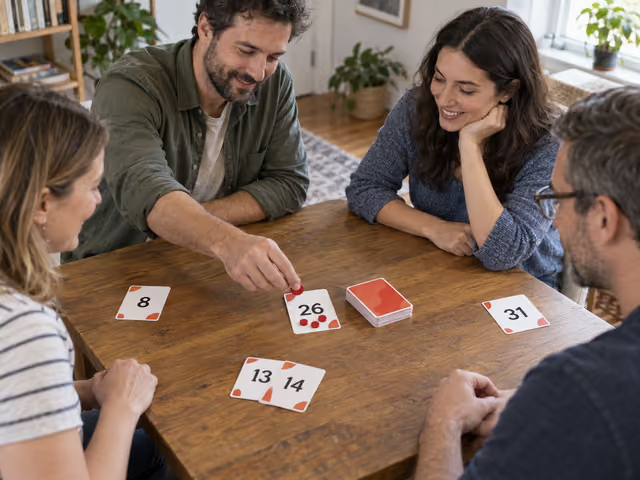
Shuffle the number cards and remove nine unseen, leaving 24. Give each player 11 counters for 3–5 players, nine for six, or seven for seven. Reveal one card. On your turn, pay one counter onto it and pass left, or take the card with all its counters. Taking means you reveal the next card and decide again. When the final card is taken, add your single cards and the lowest card of each gap-free run, then subtract your remaining counters. Lowest total wins; tied players share the win.
Saved on this device only — clearing your browser's cache or site data removes them (no account backup).
Leave nine cards unknown
This guide uses the base game in AMIGO's 2024 English rulebook, product 02455, Version 1.0. If your box contains special expansion cards, put all of them away. Use only the 33 number cards, one of each value from 3 through 35, and the 55 counters. The earlier 2018 AMIGO US edition, item 18414, has the same base turn and scoring mechanics but chooses the oldest player to start; here, use the 2024 starting rule below.
Seat 3–7 people around a table where everyone can reach the center and read each other's card values. Shuffle thoroughly, remove nine random cards face down without anyone looking, and put those nine aside until the game ends. Stack the other 24 face down in the center.
Deal 11 counters each with 3–5 players, nine each with six, or seven each with seven. Return the unused counters to the box; they do not replenish anyone during play. Conceal your personal supply in a hand or another agreed hiding place. Cards you collect remain face up, with every number readable.
The person who most recently said 'No thanks!' starts. If no one can identify that person, agree on a starter as a host suggestion. The starter turns over the top card beside the deck and makes the first take-or-refuse decision. There is never more than one unresolved face-up card in the center.
Take and go again, or pay and pass
Refuse
Place exactly one of your counters on the center card. Your turn ends and the player to your left decides on that same card. Refusing does not remove you from consideration: if it reaches you again, decide again and pay another counter if you refuse again.
Take
Move the center card into your face-up display and put every counter on it into your hidden supply. You may take a card immediately, even with no counters on it. Reveal the next card from the deck and decide on it yourself. You can keep taking cards; only paying to refuse passes the decision left.
If you have no counters
You must take the center card, including any counters on it. Use those collected counters normally on later decisions. There is no borrowing from the box or skipping your turn.
Keep runs visible
Arrange your own cards in numerical order. Two or more consecutive values form a run, even if you acquired them in a different order. Show every value; a gap splits the cards into separate scoring groups. Nobody can use a card in another player's display to connect a run.
Finish the last card
Keep deciding on the final revealed card until someone takes it and its counters. Then stop immediately. Do not reveal the nine set-aside cards for additional play or give anyone an extra turn.
As a spoken example: 'I take a 17 with three counters. The 17 goes in front of me; the three counters become mine. I reveal the next card and I decide again.' Then show that paying one counter is the action that passes play left. Start the real game with a fresh shuffled deck.
Count the start of each run
Add every isolated card plus only the lowest value in each uninterrupted run. Subtract one for every counter you still hold. A smaller final number is better; negative totals are allowed. The lowest total wins. If several people have that total, they share the victory.
For example, your cards are 8, 13, 14 and 16, and you hold five counters. The 13–14 run counts 13, while 8 and 16 are separate: 8 + 13 + 16 − 5 = 32. If you also collected 15, the 13–16 run would count only 13, giving 8 + 13 − 5 = 16. You cannot pretend a missing 15 completes the run.
With no collected cards, your card sum is zero: four counters give a score of −4. That beats a score of 0. For another game, return all 33 number cards and 55 counters, shuffle again, remove nine unseen cards again and deal a fresh starting supply.
Teach the choice, then let people choose
Keep the explanation focused on two actions and one scoring example. Counters help both now and at the finish: spending your last one can leave you unable to refuse an unwanted card. A card that extends a run upward adds no card points, but taking it immediately is still a choice; passing might attract more counters, or someone else might take it first. A missing connector may be among the nine unseen cards. Treat these as considerations, not a guaranteed winning method.
Before the first decision, agree that placing a counter or moving a card into your display commits the action. As a house suggestion for a teaching game, allow a correction only before the next player acts or a new card is revealed. Once new information appears, leave the action in place. If someone flips a new card after taking but starts handing the decision left, stop before anyone acts: the taker decides again.
Keep all number values visible and personal counter totals concealed. Only collect counters with an accepted card or pay one to refuse; the base rules provide no trading or gifting action. If someone's counters are accidentally exposed, this guide suggests continuing rather than redealing: that information cannot be unlearned, so remind everyone to conceal supplies afterward. This is a host remedy, not a printed penalty.
Give people room to make an imperfect choice; ask before offering strategy during their turn. This is an individual decision game with small objects and arithmetic. A seated setup is not a promise that every person can read, reach or conceal counters comfortably. Adjust the arrangement together before play; the open-counter house option below deliberately changes the information available.
Already know the game?
Ideas & Twists
Choose a variation together before you start.
No Thanks! · See main rules
House information variantOpen counters
Keep everyone's personal counters in visible piles throughout the game instead of concealing them. Anyone may ask for a count before deciding. Keep the usual 11/9/7 starting supplies, nine unseen removed cards, clockwise refusal, taker-goes-again turn order and lowest-score finish. This makes counter shortages public and changes the bluffing decisions; agree to it before dealing.
No Thanks! · See main rules
House planning variantKnown missing cards
After shuffling, remove nine random number cards face up in a separate shared row, rather than unseen. Leave their values visible throughout; they never enter play or anyone's score. The playing deck still has 24 cards. Counter supplies, hidden personal counters, turns and scoring stay unchanged. Everyone can now tell whether a hoped-for connector is definitely absent, while the remaining draw order stays unknown.
No Thanks! · See main rules
House match format · add paper and a penOne circuit of games
Play as many complete base games as there are players, keeping the same clockwise seats. Choose a first starter together; advance the starting seat one place left each game so everyone starts once, replacing the usual starter rule. Rebuild and reshuffle all 33 number cards, remove nine unseen and reset everyone's 11/9/7 counters between games. Record each game's actual score, including negative scores, on paper and add them after the last game. Lowest combined total wins; tied totals share the match win. Individual-game scoring is unchanged; do not stop a game early or carry counters forward.
About this guide
Main rules follow the 2024 AMIGO English base game, not its special-card expansion. The 2018 US rules independently confirm the take-and-reveal sequence, setup and scoring; their oldest-player starting rule is not used here. Scoring demonstrations are original examples. The three twists, commitment/take-back agreement and exposed-counter remedy are explicit house suggestions, not official expansion rules. Community reports inform the teach and host advice, not headcount expansion or a guaranteed strategy.
Ready for something different?
Find another game →