

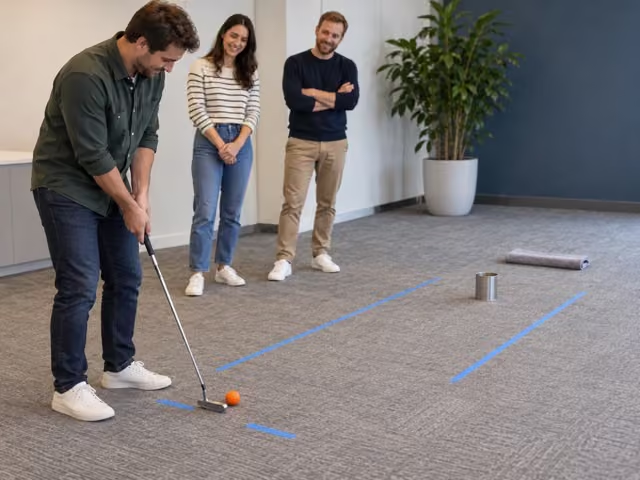
The quick version
Mark a start 1–2 metres from a target in a clear carpet lane. Use a soft practice ball. Agree capture in a floor-level putting cup, contact with an upright can or safe object, or a stop inside a flat target. Take one gentle putt each: 3 points for the agreed finish, 2 for stopping within 10 cm, 1 within 30 cm, otherwise zero. Measure the shortest gap between ball and target edges. Clear the ball before the next player. Highest total across complete rounds wins; ties share the win. Use 2 minutes to set up, 10 to play and 3 to finish and pack. Discard an unfinished round so everyone has equal turns.
Saved on this device only — clearing your browser's cache or site data removes them (no account backup).
Make one clear lane
Use a meeting room or another agreed space where play will not interrupt work. Clear a carpet lane roughly 1 metre wide, with the target 1–2 metres from the start and at least half a metre of clear run-out behind it. Put a folded towel across the far end to catch misses. Mark the start, sides and back boundary with flat, removable markers approved for that carpet; do not leave loose paper under people's feet. Shorten the lane if needed. A working aisle, doorway, fire route or occupied desk area is not a course.
Bring one shared putter and a soft foam or lightweight indoor practice ball that rolls on this carpet. An intact lightweight plastic putter is another option. Skip hard golf balls in the office. If a soft ball will not roll with a gentle stroke, change the ball or surface; do not hit harder. No clubs other than putters, raised swings, ramps, airborne shots or rebounds off furniture. Keep people, screens, glass, drinks and cables outside the lane and its possible miss paths.
Pick one target and its finish rule below. You also need paper and a pen, a ruler or tape measure, a clock or kitchen timer, and a towel backstop. No phone is required. Take one gentle unscored practice putt each and choose a distance everyone can use. Use the same ball, target and distance for scored rounds. Write names in a fixed order with a column for each round; a round means one completed turn per player. Extra balls, tubes and obstacles belong only to the twists that request them.
Agree what counts as a finish
- Putting cup: use a portable cup with a floor-level entrance that this ball can enter at low speed. A finish means the ball enters and stays in the cup's receiving area. Touching its rim or bouncing back out does not finish. An automatic return cup counts when the ball is visibly captured before the return mechanism moves it; agree that test in practice. Measure near misses to the nearest rim of the receiving opening, not the outside of a large base.
- Can or object target: use an empty upright can with a smooth, safely rolled rim, a soft block or an empty stable plastic container. The rolling ball must visibly touch the object before crossing a boundary. It need not stay touching: a legal touch still scores 3 if it rebounds away. Restore a shifted target before the next shot. Measure near misses to the object's nearest outside edge. Do not aim into an upright can's opening or use a cut-edged can, glass or a ceramic mug.
- Flat target: mark a 20 cm circle or square, or make it larger for an easier game. A finish means the ball stops with its center strictly inside the outline's inner edge. A center directly over the tape is outside; part of the ball may overhang. Measure near misses to that inner edge. Use this same center rule for landing boxes and circles in the twists unless they explicitly require the whole ball to be inside.
A cup finish and an object touch are different tests. Demonstrate the chosen one and keep it fixed for the match. These are house rules; touching a can is not holing out in golf. A real golf hole receives the ball below the putting surface. The office game needs neither a real hole nor regulation equipment.
Take a turn, then pass the putter
Start from the mark
Set the ball just behind the start line and check that everybody is behind or to the side of the lane. Aim the putter face toward the target and make a short, gentle pendulum stroke with the head close to the carpet. Each turn is one intentional attempt, including a swing that misses the ball. Lining up without trying to hit it is not an attempt.
Let the ball stop
There is no follow-up putt from where it lands in the base game. Wait until it stops before measuring, retrieving or passing the putter. Only one ball is in play at a time; nobody nudges or stops it for a better result.
Call the score
Score 3 for the agreed target finish. Otherwise measure the shortest floor-level gap between the nearest ball edge and the target edge defined above: up to and including 10 cm scores 2; more than 10 cm through 30 cm scores 1; farther away scores zero. A non-goal ball overlapping a flat outline has a gap of zero and scores 2. A ball that crosses a side or back boundary with any part, or touches the towel, scores zero even if it rolls back. A contact-target touch legally made before that exit still scores 3. A valid cup capture is final before an automatic return moves the ball; the return cannot cancel its 3 points.
Clear and rotate
When all movement stops, record the score, retrieve the ball and reset any moved target. The next player uses the same start. After everybody has played, the round is complete. Keep the layout fixed and repeat. Move the first player to the end of the order between rounds so people share the first look at the lane.
Finish fairly
At minute 12, stop starting shots; a ball already struck may finish rolling. If a round is unfinished, cross out that entire round for everybody. Add only complete-round scores: highest total wins. Equal totals share the win. Use the last three minutes to count and clear up, not for sudden death. If no full round was completed, call it practice rather than naming a winner.
Alex touches the can and rebounds 40 cm away: 3. Jo misses but stops 7 cm from it: 2. Sam stops 18 cm away: 1. Lee stops 35 cm away: zero. In cup mode, a rim hit that rolls away is a near miss, measured where the ball stops. Scores of 3, 1 and 2 across three rounds add to 6.
Fit the break and the people
Two to four coworkers: keep a personal score and share the putter. Five to eight: use the same rules, one shared ball and one lane; have the next person ready behind the start while a volunteer records scores. Expect fewer complete rounds, rather than rushing. More than eight should split into separate break sessions, not simultaneous shots across the room.
Solo: take one shot per round, record the total and target finishes, and compare a later attempt only if target, distance, ball and number of shots match. Pairs: the team twists give 4, 6 or 8 people a shared challenge. With an odd group, individual scoring or the all-team Office par format keeps turns equal.
Seated or rolling option: position a stable chair or a person's mobility aid at an accessible start with a comfortable view and reach. Keep exits clear. Use a putter from that position if comfortable, or agree a gentle underarm roll released at carpet level. Choose the method and a reachable starting distance before the match, keep them consistent for that player, and use a larger target or cooperative scoring if helpful. A helper can retrieve and place a stopped ball at the player's direction after the lane is clear. This is an adaptation to agree together, not a guarantee that the activity meets every access need.
Timebox: minute 0–2 is setup and practice; minute 2–12 is scored play; minute 12–15 is counting and clearing up. Check the clock between turns. If setup takes longer, shorten play, not cleanup. For a shorter break, use one complete round only and stop at your agreed cleanup time. Nobody needs to run, hurry a stroke or finish every twist today.
Handle misses and interruptions
Keep waiting players behind the ball and outside the club's movement. Retrieve only after the ball stops and the putter is down. Pause immediately if anyone enters the area. If an uninvolved person, accidental nudge or target failure interrupts a shot, restore the setup and replay it without counting it. Keep the original stop time; an interruption does not extend the break. If the lane cannot stay clear, pack up.
Measure only close calls, before lifting the ball. If nobody can tell whether a target was touched, replay that shot from its previous spot. A nearest-distance tie stays a tie if the available ruler cannot distinguish it. For twists that continue from a resting lie, allow up to one putter-head width of sideways or backward relief, never nearer the target or beyond an obstacle. No extra stroke is added. If the ball still cannot be played gently, end that attempt at zero. Mark positions before retrieving whenever several balls are involved.
For beginners, show the small stroke once and let the carpet determine the pace. Try a shorter backswing before adding force. Carpet grain, seams and soft balls make this a game on this surface; a good office score does not establish performance on a golf green.
Pick one twist for the break. You can try another after completing a round if everyone wants to, but the 30 options are a menu, not a checklist. Each twist's scoring overrides the main game; otherwise keep the target definitions, clear lane, gentle pace and minute-12 stop. Complete a whole round or end before comparing totals. Highest total wins and tied leaders share unless a twist specifies another result. Landing-zone boundaries use the ball-center rule above unless stated otherwise. Any prior lane exit makes that ball ineligible; replace or remove it only as that twist directs. All additional balls must be soft. Never bank off people, walls, furniture or electronics.
Already know the game?
Ideas & Twists
Choose a variation together before you start.
Office carpet putting · See main rules
Course · two soft markersGatekeeper
Putt through a 20 cm gate halfway to the target, then score the usual 0–3 points. Use two low soft blocks, with the gap measured between their inner edges. On the ball's first forward crossing of the gate line, the whole ball must pass through the opening without touching either block. Going around, clipping a block or stopping short scores zero, even if the ball later reaches the target. Clear the ball and reset the gate between players. Everyone gets one shot per round; highest total after complete rounds wins. Widen the gate before play if the ball needs more room.
Office carpet putting · See main rules
Course · one gentle reboundBook bank
Lay a closed paperback flat and secure it so an exposed edge forms an angled bank before the target. Test a gentle deflection first; use a foam-faced block instead if the book shifts or the edge is unsuitable. The ball must touch the agreed bank before touching the contact target, entering the cup or first crossing into a flat target's outline. Then use normal 0–3 scoring. A direct shot that misses the bank scores zero. A second bank contact or lane exit also scores zero. One attempt per player per round, resetting the bank each time. Highest total wins. Shorten a difficult route rather than striking harder; office furniture is never the bank.
Office carpet putting · See main rules
Course · wide cardboard tunnelTube run
Secure a short, wide cardboard tube flat on the carpet between the tee and target. Its smooth entrance must let this ball roll through gently; test it before scoring. Take one shot each. The ball must enter the near opening and come completely out of the far opening before normal 0–3 target scoring becomes available. A ball that skirts the tube, stops inside or comes back out of the entrance scores zero. Retrieve a stuck ball only after movement stops, then restore the tube before the next player. Highest total after complete rounds wins. Do not raise the tube into a ramp or blow through it.
Office carpet putting · See main rules
Course · two-stroke doglegCorner office
Lay a secured flat book as an obstacle and mark a 25 cm turning square beside it, with a contact target beyond the corner. On stroke one, stop the ball's center inside the square for 1 point. If successful, take one more stroke from that lie: a target touch adds 3, for a maximum of 4. A failed first stroke ends the turn at zero; a failed second keeps the first point. Crossing the book or any lane boundary makes that stroke a failure. No proximity points apply. Reset after each player's two-stroke turn; highest total after complete rounds wins.
Office carpet putting · See main rules
Course · choose the riskSafe or spicy
Place a large contact target nearer the tee and a smaller target farther away, both within a gentle shot's reach. Mark their positions and agree the finish test for each. Before the shot, call near for 1 point or far for 3. Only the called target counts, and it must be the first target touched; touching the other target first makes the shot zero. Misses earn no proximity points. Take one shot per player per round and reset targets between shots. Highest total after complete rounds wins. Keep the far target inside the same contained lane rather than extending play into an aisle.
Office carpet putting · See main rules
Touch · stop in the rectangleSpeed trap
Replace the usual target with a flat 30-by-40 cm rectangle, its longer dimension along the lane. Each person gets one tee shot. Stop with the ball's center inside the rectangle for 3 points; any other finish scores zero. If any part of the ball passes the rectangle's far edge, the shot is zero even if it returns inside. A center directly over the tape does not count. Remove each ball after scoring. Highest total over complete rounds wins. If it is too easy, move the tee back a little between full rounds only, keeping the setup reachable with the same gentle pace.
Office carpet putting · See main rules
Touch · three landing boxesDistance ladder
Mark three equal landing boxes at short, middle and long distances, all before the backstop. Each player takes three separate tee shots, aiming first at short, then middle, then long. Score 1 for each ball whose center stops inside its assigned box, plus a 2-point bonus for all three: maximum 5. A line-center finish or stop in a different box scores zero for that shot; still attempt the next box. Remove every ball before the next attempt, so earlier balls cannot help. Add the three results after the turn. Highest total after everybody has had the same number of full turns wins.
Office carpet putting · See main rules
Touch · closest without crossingCliff edge
Remove the target and mark a finish line across the lane. Everyone takes one tee shot, trying to stop as close to the line as possible without any part of the ball touching or crossing it, even briefly. Mark each legal ball's nearest point to the line, then lift it so later shots cannot change it. After everyone has played, the smallest gap earns 3 points; indistinguishable nearest distances each earn 3. An illegal or out-of-bounds ball cannot score. If every shot is illegal, the round is scoreless. Clear marks and rotate the first player for the next round. Highest total wins.
Office carpet putting · See main rules
Touch · close but no contactOrbit the can
Keep an upright contact target, but aim for the surrounding space. One shot scores 2 if it never touches the can and finishes with the nearest ball edge at least 10 cm and at most 30 cm from the can's outside edge. Exactly 10 or 30 cm counts. A touch at any point, a closer or farther finish, or a boundary exit scores zero. There are no 3-point finishes in this twist. Measure uncertain gaps before lifting the ball; reset the can if it moves. Play equal one-shot turns and compare totals after complete rounds.
Office carpet putting · See main rules
Touch · copy a stopping pointMatch that putt
Remove the usual target. A different volunteer makes an unscored model putt each round. Mark the ball's center with a small flat dot and remove it. Everyone, including the model player, now takes one separate tee shot to stop nearest that dot. Mark each result and remove the ball. Measure from the dot to the nearest edge of each ball; covering the dot is distance zero. Nearest earns 3 points; each tied nearest player earns 3. If the model shot leaves the lane, use a fixed middle dot instead. Highest total wins after complete rounds. Rotate the demonstrator so the extra practice is shared.
Office carpet putting · See main rules
Ball interaction · two teamsCarpet curling
For 2, 4, 6 or 8 people, make two equal teams and use one distinguishable soft ball per person. Put a center dot inside a flat circle of 30 cm radius, with room for misses. Teams alternate shots until everyone has putted once from the tee, leaving balls in play; gentle collisions are allowed. After all balls stop, eligible balls have their centers strictly inside the circle and have never left the lane. Measure dot to nearest ball edge. The closer team scores 1 for each eligible ball strictly nearer than the opponent's nearest eligible ball; if the opponent has none, count all yours. Equal closest distances score zero for the end. Clear balls, swap starting teams and rotate each team's order. Highest total after complete ends wins.
Office carpet putting · See main rules
Ball interaction · score the other ballCannon shot
Set a neutral soft ball 50 cm before the target and mark its start. Each player strikes a different soft shooting ball from the tee, trying to send the neutral ball into the target. Only the neutral ball scores: 3 for the agreed goal, 1 for a legal stop within 30 cm, otherwise zero. The shooting ball touching the target earns nothing. It must directly strike the neutral ball; no contact means zero. A neutral ball that leaves the lane cannot earn proximity points or a later goal. Reset both balls and target after every attempt. Highest total after equal one-shot rounds wins.
Office carpet putting · See main rules
Ball interaction · contact bothDouble carom
Place two stationary soft balls well apart inside the lane and mark their spots. Remove the usual target. With one gentle tee shot, try to make your shooting ball directly touch both stationary balls: 3 points for both, 1 for exactly one, zero for neither. A stationary ball hitting the other does not count as your second contact. Observe the sequence, then wait for all movement to stop. Any lane exit by any ball makes the shot zero. Reset all three balls between players. Highest total after complete rounds wins. Test the spacing with low speed; if two contacts require force, bring the balls closer.
Office carpet putting · See main rules
Ball interaction · move three ballsClear the circle
Place three neutral soft balls inside a flat circle 50 cm across and mark their starts. Remove the usual target. Each player has one tee shot with a fourth soft ball, trying to nudge neutral balls out of the small circle. Score 1 per neutral ball that finishes wholly outside the circle's outer tape edge while staying inside the larger lane. A ball touching the circle tape is not out. The shooting ball never scores. Any lane exit makes that exiting ball ineligible, and a shooting-ball exit makes the whole shot zero. Reset all four balls between players; highest total after complete rounds wins. Use gentle collisions only.
Office carpet putting · See main rules
Ball interaction · split the resultStop and send
Put a neutral soft ball 15 cm before a flat line across the lane, with clear run-out after it. Strike a second soft ball from the tee. Score 3 if the neutral ball finishes wholly beyond the line's far edge while your shooting ball finishes wholly before its near edge. Score 1 if the neutral ball finishes wholly beyond but the shooting ball does not finish before; otherwise zero. A ball touching the tape fails its side test. If either ball exits the lane, score zero. Reset both starts after each player. Highest total after complete rounds wins. This is a soft transfer of motion, not a power shot.
Office carpet putting · See main rules
Tactics · predict the resultCall your score
Before your one tee shot, call 1, 2 or 3 using the base game's scoring bands. Earn that many points only if the actual result exactly matches your call. Calling 2 and making the target for a base score of 3 earns zero in this twist; so does calling 3 and stopping close. There is no zero call. Keep the target and measured bands fixed for the whole match, and remove each ball after scoring. Highest total after complete rounds wins. Make the prediction before placing the putter behind the ball; it cannot change once the attempt begins.
Office carpet putting · See main rules
Tactics · a second-shot decisionKeep it or risk it
Take one normal tee shot and note its 0–3 score. With zero, the turn ends. With 1, 2 or 3, choose to keep that score or take one new shot from the tee. If the second shot's base score matches or exceeds the first, earn double the first score. If it is lower, the whole turn scores zero. For example, risking a first score of 2 earns 4 if the next result is 2 or 3, and zero if it is 0 or 1. Remove the first ball before retrying. Highest total after equal full turns wins.
Office carpet putting · See main rules
Tactics · one replacement tokenLast mulligan
Give every player one paper replacement token for the whole break. Play normal one-shot rounds. After seeing a shot's score but before the next player starts, you may spend your token, erase that score and take a replacement from the same tee. The new score must replace the old one, even if worse. Remove the first ball and reset the target before retrying. A token cannot be used on somebody else's turn or after the cutoff, and an unused token earns no bonus. Highest total over complete rounds wins. If the final incomplete round is discarded, discard its scores and any token use within it together.
Office carpet putting · See main rules
Tactics · choose the next-nearest ballSecond place wins
Use a flat center dot and leave balls in play so gentle collisions can change positions. With 3–8 people, each person putts one distinguishable soft ball; with two, alternate two balls per person. Remove any ball that leaves the lane. After all shots, measure dot-to-nearest-edge distances. Skip every ball tied at the closest distance; the next distinct distance is second place, and each owner at that distance earns 3 points, at most once per owner. If fewer than two distinct legal distances remain, nobody scores. Clear balls and rotate the starter. Highest total after complete ends wins. Agree this tie rule before the first shot.
Office carpet putting · See main rules
Tactics · bid a harder startDistance auction
For 2–6 players, mark three tee distances that all work with a gentle putt. Starting with a rotating opener, players in turn either pass for this round or bid a farther unused tee; the first bid may choose any tee. Passing removes you from that round's bidding. When every other player has passed, the last bidder gets one shot: an agreed target finish earns 3; a miss gives each other player 1. No proximity points apply. If everybody passes before a bid, the round is scoreless. Each bid must increase distance, so bidding is finite. Compare totals after equal numbers of opening turns; disregard an incomplete cycle.
Office carpet putting · See main rules
Team · finish in three strokesAlternate-shot team
For 4, 6 or 8 players, make pairs. A pair plays one shared ball, alternating strokes from its resting place. A goal on stroke one scores 3, on stroke two scores 2, on stroke three scores 1; unfinished scores zero. There are no proximity points. If the ball leaves the lane, that stroke is used and any remaining stroke starts back at the tee; an earlier valid contact-target goal already ended the turn. Stop as soon as a goal is made. Switch which partner opens next round. Highest team total after complete rounds wins. Retrieve only once the lane is still; this is not a relay race.
Office carpet putting · See main rules
Team · choose an approachBest-ball rescue
Make pairs for 4, 6 or 8 people. Each partner takes a separate opening shot from the tee, marking and removing the first ball before the second. An opening goal immediately gives the pair 3 points and ends the turn. Otherwise choose either legal resting position for one final rescue putt, taken by the partner whose opening position was not chosen. A rescue goal scores 3; a legal rescue finish within 30 cm scores 1; everything else scores zero. No legal opening positions means zero. Restore the chosen lie accurately and remove the discarded ball. Highest total after complete team rounds wins; swap the first shooter each round.
Office carpet putting · See main rules
Team · opposite sides of the dotBookends
For pairs, replace the target with a flat circle of 30 cm radius divided across its center into near and far halves. Partners take one tee shot each, leaving the first ball in play. After both stop, score 3 if both centers are strictly inside the circle and on opposite sides of the divider; score 1 if at least one center is inside but the pair does not make bookends; otherwise zero. A center over the divider can earn the 1-point result but cannot form a bookend. Gentle collisions are allowed. Out-of-bounds balls are removed. Reset between pairs; highest total after equal turns wins.
Office carpet putting · See main rules
Cooperation · fill three spacesParking lot
For 2–8 people, mark three separate 20 cm landing squares inside the lane and use three soft balls. The whole group shares two putts per person, rotating shooters after every shot. Leave successfully parked balls in place; a center strictly inside a square is parked. Before each shot, choose a ball not currently parked, retrieve it once all movement stops, and putt it from the tee. If several balls occupy one square, choose and remove an extra ball instead. Collisions can unpark an earlier ball. Win together as soon as one ball is parked in each square after a shot. Otherwise, after all allotted putts count occupied squares, 0–2, and try again next round.
Office carpet putting · See main rules
Cooperation · a shared target scoreOffice par
Keep normal 0–3 scoring, but add everyone's points as one group. Each player gets one separate tee shot per round, clearing the ball each time. The team's target is twice the player count: four people aim for 8 points, six for 12. Meeting or beating that target wins the round together; falling short gives a score to improve next round. Do not let one expert take another player's shot or add an extra attempt to reach par. Rotate the first player and keep the layout fixed. Count how many complete rounds the group wins before the cutoff. Solo play aims for 2 points per shot.
Office carpet putting · See main rules
Social challenge · predict a finishRead the putt
For 2–8 people, take turns shooting at the agreed target. Before each shot, every nonshooting player privately writes goal or miss, predicting a target finish rather than a proximity score. The shooter gets normal 0–3 putting points. After the ball stops, reveal predictions; each correct forecast earns its author 1 extra point. A near miss is a miss for forecasts even when it gives the shooter 1 or 2. The shooter does not forecast their own attempt, and predictions cannot change after the stroke. Keep forecasts private until the result, clear the ball and rotate. Highest combined total after complete rounds wins, so everyone has equal shooting and forecasting turns.
Office carpet putting · See main rules
Short challenge · collect three resultsPoint bingo
Each player gets four separate tee shots using the base 0–3 target rules. On paper, mark the first time you score a 1, a 2 and a 3. Each different marked value is worth one bingo point, so the turn scores 0–3. Repeating a value and scoring zero add nothing; they still use an attempt. A target finish always has base value 3 and cannot be called a 1 or 2. Remove the ball between shots. Highest bingo total after everyone has completed the same number of four-shot turns wins. Compare marked values, not the sum of ordinary putting points.
Office carpet putting · See main rules
Short challenge · left, middle, rightThree-angle tour
Mark left, center and right tees on the same back line, all inside the clear lane and at gentle-shot distances from the target. Everyone takes one separate shot from each tee in that order. Score 1 per agreed goal; misses and proximity score zero, for a maximum of 3. Clear the ball and restore targets between attempts. Keep any agreed obstacles fixed throughout the tour. Highest total after everyone completes all three angles wins. If the timebox interrupts a tour, count only matching tee stages completed by everyone. Spectators stay behind the active tee; never move a tee beyond the target or shoot back toward waiting people.
Office carpet putting · See main rules
Short challenge · draw the destinationMystery landing
Mark three equal flat landing boxes at different safe distances and label them A, B and C. Put three matching letter slips in a cup. Before your one tee shot, draw a slip and show everyone which box you must reach. Stop with the ball's center strictly inside that box for 2 points; a line-center finish or any other result scores zero. Replace and mix the slip after every shot, so every player faces the same chances. Remove the ball between attempts. Highest total after complete rounds wins. Use large letters and read each draw aloud; the labels need not depend on color.
Office carpet putting · See main rules
Creative · one small course puzzleDesign a shot
A rotating designer has up to one minute of the existing break to arrange at most two safe props: flat secured books, wide cardboard tubes or low soft blocks. They explain and demonstrate a gentle route to the agreed target, including which contacts or passages are required. Simplify any route needing force, lifting the ball or furniture contact. Everyone, including the designer, gets one practice shot and one scored shot on the unchanged layout. Completing both the route and goal scores 3; otherwise zero, with no proximity points. Highest score wins that puzzle, with shared ties. Do not begin another design unless there is time for everyone's turns before cleanup.
About this guide
This is an original STUDplay house game for a coworker break. The target choices, 3/2/1 scoring, 15-minute stop and all 30 twists are suggested rules, not official golf or miniature-golf competition rules. Golf's distinction between a holed ball and mere target contact informs the explanation. Community accounts show people adapting carpet and office space, while disagreeing about transfer to a real green; they do not establish demand, safety certification or a training benefit. The photograph is an AI-generated illustration.
Ready for something different?
Find another game →