

The quick version
Bid your predicted number of tricks. Follow the suit led whenever possible; highest trump wins, otherwise highest card of the led suit wins. Make a positive bid exactly for 10 points per trick; make zero for 10. Miss either way and lose 10 points per trick of difference. Highest running score after the hand series wins.
Saved on this device only — clearing your browser's cache or site data removes them (no account backup).
Prepare the deck and hand schedule
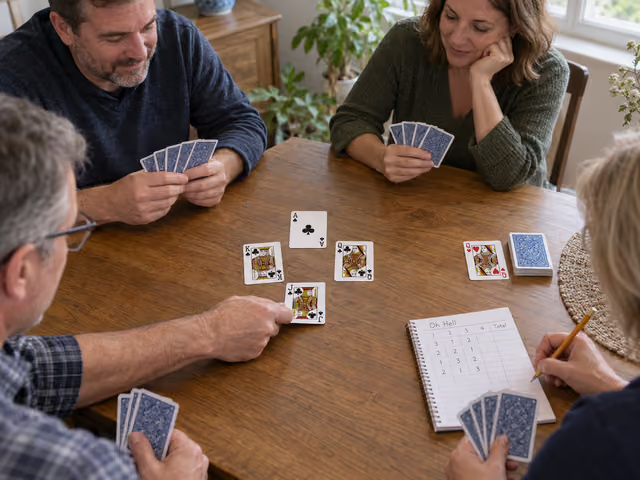
Seat 3–7 people around one table. Remove jokers; use all 52 ordinary cards. Aces are high, then king, queen, jack, 10 down to 2. There are no partners. Give one person paper and a pen to record each player's bid, tricks won, hand points and running total; start totals at zero.
Write the hand sizes before playing. With 3–5 people, deal 10 cards each, then 9, 8 and so on down to 1, then 2, 3 and so on back to 10: 19 hands. With 6 people, go 8 down to 1 and back to 8: 15 hands. With 7 people, go 7 down to 1 and back to 7: 13 hands. Play the one-card hand once.
Draw a card each to choose the first dealer; highest rank deals. As a host convention, tied highest drawers draw again. Return the drawn cards, shuffle and have another player cut. Deal one card at a time clockwise, starting on the dealer's left, until everyone has the scheduled number. Turn the next undealt card face up beside the remaining face-down deck: its suit is trump for this hand. Leave it visible and out of play. Nobody draws replacement cards during the hand.
Bid, then play one card each
Make a prediction
Look at your cards and the trump suit. Starting on the dealer's left and going clockwise, each player announces a whole number from zero to the hand size. The number predicts tricks you will win, not card points. Everyone must bid. The scorer writes the bids where the table can check them.
Check the dealer's hook
The dealer bids last and cannot make all bids total the number of cards in one player's hand. In a four-card hand, if earlier bids total 3, the dealer cannot bid 1. They may bid 0, 2, 3 or 4. If earlier bids already exceed 4, every legal bid is allowed. This hook means everyone cannot make their prediction on the same hand.
Lead the first trick
In this club-sheet format the dealer puts any one card face up in the middle, including trump. Clockwise, everyone adds one card. Those cards together are one trick. You must play the led suit if you hold it. If you have none, play any card; you may trump, but need not. There is no requirement to beat the current high card or wait for trump to be broken.
Take the trick and lead again
The highest trump played wins. If nobody played trump, the highest card in the suit led wins; an off-suit non-trump cannot win. The winner gathers the trick into a separate face-down packet beside them and leads the next. Keep won packets countable. Continue until every hand is empty: a four-card hand has exactly four tricks, however many people are playing.
If hearts are trump and a club is led, a 2 of hearts beats an ace of clubs. But a player holding a club must follow clubs; they cannot choose the heart instead.
Score the hand and finish the series
Count each person's won tricks and compare with their recorded bid. An exact positive bid earns 10 times that bid: bid 3 and take 3 for 30 points. Bid zero and take none for 10 points. Any miss loses 10 times the difference: bid 3 and take 2 or 4 for minus 10; bid zero and take 2 for minus 20. Missed bids earn no additional points for tricks taken. Negative running totals are allowed.
Check that everyone's won tricks add up to the hand size, confirm the points aloud and add them to the running totals. Gather and shuffle the entire deck. Move the deal one seat clockwise, use the next written hand size and turn a new trump card. Do not carry trump or won tricks into the next hand.
After the last scheduled hand, highest running total wins. If the lead is tied, all players play another hand at the maximum size for this group, with the next dealer and a fresh trump turn-up. Add those points to existing totals. Repeat while the highest total is tied; someone outside the original tie can become the winner. The game has no target score and does not stop early when somebody takes a large lead.
Make predictions and disputes easy to check
Before the scored game, demonstrate one unscored trick and the three scoring examples above. Explain that avoiding a trick can be the right move after reaching your bid. Keep the trump card separate from the current trick, announce the next hand size and let anyone ask for a player's bid or won-trick count.
A bid may change only before the next player bids. As a house convention, the dealer may correct their last bid before the opening lead; correct an illegal dealer bid before play starts. Count cards before bidding. For this friendly table, use these explicit house remedies: an incorrect deal is collected and redealt at the same hand size by the same dealer; a failure to follow suit caught before collecting the trick is corrected with a legal card. If an earlier illegal play or an illegal bid is discovered after play has moved on, void and redeal that hand with no points from it. These are hosting remedies, not tournament penalties.
If a trick winner is disputed, leave the cards in place and check the led suit and trump first. If you discover a scoring error, recalculate from the recorded bid and trick count; do not erase the evidence. Agree any variation before the first scored hand and keep it for the whole game. Extra friends can join the next game rather than changing headcount partway through the schedule.
Already know the game?
Ideas & Twists
Choose a variation together before you start.
Oh Hell · See main rules
Suggested house variation · hand scheduleBuild up once
Replace the down-and-up schedule with 1 card each, then 2 and so on to this group's normal maximum: 10 with 3–5 people, 8 with 6, or 7 with 7. Stop and compare totals after that maximum hand. Keep the same bidding, dealer lead and scoring; if tied, retain the main game's maximum-hand tiebreak. This begins with small hands for learning and removes the return journey, without promising a fixed duration.
Oh Hell · See main rules
Documented scoring variation · changes only pointsTricks plus an exact-bid bonus
Replace club-sheet points with 1 point per trick won, plus 10 extra when the bid is exact. Bid 3 and take 3 for 13; take 2 for 2, or 4 for 4. An exact zero still scores 10. There are no negative hand scores. Keep this guide's hand schedule, hook, dealer lead and final-total finish. Pagat documents this scoring; DKM also uses it, but DKM's fixed ten-card hands and 101-point finish are not adopted here.
Oh Hell · See main rules
Documented house variation · removes the hookLet the bids add up
Allow the dealer any bid from zero to the hand size, even when the combined bids equal the available tricks. Announce the total before the dealer leads. Keep all other rules, including club-sheet scoring. Everyone can now make their bid on the same hand, but correct predictions are not guaranteed. Pagat records disagreement over whether this adds tactical choice or reduces tension.
About this guide
Main format follows the undated Carter Hoerr club-sheet PDF currently linked by Pagat: 3–7 players, down-and-up hands, dealer opening lead, hook and 10-per-bid-trick / negative-difference scoring. It is a named traditional format, not a universal official edition. Pagat's main opening lead and common scoring differ; Bicycle's ascending Oh Pshaw also differs. Tied dealer draws, table preparation, demonstrations and error remedies are host conventions. Variations state exactly what changes. Source time estimates and monetary settlement are not adopted.
Ready for something different?
Find another game →