

The quick version
Put each Master's four Students beside it on its home row. Deal two face-up movement cards to each player and one beside the board; that fifth card's colored stamp chooses the starting player. Move one pawn to a destination shown on one of your two cards, capturing any opposing pawn there. Exchange the used card for the side card. Take turns until someone captures the opposing Master or moves their own Master into the opposing temple.
Saved on this device only — clearing your browser's cache or site data removes them (no account backup).
Set the board and five movement cards
This guide uses the physical English-language Arcane Wonders Onitama base game: a roll-up mat with a 5×5 playing grid and two marked Temple Arch squares, two Master pawns, eight Student pawns, sixteen Move cards and the rulebook. The current publisher listing retains that inventory and links its base-game rulebook. Sensei's Path, Way of the Wind and Light & Shadow are separate expansions and are not used here.
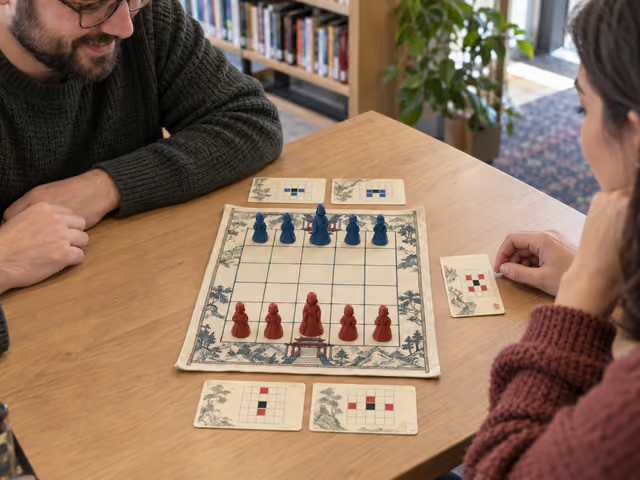
Sit opposite each other at an indoor table with room for the mat and face-up cards. Choose red or blue. Put your Master on the center square of the row nearest you, the marked temple. Put one Student on each of the four other squares in that same row. The opponent does the same at the opposite end. All middle rows start empty; there are five pawns per side.
Shuffle the sixteen Move cards. Deal two face up to each player, oriented toward that player. Reveal a fifth card and read its colored stamp: the matching pawn color goes first. Put this fifth card to the starting player's right, facing that player. Return the other eleven cards to the box; they are not a draw pile. Only these five cards circulate during the game. Keep every card visible to both players.
Read a card from your own side
A card's center square represents the pawn you choose, wherever that pawn stands. Each colored square is one possible destination relative to it. Choose one destination, not a sequence of all the marked squares. Read the card upright from your seat: forward is toward the opponent. The same card faces the opposite direction when the other player owns it.
Masters and Students use the same movement cards. Move directly to the selected square. Pawns and temple markings do not block the spaces you pass over, and jumping over an enemy does not capture it. Your destination must be inside the grid and cannot contain your own pawn. An enemy pawn on the destination is captured and removed; either kind of pawn may capture either kind.
Before starting, demonstrate one legal move from a dealt card and the following exchange, then restore the starting layout and cards. Point to both temples and identify both Masters. The real first action is the stamp-selected player choosing one of their two cards and moving one pawn.
Move once, exchange once, then hand over
Choose and move
Select either of your two cards and one of your surviving pawns. Move that pawn to one legal destination on the chosen card. Remove an opponent's pawn if you land on it. Capturing a Student earns no points and does not end the game. You do not have to capture when another legal move is available.
Exchange the used card
If the game continues, put the card you used to your left, rotating it 180 degrees to face the opponent. Take the card from your right into your face-up pair. You can use this incoming card on your next turn; it does not grant another move now. The card you gave away is now on the opponent's right: they acquire it only after their next move, not before choosing that move.
Pass only when forced
If neither of your two cards permits any legal move by any surviving pawn, move nothing. You must still choose one card to give away and take the side card exactly as above. If even one legal move exists, you must move, even if every choice looks strategically bad. Being threatened is not permission to pass.
Win immediately
Capture the opposing Master to win by the Way of the Stone, or move your own Master onto the opponent's marked Temple Arch square to win by the Way of the Stream. A Student reaching that square does not win. There are no capture points or equal-turn finish; stop as soon as either winning move happens. For another game, restore all ten pawns and shuffle the sixteen cards for a fresh five-card deal.
Keep threats, card flow and disputes clear
Before committing, look at the opponent's two current cards and both temple squares. Then consider what your chosen card will let them do after their next exchange. Keeping a seemingly strong card forever can leave you predictable. These are practical thinking prompts, not guarantees of a winning strategy.
Onitama is played to an actual Master capture or temple arrival. The base rules do not require a chess-style check announcement or prohibit moving your Master into danger. A threatened Master does not end play automatically. Resolve a disputed move by reading the selected card from the moving player's viewpoint and checking the destination, not by guessing from the card's animal name.
If a wrong move or exchange is noticed immediately, this guide suggests restoring the last agreed position and replaying the whole turn legally, including its exchange. That is a house correction, not a printed penalty. Do not reconstruct several disputed turns from uncertain memory; agree to restart that game without a result instead.
The base rulebook gives no automatic repetition draw, move-count draw or stalemate loss. A player with no legal move passes and exchanges. If a position keeps returning and both players want to stop, this guide's house remedy is an agreed draw followed by a fresh deal. Count a repetition only with the same pawn positions, each player's same pair of cards, the same side card and the same player to move; a matching board alone is insufficient.
For a first game, allow questions and use a steady pace rather than surprising a new player with a clock. Both players need to see the small movement grids and distinguish Masters from Students. Say the pawn and destination aloud if that helps; a seated setup is not a guarantee that every access need is met.
Already know the game?
Ideas & Twists
Choose a variation together before you start.
Onitama · See main rules
House match formatTwo-game mirror match
Play two games with the same five cards. After game one, restore the initial pawn rows and exactly the original card allocation and side-card orientation, then swap seats so each person takes the other starting color and pair. The same color starts both games under the original side stamp. Record one match point per win and half a point each for a mutually agreed draw. After two games, the higher total wins; equal totals are a tied match. All movement, exchanges and immediate game wins stay unchanged. Use a quick sketch of the initial deal if needed; an extra random third game is not part of this format.
Onitama · See main rules
House learning formatOpen coaching round
Before each move, the active player states their card, pawn and destination, and both players may discuss threats openly. Allow revision until the pawn is released on a legal square; after release, complete the exchange and hand over. Keep all cards visible and use the normal setup, forced-pass rule and two win conditions. There are no timed turns or coaching points. End at the normal winning move or a mutually agreed draw; return to ordinary independent play in the next game.
Onitama · See main rules
House timed formatClock duel
Add a two-sided chess clock and give each player five minutes total with no increment. Start the starting player's clock after setup. Complete the entire move and card exchange, or a forced pass and exchange, before pressing the clock. A normal winning move ends the game immediately; otherwise a player whose time expires loses. Pause both clocks for a rules correction and restore the last agreed legal position before resuming the active player's clock. A mutually agreed draw remains a draw. If both clocks show expired and nobody can establish which expired first, record a draw. The board rules stay unchanged; the clock and time-loss condition are additions to this house format.
About this guide
Base-game setup, movement, card exchange, forced passing and the two wins follow the currently linked Arcane Wonders English rulebook. Community discussion informs the host advice about card flow and pace; it is not a rules authority. The correction remedy, agreed draw and all three twists are labeled house suggestions. No expansion rules, automatic chess draws or timed main-game claim are imported.
Ready for something different?
Find another game →