

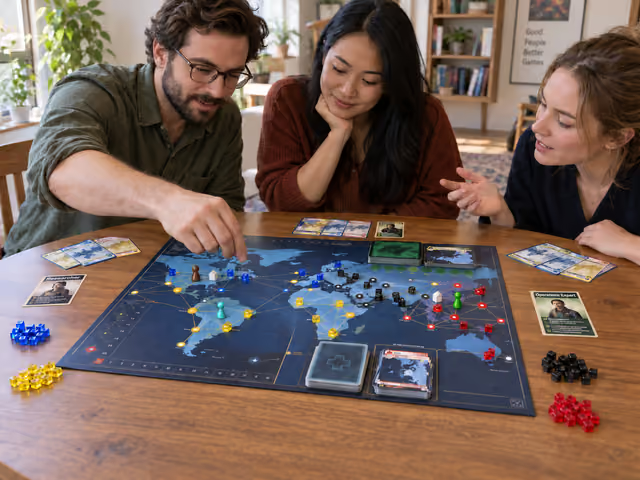
The quick version
Use the standard base game with 2–4 players and four Epidemic cards for a first game. Start all pawns at Atlanta and set up nine infected cities. On your turn take up to four actions, draw two Player cards, resolve any epidemics, then infect cities. Ordinary infection adds one cube per card. At any research station, discard five same-color City cards to discover that cure; the Scientist needs four. Win immediately with four cures. Lose at eight outbreaks, a required cube shortage, or inability to draw two Player cards.
Saved on this device only — clearing your browser's cache or site data removes them (no account backup).
Prepare the board, roles and two decks
Choose this edition
This guide uses Z-Man Games' standard English 2013 revised base game, as published in its current eight-page rulebook. Use only the base components. Legacy, Hot Zone, The Cure, Rapid Response and expansions change the game. The main format is the official Introductory game with four Epidemic cards and open hands.
Lay out the supplies
Put the map on a stable table where everyone can read and reach it. Sort the 96 cubes into blue, yellow, black and red supplies of 24 each. Put one of the six research stations in Atlanta and the other five nearby. Set outbreaks to 0 and infection rate to the first, leftmost 2 space. Keep all four cure markers off their discovered-cure spaces, vial side up.
Give each person a specialist
Shuffle the seven Role cards and deal one face up to each player. Each takes the matching pawn and places it in Atlanta, plus a reference card. Set unused roles and pawns aside. Read your role's abilities before play; the role section below explains them. Even the Quarantine Specialist does not prevent setup cubes.
Infect the starting cities
Shuffle the separate 48-card Infection deck. Reveal three cards and put three cubes of each card's color in its named city; reveal three more and add two each; reveal three more and add one each. That is nine cities and 18 cubes. Put these nine cards face up in the Infection discard pile. Keep the remaining Infection deck face down.
Deal the starting hands
Remove all six Epidemic cards from the Player deck. Shuffle its 48 City cards and five Event cards together. Deal four cards each with two players, three each with three players, or two each with four players. Lay these hands face up. Role and reference cards are separate from hands.
Seed the epidemics without one big shuffle
Choose four Epidemic cards; set the other two aside. Split the remaining Player cards into four face-down piles as equal in size as possible. Shuffle one Epidemic into each pile separately, then stack the piles into one Player deck, with smaller piles at the bottom. Do not shuffle the resulting whole deck. Leave a separate Player discard pile.
Make the first decision
The player holding the City card with the highest printed population starts. For an unresolved population tie, this guide suggests choosing either tied player by agreement; that is a house tie-break. The first player names a goal and spends the first action on one of the choices below. Play then passes to the player on the left after each complete turn.
Spend up to four actions
Count each action aloud; you may repeat an action or leave actions unused. Cards spent on actions go into the Player discard pile. Normal movement does not remove cubes, and treating disease does not spend a City card.
- Drive or ferry: move your pawn along one printed white connection to an adjacent city. Follow connections that wrap around the board edges; geographic closeness alone is insufficient.
- Direct flight: discard the City card for your destination and move there.
- Charter flight: discard the City card for the city you are leaving and move to any city.
- Shuttle flight: move between two cities that both have research stations, with no card cost.
- Build a research station: in your city, discard that city's card and place a station there. Only one station belongs in a city. If all six are already on the map, relocate one from another city.
- Treat disease: in your city, remove one cube of one color to its supply. If that color is cured, one treatment removes all cubes of that color there. Different colors need separate treatments. The Medic has stronger treatment.
- Share knowledge: with another pawn in the same city, give or take the City card naming that city. Both people agree, and one card transfer costs one action. Merely having the same color is insufficient. The Researcher's giving exception is below.
- Discover a cure: at any research station, discard five City cards of one color from your own hand and place that color's cure marker on its indicator. The station's city color need not match. Cards distributed among several players cannot be pooled; the Scientist needs only four.
Curing does not remove existing cubes or stop new cubes by itself. A cured color with no cubes anywhere on the map is eradicated: flip its marker to the eradication side. Future infections of that color place no cubes. Clearing an uncured color does not eradicate it.
Finish each turn: draw, epidemic, infection
Draw exactly two Player cards
After your actions, take the top two Player cards together. If fewer than two remain when you need to draw, everyone loses immediately; do not recycle the Player discards. Keep City and Event cards. Resolve any Epidemic cards now, remove them from the game, and do not draw replacements. Two epidemics mean two complete epidemic sequences, one after the other.
Resolve each epidemic in three steps
First advance the infection-rate marker one space; read the number below it rather than assuming every advance increases that number. Next draw the bottom Infection card. If its color is not eradicated, add three cubes of that color to its city. If that city already has any cubes of that color, fill only to three and trigger one outbreak instead. Respect role protections and required-cube shortages. Discard the bottom card. Finally shuffle only the Infection discard pile, including this new card, and put it on top of the existing Infection deck. Never shuffle the whole Infection deck.
Keep every hand within seven
After resolving drawn epidemics, anyone with more than seven Player cards must discard cards or play Events until within seven. This limit also applies immediately after receiving a card through Share Knowledge. City and Event cards count; Role and reference cards do not. A stored Contingency Planner Event is separate.
Infect the number of cities shown
Reveal that many cards from the top of the Infection deck one at a time. Each adds ONE cube of its own color to its named city, unless eradication or a role prevents it. An infection rate of 3 means three cards, each normally adding one cube; it does not mean three cubes per card. When a city already has three of that color, resolve an outbreak instead of adding a fourth. Fully resolve each card, then discard it before revealing the next.
Pass to the left
After all required infections, the next player takes a full turn. Infection happens after every player's turn, not once after the whole table. Keep the cure goal visible while deciding which danger needs attention now.
Imagine an ordinary player in Atlanta and one blue cube in neighboring Washington. Moving along the printed connection costs one action; removing that cube costs a second. Two actions remain. This is only a teaching example—do not add a practice cube to the real setup.
Resolve an outbreak without a loop
A city holds at most three cubes of each color. An outbreak advances the outbreaks marker once, then attempts to place one cube of the outbreak's color into every directly connected city, even cities printed in a different color. Leave the original city's three cubes there.
If a connected city already has three of that color, it has a chain outbreak after the current outbreak, advancing the marker again and spreading to its neighbors. Keep track of cities that have already outbreaked while resolving this one Infection card. They cannot outbreak again or receive additional cubes from that chain; this prevents the disease bouncing back and forth forever. A later Infection card starts a fresh chain, so the same city can outbreak again then.
Apply Quarantine Specialist and cured-disease Medic protection before placing cubes or triggering a prevented outbreak. Reaching 8 outbreaks loses immediately. Likewise, if the game requires a cube of a color whose supply cannot provide it, lose immediately—even during a chain. An empty supply alone does not lose until a cube is actually needed.
Use your specialist's exact exception
- Medic: one Treat Disease action removes all cubes of one chosen color in your city, even before a cure. After a color is cured, automatically remove its cubes whenever you enter or occupy a city, with no treatment action. Prevent placement and outbreaks of cured colors in your location. This automatic clearing also works if the Dispatcher or Airlift moves you.
- Scientist: discovering a cure needs four same-color City cards instead of five, still in your own hand at a research station and still costing an action.
- Researcher: Share Knowledge can give any City card from your hand to a player in your city. It need not name that city. This works on your turn or when the other player takes a card from you on theirs. Receiving cards from other players still uses the ordinary matching-city rule. Each transfer still costs the acting player's action.
- Operations Expert: build a station in your current city for one action with no City card. Once during your own turn, spend one action and any City card to move from a research station to any city.
- Dispatcher: for one action, move any pawn to a city occupied by another pawn, or move another player's pawn using normal movement actions as if it were yours. Obtain its owner's permission. Flight card costs come from your hand; a charter card matches the moved pawn's departure city. You cannot make that pawn treat, trade or cure, and cannot borrow the Operations Expert's special station departure.
- Quarantine Specialist: prevent disease-cube placement and outbreaks in your city and every directly connected city. Existing cubes remain, and setup infections are unaffected.
- Contingency Planner: for one action, retrieve one discarded Event onto your Role card. Store at most one there; it does not count toward seven. When you play that stored Event, remove it from the game. You may still hold and use ordinary Events normally.
Use Events between resolutions
Any player may play an Event on any player's turn without spending an action; the Event's owner chooses its use. Read its printed effect and any consent or timing limits, carry it out, then discard it to the Player discard pile. Events cannot be exchanged through Share Knowledge.
The five base Events offer different help: Airlift moves one pawn to any city with its owner's permission; Government Grant adds a research station without spending a City card, relocating a station if all six are used; Forecast lets you examine and reorder the top six Infection cards; One Quiet Night skips the next entire Infect Cities step; Resilient Population removes one card from the Infection discard pile from the game. None is an extra cure or an ordinary action.
Pause before revealing an Infection card if you want to prevent its consequences. Once a card has been drawn, finish resolving it before an Event can interrupt again. You may play Events between fully resolved Infection cards, between an epidemic's completed Infect and Intensify steps, or between two completed epidemics. One Quiet Night does not cancel an epidemic's bottom-card infection. Resilient Population can remove that bottom card after its infection is resolved and before the discard pile is shuffled. An Event cannot retroactively undo a completed loss.
Four cures end the game immediately
The moment the fourth cure is discovered, everyone wins. Do not finish that player's actions, draw more Player cards or infect more cities. Cubes may remain on the board. There is no individual score, winning player or tie.
Everyone loses if outbreaks reach 8, a cube that must be placed cannot be supplied, or a player cannot draw the required two Player cards. Discovering the fourth cure during actions wins before that turn's later draw would fail. Drawing the last two Player cards is legal; reaching an empty deck only becomes a loss when a later draw of two is required.
For another game, return every component, separate the two decks, restore all five Events including any removed by the Contingency Planner, restore all Infection cards removed by Resilient Population, and rebuild the full setup. Take new roles if desired. Do not carry over cures, shuffled epidemic piles or eradications.
Coordinate without taking over
Before the first turn, each player explains their role and names the color they may collect. At the start of a turn, the active player proposes a goal; others offer options, then that player decides. Ask a quieter player for their idea before an experienced player gives a whole four-action plan. Cooperative discussion is part of the game, but controlling someone else's turn can leave them watching rather than playing.
Look for cities at three cubes that are likely to be infected again, especially after Intensify returns known discards to the top. Buying safety with treatment can help you reach a cure; cleaning every city can consume the Player deck while advancing no cure. Discuss a specific meeting and card transfer rather than traveling toward a vague eventual trade. Save useful same-color sets, but spend a flight card when it prevents a serious chain. These are situational suggestions, not guaranteed winning strategy.
For disputes, separate the Player and Infection decks, reread the relevant role or Event, and check the printed map connection. Correct a known error before revealing more hidden information. If a mistaken draw, shuffle or chain cannot be reconstructed, this guide suggests ending that attempt without a declared result and restarting; this is a house recovery rule. Do not guess hidden card order or silently change difficulty midgame.
Everyone needs to distinguish cube colors, read cards and inspect the map. Keep supplies separated and announce city names and colors; offer help handling pieces if requested. A seated table format does not establish universal visual, motor, language or cognitive accessibility. No phone, app, timer or score sheet is required.
Already know the game?
Ideas & Twists
Choose a variation together before you start.
Pandemic · See main rules
Official difficulty and information changeStandard challenge
Replace the four-epidemic setup with FIVE Epidemic cards: divide the remaining Player deck into five nearly equal piles, shuffle one Epidemic into each, and stack smaller piles at the bottom without a whole-deck shuffle. Keep hands private as the rulebook directs, while freely discussing their contents; experienced groups may agree to open hands instead. All action costs, roles, seven-card limits, four-cure victory and three loss conditions remain unchanged. Use this for a group ready to plan around more frequent epidemics, not as an extra card inserted midgame.
Pandemic · See main rules
Official harder setupHeroic response
Use SIX Epidemic cards and six nearly equal Player-card piles, one Epidemic shuffled separately into each; stack with smaller piles at the bottom and do not reshuffle the whole deck. Use private hands, or the official experienced-group option of open hands by agreement. All other base rules and endings stay unchanged. This changes epidemic frequency, not the number of cubes per ordinary Infection card. Try it after mastering Standard; no expansion pieces or extra roles are added.
Pandemic · See main rules
House communication agreementAdvice by invitation
Keep the four-epidemic open-hand setup. Before each turn's first action, the active player states their own proposed goal while others listen. Strategic suggestions wait until that player asks for advice; brief factual rules corrections remain allowed immediately. Once advice is invited, everyone may discuss, but the active player chooses the actions. Each Event owner still decides whether and how to play their Event, and Dispatcher or Airlift still requires pawn-owner permission. No timers, extra actions, hidden cards or altered victory conditions. The change gives each player the first opportunity to solve their own turn; agree to it before setup.
About this guide
Main rules are the standard English revised base game (2013 copyright; current publisher-hosted rulebook), for 2–4 players using official Introductory difficulty and open hands. Standard and Heroic are official setup changes, including the rulebook's private-hand default and optional open hands. Advice by invitation, an unresolved starting-population tie-break and unreconstructable-error restart are explicit house suggestions. Community observations inform host advice, not official mechanics or popularity claims. Printed role/Event cards govern their exact effects; no expansion, Legacy, Hot Zone or solo rules are imported.
Ready for something different?
Find another game →