

The quick version
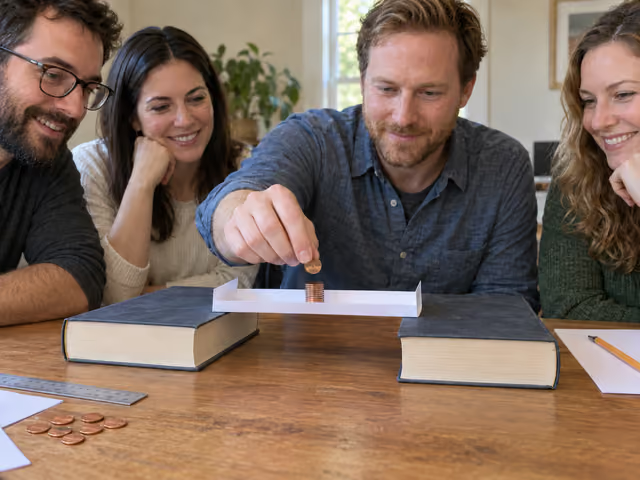
Give each person one sheet. Fold or bend it into a bridge that rests freely on two books 20 cm apart. Once all bridges are ready, test them in turn with the same 50 pennies: add one at a time in a single stack at the middle, let go, and count to three. Record the last successful count. Build again on fresh paper, test again, and compare each person’s better score. Highest wins; equal scores share the result.
Saved on this device only — clearing your browser's cache or site data removes them (no account backup).
Make one fair test station
Use ordinary 8.5 × 11-inch or A4 printer paper from one pack: pick one size and thickness for everybody. Each player gets two building sheets, one for each round. Keep two extra sheets for spoiled tests and use another sheet for scores. The total is two sheets per player plus three shared sheets: seven sheets for two players, nineteen for eight.
Place two stable closed books flat on the same table, with their top surfaces at equal height. Measure a clear 20 cm gap between their facing edges. Each book needs enough top area for the paper ends to rest on it. Keep this station unchanged for every scored test. Have everyone fold at their own place; use the shared station in turn for fitting checks before the tests.
Count exactly 50 U.S. pennies into one shared supply. Set them in a line or rows and always load them in the same order; collect them back in that order after each test. Use the same physical coins throughout, even if their dates differ. On the score sheet, write each name with columns for round one, round two and better score. Choose a testing order around the table.
This is a STUDplay house competition, not a purchased edition or an official tournament. Before handing out paper, explain the construction limits, coin stack, three-count check and 50-coin ceiling below. Everyone, including the host, may enter; another player witnesses each test.
Fold a bridge, using only your sheet
For round one, take one fresh sheet and choose its shape. Folding and bending are allowed. Do not cut or tear it, add tape or glue, use paper clips, combine sheets, or build with the ruler, pen, coins or books. The books are supports and the coins are test loads; neither becomes a bridge part.
The finished bridge must span the entire gap, with its two ends resting freely on the books’ upper surfaces. Nothing may support it from underneath or touch the table inside the gap. Do not attach it to, tuck it under, hook it around or trap it between the books. Keep a place at the exact middle of the span where a penny can lie flat. You may not steady any part during testing.
A useful starting idea is a channel: keep the long dimension of the sheet running from book to book, and fold both long edges upward to leave a flat floor between two side walls. Choose the folds yourself and make the floor wide enough for a penny. This is an optional hint, not a required design or a promised winning shape. A flat sheet is also a legal entry.
You can check fit with no coins at the shared station while building, then take your bridge back. There are no practice coin tests before round one. When everybody says they are ready, all bridges are frozen for that round: no more folding, including while watching someone else’s test. No timer is required.
Test, learn, and build once more
Set an entry in place
Follow the chosen order. The builder sets the bridge on the books; the witness checks the 20 cm span, construction limits and clear gap. An entry that breaks the construction limits or cannot stand under its own weight scores 0. Otherwise choose the midpoint between the facing book edges as the loading point, halfway across the bridge’s width. The builder acts as loader; the witness counts and records.
Load one stack
Lay the first penny flat at that midpoint. Remove your hand completely and count aloud ‘one, two, three’ at a steady conversational pace. If it passes, add the next penny flat on top, release it and count again. Continue one coin at a time, keeping a single vertical stack in the same place. Do not move earlier coins, press them down, spread them along the deck, or change the folds.
Stop and record
A coin passes only if the paper carries the whole stack for the full count, with neither bridge nor coins touching the table or another support in the gap. Stop as soon as the bridge falls off a book, touches the table, or a released coin slips off the stack or bridge. Score the last completed successful count: if the 14th penny makes it fail, score 13. Bending alone is allowed while the clearance and coin stack remain intact. If all 50 pass, score 50 and stop; this is the test ceiling, not a measured maximum capacity.
Give everyone the same chance
Return the same pennies to their loading order and leave the books unchanged. Test the next entry. After every round-one result is recorded, ask each builder what moved first: the middle, an end, a fold or the coin stack. Everyone sees the tests and may borrow an idea for the next round.
Redesign and finish
Each person uses their second fresh sheet. Keep the same construction limits and test; change a fold, width or another feature after considering the first result. Freeze all entries when everyone is ready, then test in reverse order. Write both scores and keep the larger as that person’s final score. The highest final score wins; tied highest scores share the result, including several 50s or an all-zero round. No extra coin load or sudden-death rebuild breaks a tie. Finish by showing the designs and collecting coins and paper.
Keep the test clear and the group involved
Before play, say: ‘Only your one sheet becomes the bridge. Two books support its ends; coins test the middle. We stop at 50, and we each get a second fresh sheet.’ Let everyone ask about the boundary now. Check construction and fit before the group freezes its entries; a mistake can be corrected then. After that freeze, an invalid entry scores 0 and no entry may be refolded. Setting a frozen bridge on the books is allowed; changing its shape is not.
If the loader releases a coin and the stack slips, that is an ordinary failed test. If someone bumps the table or drops a coin onto the bridge from above rather than placing it gently, the witness should call an accidental disturbance immediately. Void that test, use the same bridge if undamaged, or rebuild the same design with a shared spare sheet; do not use the replacement to redesign. Repeat with the same coins from the start. If the group cannot tell whether there was a disturbance, keep the witnessed score. If both spare sheets are exhausted and another damaged entry needs replacement, pause the competition until matching paper is available.
If a book moves during a test, void that test and reset the 20 cm gap before retrying. If someone secretly adds material, remove that entry from the round; its score is 0. Do not decide a score by arguing about which bridge looks stronger: the witnessed coin count controls. These remedies, the freeze, the ceiling and the winner rule are house rules.
Ask the next player to witness rather than leaving all the work to the host. Invite one observation after each test, then let the builder decide what to change. A collapse is useful information, not an invitation to mock the builder. If a friend would rather direct folds than make them, another person may help carry out that friend’s design; use the same assistance arrangement in both rounds and agree it before building.
Keep the station within comfortable seated reach and use only small coin loads above the tabletop. This format involves close hand work, small objects and visual inspection; a seated setup is not an accessibility guarantee. For a group that wants collaboration instead of individual rankings, choose the pairs or shared-design variation before distributing the paper.
Already know the game?
Ideas & Twists
Choose a variation together before you start.
Paper bridge challenge · See main rules
House suggestion · 4, 6 or 8 peopleBridge design partners
Replace individual entries with pairs. Each pair gets one sheet per round and submits one bridge, so bring two sheets per pair, two shared spares and one score sheet. Partners discuss and fold together; one loads and the other witnesses another pair’s test. Swap the loader in round two. Keep the 20 cm gap, construction limits, 50-coin central stack and better-of-two scoring. The highest pair score wins and ties share the result. This variation supports 4, 6 or 8 people; it is not the main game’s 2–8 individual format.
Paper bridge challenge · See main rules
House suggestion · cooperativeA bridge everyone improves
Use one shared entry for the whole 2–8-person group and replace individual scores with a shared comparison. Bring two building sheets, two spare sheets and one score sheet. Before folding, each person offers one idea; choose a design together and let willing participants take turns making its folds. Test round one with the usual 20 cm gap and central stack. On fresh paper make one agreed revision, change the loader, and test round two. Keep all construction and failure limits. Finish by comparing the two counts and describing what changed; there is no winner and no required improvement target.
Paper bridge challenge · See main rules
House suggestion · different load testSpread the traffic
Keep individual builders, both rounds, the paper limits and the 20 cm gap, but replace the central stack with five loading positions along the span: 2, 6, 10, 14 and 18 cm from the left book’s facing edge. Identify those positions with the shared ruler before the test and remove it. At each position a coin must lie flat, halfway across the width. Load positions left to right, one penny at a time, then start the next layer on those same five positions; complete ten layers at most. Release and count to three after every penny. A falling coin, bridge touching the table or lost end support ends the test. Score the last successful total out of 50. Keep better-of-two and shared ties. All entries use this same procedure; do not compare these counts with central-stack scores.
About this guide
Educational sources document paper spans, changing folded shapes and testing with small weights; they do not set one universal party-game rulebook. This guide’s individual 2–8 format, fold-only material limit, two rounds, 20 cm station, single-stack three-count test, 50-coin ceiling, scoring, ties and dispute remedies are a stated house competition. PBS also permits clips and scissors; Science Buddies uses tape and distributed coins. Those permissions are not imported into the main format. All three variations are house suggestions.
Ready for something different?
Find another game →