

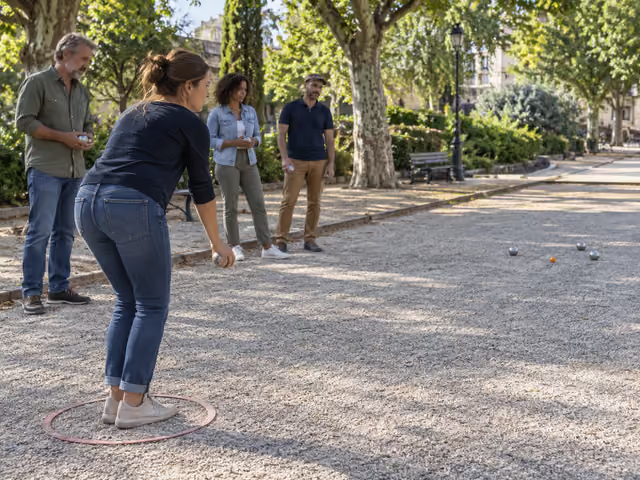
The quick version
Make two pairs, with three boules per player. Toss the jack 6–10 metres from the circle, then throw one boule. The other team plays next; after that, the team without the closest boule plays. Once all boules are used, only one team scores: one point per boule closer than the other team's best. First to 13 or more after an end wins.
Saved on this device only — clearing your browser's cache or site data removes them (no account backup).
Bring enough boules and choose the ground
This guide uses recreational doubles: two against two, three boules per person, following the FIPJP December 2020 playing mechanics with the house arrangements below. Bring twelve metal pétanque boules, a small wooden jack about 30 mm across, a measuring tape and markers. A six-boule leisure set only supplies singles; doubles needs twelve. Identify each person's three boules by their grooves or markings before play. Leisure equipment is acceptable for this friendly format; sanctioned play requires approved boules and jacks.
Choose firm dirt or compact gravel where you have permission to play. Inspect the ground before starting and leave the throwing path clear of people, pets and belongings. A useful rectangle is 15 metres long and 4 metres wide, with extra safe space around it. Mark it using flat, visible markers that do not obstruct throws. House boundary rule: every outer edge is a dead-ball line. This isolated rectangle is simpler than official adjoining-lane rules.
Use a 50 cm hoop lying flat, or draw a circle 35–50 cm across that fits both feet. Keep it more than 1 metre from obstacles and at least 1.5 metres from another game's circle or jack. Wear shoes covering toes and heels. Choose partners and toss a coin: the winning team chooses the first circle and opens the first end. An end is one sequence of play until the boules are used or the jack becomes dead. This friendly game has no enforced throw timer or tournament card penalties.
Follow the closest boule, not alternating turns
Set the jack
A player on the opening team throws the jack once. It must be visible, 6–10 metres from the inside edge of the circle, at least 50 cm from obstacles and the rectangle's end line, and at least 1.5 metres from another circle or jack in use. If the throw is invalid, the opponents place the jack in a valid position; the original opening team still throws the first boule. Mark the jack's position with small scratches beside it so accidental movement can be restored.
Throw the first boule
Any member of the opening team throws one of their own boules. Keep both feet entirely inside the circle, touching the ground until the boule lands; no run-up. An underhand toss is a useful starting technique. Everyone throws from that same circle during this end. The opponents then play one boule. If the opening boule went out, the opponents still throw next; alternate while neither team has a live boule.
Give the next throw to the trailing team
Compare each team's closest live boule to the jack. The team without the closest one throws again, one boule at a time, until it gets strictly closer or uses all six of its boules. Either partner with boules left may take that team's next throw; each person can use only their own three. When one team is empty, the other throws its remaining boules. Measure close calls before choosing who plays.
Choose a point or a shot
Pointing means trying to leave your boule near the jack. Shooting means trying to hit a rival boule away. Contacts with boules and the jack are allowed: compare distances using their new positions. Keep waiting players behind the thrower and off to the side. Pause for anyone entering the lane. Do not sweep a landing strip or roll extra practice boules during an end; the next thrower or a partner may fill one hole made by an earlier boule.
Resolve equal distances
If opposing closest boules are tied and both teams have boules left, the team that just threw plays again; then alternate teams while the tie remains. Resume ordinary trailing-team play once one is strictly closer. If only one team has boules left, it plays them and can score only boules strictly closer than the tied opposing boule. If the nearest opposing boules still tie after all throws, the end scores zero. If no live boules remain during play, use this same alternating procedure.
Score only after the end
Wait until every boule has stopped and all twelve have been played. Only the team with the closest boule scores: one point for each live boule closer than the opponents' nearest live boule. For example, your boules at 15 cm and 25 cm beat their best at 40 cm, but your boule at 60 cm does not: you score 2. If the other team has no live boules, count all yours. If neither has any, score zero. Confirm the total together before picking anything up.
Start the next end and finish
The scoring team opens the next end. After a zero-point end, keep the team that opened that end. Move the circle to the jack's last valid position, adjusting for the required clearances. If no direction permits a 10-metre jack throw, move the circle back along the previous direction of play only as far as needed to make that distance possible. Erase old drawn circles nearby. Each person gets their three boules back. Continue until one team reaches 13 or more after an end; no exact landing on 13 or two-point margin is required. Reset both scores for a new game.
Blue opens with one boule. Red beats it with one. Blue misses with its next boule, so Blue throws again. Team turns depend on the closest boule, not the number of throws or whose farthest boule is worse.
Handle an out-of-bounds boule or a dead jack
A boule is dead once it completely crosses an outer boundary when viewed from above, even if it rolls back. Remove it when safe; it uses that player's throw. Restore anything it moved after crossing out if the earlier positions were marked. A boule touching the line but not completely beyond it is still live. Mark close boules as well as the jack with small scratches beside them.
The jack is dead if it fully crosses the boundary, moves less than 3 metres or more than 20 metres from the circle, becomes invisible from the circle except for being hidden by a boule, cannot be found within five minutes, floats in a puddle, or has an out-of-bounds area between it and the circle. A jack moved by a legal boule otherwise stays where it stops, even outside the original 6–10 metre throwing distance.
A dead jack ends play immediately. If both teams still have boules, or neither has any, score zero. If only one team has unplayed boules, it scores one point for each of those remaining boules, rather than for boules lying on the ground. That team opens next; after zero points, the original opening team opens again. Use the jack's last valid marked position to set the next circle. A dead-jack score can win the game.
Measure fairly and give partners a say
Before the match, let each person try a few unscored throws, then clear the ground and start afresh. Explain the one-boule opening and demonstrate a change of lead. Before each team throw, ask whether to point or shoot; partners can discuss the choice without making the other player surrender their boules. Speak softly between throws and give the thrower quiet while preparing and releasing.
Measure the shortest gap between the jack and the boule's outer surfaces, using the same method for both. The team that just played measures first; opponents may check. Feet and guesses are poor substitutes for the tape. Mark pieces before moving any that block a measurement, then replace them. If a player disturbs a disputed piece while measuring, their team loses that disputed point. An agreed equal measurement uses the tie procedure, not a coin toss.
House remedies for this friendly match: a foot-circle violation spends that boule; remove it and restore marked pieces it moved. An accidental throw while already holding the point stays played and uses that boule, consistent with FPUSA's 2023 clarification. Stop and check whose turn it is before the next throw. Return accidentally kicked or wind-moved stationary pieces to marked positions; if no mark lets both teams restore the position confidently, replay the end for zero points. For a moving boule or jack touched by a person or an outside object, stop, clear the lane and replay the end for zero points. These replay remedies simplify tournament interference rules.
Keep a spoken running score or use an optional score sheet. If weather or ground conditions become unsafe, pause and agree to resume with the recorded score or leave the game unfinished. Do not make a player chase moving metal boules or throw through a crossing path.
Already know the game?
Ideas & Twists
Choose a variation together before you start.
Pétanque · See main rules
Official team formatSingles
For two players, each plays alone with three personal boules, so bring six total. Each player is their own team; keep the same opening, trailing-side turns, ties, boundaries and 13-point finish. A normal scoring end can give at most 3 points rather than 6. A dead jack still awards only the unplayed boules when exactly one player has any left. The friendly setup and house remedies remain.
Pétanque · See main rules
Official team formatTriples
For six players, make two teams of three and give each person two personal boules: twelve total, six per team. Any teammate with a boule left can take the team's next throw. Keep ordinary turn order, scoring, ties and first to 13. Agree who will point first and who will save a boule for a possible shot, while allowing the team to change its plan as the end develops. The friendly setup and house remedies remain.
Pétanque · See main rules
Suggested house variationPointing only
Keep doubles, all twelve boules, the same circle and first-to-13 scoring, but agree before starting that every throw must aim to place near the jack rather than intentionally strike a boule or the jack. Accidental contacts stand, including a moved or dead jack; normal ties and dead-jack scoring still apply. For an obvious deliberate shot, spend that boule, remove it and restore any marked pieces it moved. If restoration cannot be agreed, replay the end for zero points. This is a placement-focused house game, not a tournament restriction.
About this guide
The FIPJP rules supply doubles, singles and triples allocations, circle and jack distances, trailing-team turns, ties, dead-jack scoring and the 13-point finish. This recreational guide permits leisure boules, makes all edges of one isolated rectangle dead, omits enforced tournament timing and uses explicitly labeled friendly foul/interference remedies. Pointing only is a house variation. Sanctioned competition also uses equipment approval, umpire penalties, adjacent-lane and tournament rules in the full rulebook.
Ready for something different?
Find another game →