

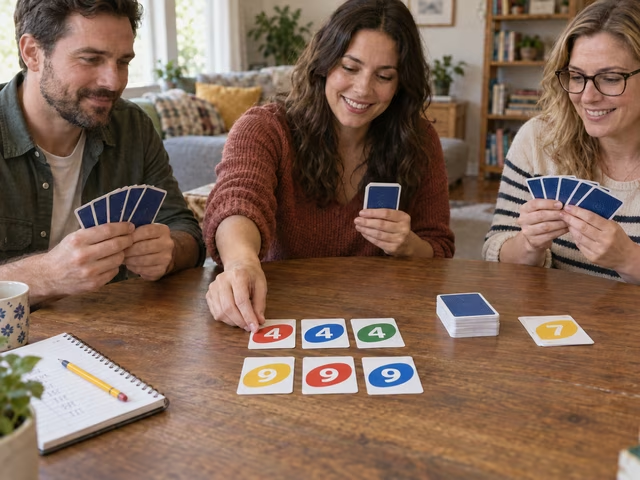
The quick version
Deal ten cards each. On your turn draw from the stock or take the top discard, optionally expose your entire current phase and add legal cards to completed phases, then discard. A Skip cannot be picked up. The first empty hand ends the deal immediately. Anyone who exposed their phase advances one phase next deal; everyone else repeats theirs. Score cards left in hands as penalties. Finish phase ten to contend for the win; if several finish it in the same deal, the lowest accumulated penalty wins.
Saved on this device only — clearing your browser's cache or site data removes them (no account backup).
Put the phase list where everyone can see it
Use the standard game, not Phase 10 Twist or another edition with a different board or deck. Remove reference cards from the playing deck. Shuffle and deal ten face down to each player. Put the stock in the centre and turn one card up for the discard pile. Choose a dealer; play clockwise from their left. If the initial discard is a Wild, the first player may take it. If it is a Skip, that first player loses the opening turn.
Write each player's current phase and running penalty total. A set contains cards of one number, in any colours. A run is consecutive numbers, in any colours: no wrapping twelve to one. Separate sets may use the same number. The ten phases, in order, are:
- Two sets of three.
- A set of three and a run of four.
- A set of four and a run of four.
- A run of seven.
- A run of eight.
- A run of nine.
- Two sets of four.
- Seven cards of one colour.
- A set of five and a set of two.
- A set of five and a set of three.
Draw, finish your phase, then discard
Draw one
Take the top stock card or the top discard. You cannot take a Skip from the discard pile. If the stock runs out, keep the top discard in place and shuffle the other discarded cards into a new stock.
Expose the whole phase
After drawing, you may lay your entire current phase face up. You cannot lay only one of its two combinations in standard play, and you may complete only one phase per deal. Use at least one numbered card; Wilds can supply any needed number or colour. State what each Wild represents and leave it in that group for the rest of the deal.
Hit exposed groups
Once your own phase is down, add any legal cards to your own or other players' exposed phases. Extend a run at either end, add the matching number to a set, or add the required colour to phase eight. You may hit on the same turn you exposed your phase. You cannot hit before your own phase is complete.
Discard or go out
End your turn by discarding one card, unless you emptied your hand by hitting. Discarding a Skip makes a player you choose miss their next turn. A person cannot be skipped again until they have had a normal turn. Skip cards cannot form phases or be hit. As soon as anyone has no cards, the deal ends; nobody gets a final turn.
Advance completed phases and record remaining cards
Each player counts the cards still in their hand: numbers one through nine are five points each; ten through twelve are ten each; Skip is fifteen; Wild is twenty-five. Lower penalties are better. Anyone who exposed a complete phase moves to the next phase in the next deal, even if they did not go out. Anyone who did not expose theirs tries the same phase again. Gather all cards, shuffle, pass the deal clockwise and deal ten each again.
The match ends after a deal in which someone completed phase ten. If just one player did, that player wins. If several did, compare only those finishers' cumulative penalties. If their scores also tie, those tied players replay phase ten among themselves; the first to go out wins. A player on an earlier phase cannot win merely by having fewer penalties.
Choose the length and house rules before the deal
The standard match can take many deals because missed phases repeat. Keep the phase list and score visible. Explain the difference between completing a phase and going out before starting; they produce different results. Call a Skip's target clearly and leave a reminder by that player.
For a first session, use the full-match rules above or explicitly choose the ten-deal variation below. If the group stops a standard match early, record its progress without presenting the leader as the standard-game winner. Use one house variation at a time until the table understands its effects.
Already know the game?
Ideas & Twists
Choose a variation together before you start.
Phase 10 · See main rules
Publisher's ten-deal variationEveryone advances
Play phases one through ten together, one per deal. Everyone advances after every deal whether or not they exposed the phase. Keep ordinary draw, hit and discard rules and score remaining cards each deal. After the tenth deal, the lowest total penalty wins. This replaces repeated attempts with a shared sequence.
Phase 10 · See main rules
Game-club house suggestionExpose one combination early
For a phase with two combinations, you may expose either complete combination on your turn before you have the other. Do not expose an incomplete individual set or run. Until both combinations are down, you cannot hit any exposed phase, including your own. If the deal ends before you complete both, you repeat that phase next deal; only cards still in your hand score penalties. Single-combination phases still require their whole combination.
Phase 10 · See main rules
Game-club house suggestion; explicit timing ruleTake an unwanted discard
When the current player chooses the stock, pause before they look at the drawn card. Another player may take the unused top discard and one extra stock card as a penalty. Give priority clockwise from the current player's left if several ask. The current player then continues their ordinary turn; the claimant gets no immediate play or discard. Only the top discard is available, never a Skip. All other rules stay unchanged.
Phase 10 · See main rules
Game-club house rule tried December 8, 2005Free a Wild
On your normal turn, after your own complete phase is exposed, you may replace a Wild in an exposed group with the exact numbered card and colour needed for that position. For a set without a colour requirement, any colour of that number works. Take the Wild into your hand, then use it legally or keep it. The group must remain valid. This is a house exception to the standard rule that exposed Wilds stay in place.
Phase 10 · See main rules
Game-club grace-round rule tried January 12, 2006One last chance
After someone goes out, every other player gets exactly one final ordinary turn in clockwise order, then score and advance completed phases. The person who already went out takes no further turn. An existing Skip still consumes its target's final turn; a newly discarded Skip may affect someone whose final turn has not happened. Nobody starts another circuit by going out during this grace period.
Phase 10 · See main rules
Game-club house rule tried February 2, 2006Choose your next phase
Track a checklist of all ten phases for each player. On the first deal, and on a new deal after you completed your previous choice, inspect your hand and announce one phase you have not yet completed, before the first turn begins. If you fail to expose that phase, keep attempting it on later deals until successful; you cannot choose again after a failure. Only successfully exposed phases are checked off. Keep normal play and penalties. The first deal in which someone checks off their tenth phase ends the match; resolve multiple finishers by penalties as in the main guide.
About this guide
The main game and everyone-advances variation follow Mattel's standard instructions. The other variations come from a club's own account, with explicit turn timing supplied here where needed. Dated play notes are distinguished from undated suggestions, which are not described as tested. The club found that reverse-order phases could let the leader pull further ahead; that format is not included here.
Ready for something different?
Find another game →