

The quick version
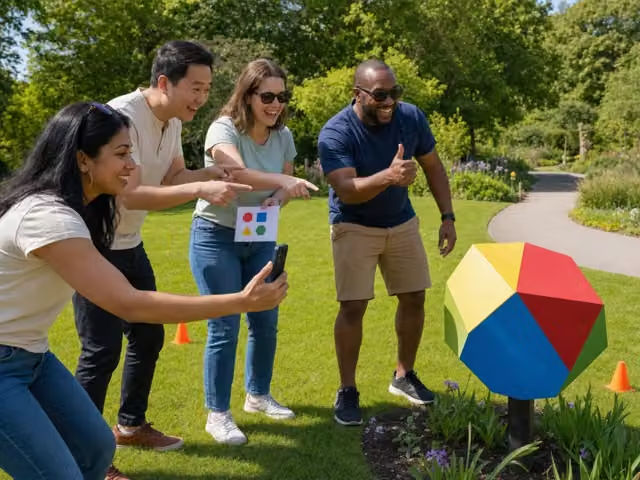
Teams of two or three photograph ten listed things inside the agreed boundary. Take new photos during the round and use a different subject for each prompt. Stop at the deadline, meet back and check the evidence together. Most accepted prompts wins; equal totals tie.
Saved on this device only — clearing your browser's cache or site data removes them (no account backup).
Give every team the same list
Choose a compact park or public walking area with a clear meeting point. State its boundaries, the return route and an exact finish time twenty minutes after the start. Teams should remain together; plan the route back inside that time. Divide into pairs or threes and give each team one phone and the same numbered list.
Use these ten prompts, replacing any that cannot reasonably be found there before play: a reflection; a repeating pattern; a circle in something built; a plant growing through a gap; a shadow with a recognizable shape; two contrasting textures; something older beside something newer; an arrow; three shades of one color; and an unusually shaped bench or seat. The host explains any subjective term now, using one example that is not itself eligible.
Set one point per accepted prompt, maximum ten. No speed or artistic-quality bonus. Equal final totals share the win. A photo must show the requested feature clearly, be taken in this round inside the boundary and use a subject not already counted for that team.
Find, photograph and review
Start together
The host announces the starting time and finish time. Teams choose their own order through the list. Open the camera, find a subject and take a clear photograph; an empty gallery or a new album helps separate this round's evidence from old pictures.
Keep a numbered record
Mark which prompt each photo answers. You may retake an unclear photo or replace your choice before the deadline, but submit only one photo per prompt. One photo answers one prompt. Do not move or stage found objects to create an answer, and do not borrow another team's images.
Return before reviewing
Leave time to reach the meeting point. At the deadline stop taking eligible photos. Arriving late earns no extra hunt time; photos captured after the deadline cannot score. Finish walking back normally, without racing.
Check the ten answers
Teams show photos on their phones in prompt order. The host applies the announced criteria consistently. Clear answers earn one; missing, repeated-subject or nonmatching answers earn zero. Resolve an unclear image by checking it against the prompt, not by awarding style points. Add accepted prompts, announce the highest total and share any tie. For another round, replace the list and start a fresh album.
Make the clues usable
Choose things visible from permitted paths. Keep strangers, private interiors, identifying documents and vehicle plates out of the prompts and the photographs. No photo requires a person to appear. Show pictures locally for scoring; public posting is a separate choice for the people involved.
If a route closes or a prompt proves impossible, announce one replacement to all teams or remove that prompt from everyone's maximum. Do not quietly give one team an easier list. A useful hunt offers several possible subjects per clue rather than making everyone queue for one hidden object.
Already know the game?
Ideas & Twists
Choose a variation together before you start.
Photo scavenger hunt · See main rules
Suggested house variationFive-photo editor
Keep all ten prompts but accept at most five submitted photos per team, each answering a different prompt. Teams can shoot more while hunting, then choose five before review. Each valid choice earns one; maximum five and equal totals tie. This changes the task from filling the entire list to selecting the clearest five pieces of evidence.
Photo scavenger hunt · See main rules
Suggested house variationFind the same landmark
The host takes six close-up photographs of public details in the boundary before play. Give every team those same six clues instead of the word list. Teams photograph each matching location from a wider view so the host can verify it. One point per correct match, maximum six, with the same deadline and shared ties. Choose fixed landmarks; a moving vehicle or person cannot serve as a clue.
About this guide
This is a proposed phone-camera house game. Goosechase's camera-mission documentation supports photo missions, chosen point values, live-capture choices and hidden submissions as practical design precedents. It does not prescribe this list, timing, scoring, privacy boundaries or variations; no Goosechase account is required.
Ready for something different?
Find another game →