

The quick version
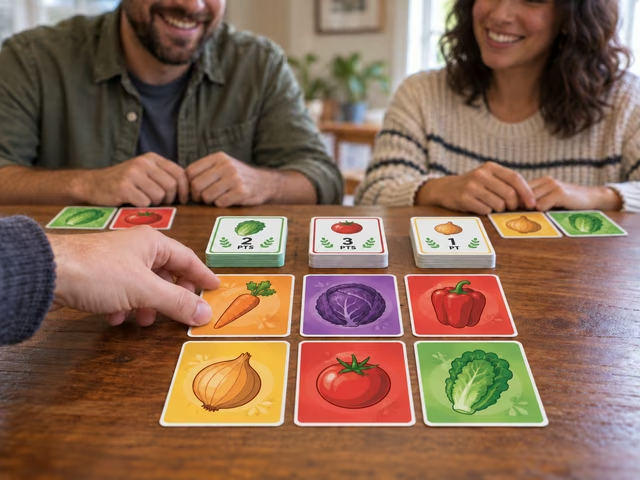
Take one scoring card or two visible vegetables. Optionally flip one owned scoring card into its vegetable side. Refill the market. When every card has been drafted, apply each owned scoring condition to your full vegetable collection; highest total wins.
Saved on this device only — clearing your browser's cache or site data removes them (no account backup).
Scale the deck and lay out the market
There are 18 cards of each of six vegetables. For two players randomly keep six of each vegetable; for three keep nine; for four keep 12; for five keep 15; for six use all 18. Choose by vegetable face without inspecting scoring backs, and return unused cards unseen to the box.
Shuffle the selected deck and divide it into three roughly equal piles with scoring sides facing up. From each pile turn over its top two cards into a column of vegetables below it. You now have three scoring options and six visible vegetables. Choose a starting player randomly; play clockwise. Nobody starts with cards.
Take a scoring rule or two vegetables
On your turn take ONE top scoring card from any pile, or TWO vegetables from any positions in the six-card market. Add them face up to your own area. Keep scoring cards apart from vegetables. If only one vegetable remains at the end of the game, take that one.
Once during your turn, you may also flip one of your scoring cards into its vegetable side, including a card just drafted. The vegetable symbol in its corners tells you what is on the reverse. This is optional and free; you cannot normally flip a vegetable into a scoring card.
After choosing, refill empty vegetable positions from the pile above each column, turning new cards vegetable-side up. If a draw pile runs out, split the largest remaining pile roughly in half and move its bottom half into the empty position, keeping that original pile's top scoring card visible. Continue until all piles are exhausted, then draft the remaining vegetables without refilling.
Score each card against the whole collection
Stop when no cards remain in either piles or market. Score every scoring card you kept, using your entire vegetable collection separately for each. Vegetables are not spent by scoring. A carrot can therefore contribute to a carrot pair, a mixed set and a points-per-carrot card.
Repeat a card's set reward for every full set unless its printed condition says otherwise. Apply negative vegetable values too. A vegetable with no relevant scoring card has no inherent point value. For a most/fewest tie, the owner of that scoring card receives its reward if their collection ties the qualifying count.
Add your scoring-card results. Highest sum wins. A tied total goes to the tied player who was later in the original turn order. Read each card's exact condition. For this guide, agree the following house clarification before play: an odd/even card requires at least one of its vegetable to earn points; zero can still qualify for a fewest card. This makes the zero-count case explicit.
Show why the backs matter
For a sample decision, point to a vegetable in the market and two scoring cards that could reward it. Explain that taking two vegetables may expose different scoring cards when the market refills. Keep collections visible so comparative cards can be checked. Take a moment at the end to calculate one person's full score together.
A recommendation discussion highlights its compact card-scoring appeal. Teach with a pair of scoring cards that reward the same vegetable in different ways.
Already know the game?
Ideas & Twists
Choose a variation together before you start.
Point Salad · See main rules
Original STUDplay house twistOpening recipe
Before the normal market is revealed, deal three scoring-side-up cards to each player from the prepared deck. Everyone simultaneously keeps one as an initial scoring card and returns two. Shuffle returned cards into the deck, then set the ordinary market. This grants a visible initial direction without changing later turns.
Point Salad · See main rules
Original STUDplay house twistFresh shelf
Give each player one paper token. At the beginning of their turn, they may discard it to move one top scoring card to the bottom of the SAME pile. The new top is available immediately. The token does not replace their drafting action and cannot be used on an empty pile.
Point Salad · See main rules
Original STUDplay house twistThree recipes
You may hold no more than three scoring-side-up cards at any time. Before taking a fourth, you must use your normal once-per-turn flip to turn one existing scoring card into a vegetable. If you already used that flip, you must choose vegetables instead. This increases the value of flexible scoring combinations.
Point Salad · See main rules
Original STUDplay house twistOne reverse flip
Give each player one paper token. Once during the game, on their own turn, they may discard it to flip one owned vegetable into its scoring side. This uses that turn's optional flip, so they cannot also flip a scoring card into a vegetable. All other turns retain the ordinary one-way flip.
Point Salad · See main rules
Original STUDplay house twistMatching harvest
When choosing the two-vegetable action, you must take two of the same vegetable if such a pair exists anywhere in the market. If no pair exists, take any two. Scoring-card drafting remains available. This makes visible pairs a shared tactical constraint; the final single-card take still works normally.
About this guide
Use the named physical base game and its supplied cards, boards and rules. Rules below are paraphrased teaching guidance. Original STUDplay house twists are optional suggestions, not publisher rules or balance-tested claims; agree one before setup.
Ready for something different?
Find another game →