

The quick version
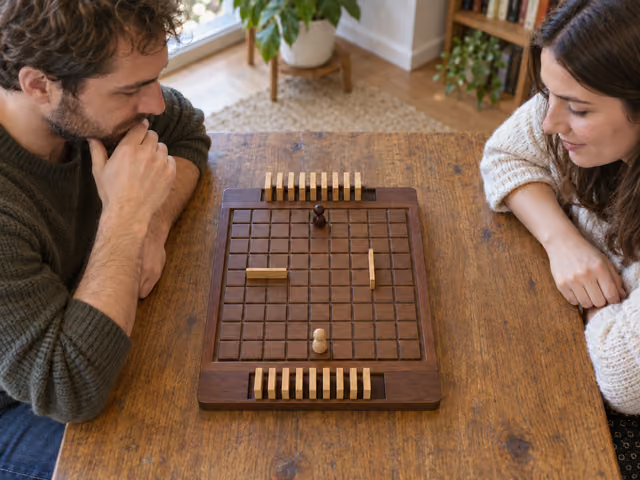
Start one pawn in the middle square of each of two opposite edges and give each player ten walls. Take turns moving your pawn or placing one wall. A normal move goes one square forward, backward or sideways; adjacent pawns have special jump rules. Walls span two squares and must leave each player a route to their opposite edge. First pawn to any square on its target edge wins immediately.
Saved on this device only — clearing your browser's cache or site data removes them (no account backup).
Choose your edges and count the walls
Use the standard Gigamic Quoridor Classic wooden 9×9 board and its twenty fences. The manufacturer's set contains four pawns; use two distinguishable pawns here and put the other two away. Quoridor Junior, Pac-Man and unrelated wall-racing games have different rules or components.
Place the empty board between two players on a stable table, where both can see the grid and reach its grooves. Each takes one pawn and ten fences, keeping unused fences in a separate reserve. A fence is also called a wall; those words mean the same piece throughout this guide.
Put each pawn on the middle square of a different, opposite edge. Your finish line is the entire edge across from where you started, not just its middle square. Point out both finish lines before play. Choose the opener by a random draw; choosing randomly from the two concealed pawns is one practical host method. The other player goes next. No dice, cards, score sheet or timer are needed.
Take one action, then hand over the turn
Make the first choice
The opener either moves their pawn one legal step or places one fence from their reserve. Then the opponent takes one action. Continue alternating. You cannot move and build on the same turn, and you cannot pass. Once your reserve is empty, every turn must be a pawn move.
Move around the walls
Normally move to one empty square sharing a side with your square: forward, backward, left or right. You may move away from your finish line. Do not step through a wall, move diagonally across an empty corner, occupy another pawn's square or capture a pawn. Use the special jump below when pawns meet.
Or build one fence
Seat one reserve fence upright in a groove, horizontally or vertically, spanning exactly two neighboring square edges. It blocks movement across both edges for everyone. Keep the whole fence on the board. It may touch the end of another fence, including an L or T junction, but cannot overlap part of a fence or cross through another fence's midpoint. Once legally placed, it stays: no moving, rotating, reclaiming or removing it.
Keep a way through
A proposed fence is illegal if it removes either pawn's last wall-free route to any square on that pawn's own finish line. Check both players, including yourself. A detour can go sideways or backward and can finish anywhere on the target edge. Another pawn is a temporary occupant, not a wall for this route check. Trace possible routes over the squares without crossing fences; you do not need to prove that a route is short or strategically good.
Finish on arrival
The first pawn to reach any one of the nine squares on its opposite edge wins immediately. The other player gets no extra turn. There are no captures, running points or remaining-wall bonus, and sequential turns cannot produce simultaneous winners. For another game, remove all fences, return both pawns to their starting centers, divide ten fences each and choose an opener again.
Before you build, compare what it does to both routes. A fence that lengthens your opponent's journey may lengthen yours as well. You can keep unused fences for later; using all ten is not an objective.
When pawns meet, check the square beyond
If an opponent's pawn is on a square sharing a side with yours, with no wall between you, you may jump straight over it to the empty square immediately beyond. This is one pawn action, not two turns. The jump cannot cross a wall behind the opponent. You may still choose another legal ordinary step instead.
If a wall behind the opponent or the board edge prevents that straight jump, you may instead land on either empty square directly beside the opponent, perpendicular to the direction you approached. This is the special sideways jump that looks diagonal from your starting square. The path from your square to the opponent, then from the opponent to the landing square, must cross no wall. A wall on one side removes that landing choice. If a straight jump is available, you cannot choose a sideways jump instead.
For example, imagine your pawn immediately below the opponent, with no wall between you. If the square above the opponent is open, you can jump there. If a fence blocks that exit, you can jump to the square left or right of the opponent, provided that side is open. You cannot simply move to any diagonal square because a fence is near you. The same rule works when you approach a pawn from the side or from behind; it is not limited to moving toward your finish line.
Teach the exceptions before they decide a game
Before starting, use the pieces for an unscored demonstration: show an ordinary step, a straight jump over an adjacent pawn, then add a fence behind that pawn and show the two possible sideways landings. Replace the pawns on their starting centers and return the demonstration fence to its owner's ten-piece reserve. Ask each player to identify their whole finish edge.
Pause a disputed placement before the next action. Check the fence's full two-square span, overlaps, crossing and a route for each pawn. An attempted illegal move or fence is corrected on the same turn; choose a legal action instead. This correction policy is a friendly house remedy, not a manufacturer penalty. If an illegal fence is noticed later, restore the last agreed legal position if both can reconstruct it. Otherwise restart without recording a winner. Agree to this recovery policy before play.
For a legal move you regret, let it stand. As a house commitment rule, a piece is played when you release it in its legal position. Ask before handling a piece merely to demonstrate an idea. Spectators can save tactical suggestions until the result unless both players request a teaching game.
A drawn game is not the normal finish rule. The manufacturer's sheet gives no repeated-position draw threshold. If both players choose to stop a repeated back-and-forth, record an agreed draw as a house resolution; do not award victory by distance remaining. A voluntary concession awards the opponent the game only by agreement. These choices prevent a friendly evening from depending on an invented official penalty or tiebreak.
Try counting possible steps before committing a wall, but treat that count as planning: the other player can change the board on their next turn. The game can be played seated at a suitable table; that does not establish reach, vision or dexterity access for every player. Confirm that both can distinguish the pawns and walls and use the board comfortably.
Already know the game?
Ideas & Twists
Choose a variation together before you start.
Quoridor · See main rules
Official four-player format · host turn orderFour-way race
Use exactly four players and all four distinguishable pawns, one on the middle square of each edge. Give each person five walls, twenty total. Each races to their own opposite edge; everyone plays individually. Choose an opener randomly and, as a host convention, go clockwise around the table throughout. Take one move or fence action per turn and leave a route for every pawn. You may jump only one pawn: if another pawn occupies the square beyond an adjacent pawn, use the sideways-jump rule to an empty unblocked square beside that adjacent pawn instead; never jump a chain. All other movement and fence rules remain. Stop immediately when the first pawn reaches its target edge, with one winner and no distance-based placings. This changes the main guide's two-player count.
Quoridor · See main rules
Suggested house variationFive-wall duel
Keep two players, the same 9×9 board, starting squares, movement and immediate finish. Give each player only five walls and set the other ten aside for the whole game. Each placed fence still consumes its own turn and must leave both routes open; once your five are gone, you can only move. Neither player can reclaim or borrow the set-aside fences. This makes the limited wall supply a different planning problem rather than a promise of a shorter game.
Quoridor · See main rules
Suggested house matchBoth players start once
Play exactly two standard two-player games, resetting the full board and ten-wall reserves between them. Pick the first opener randomly and let the other player open game two. Award one match point for a game win and half a point each for a mutually agreed house draw; a restarted game earns no points and uses the same opener. Higher total after the second completed game wins the match; equal totals are a shared match result, with no automatic extra game. An arrival still ends each individual game immediately.
About this guide
The physical Classic set follows Gigamic's standard two- and four-player race rules. Board Game Arena corroborates the empty-square, optional-jump and full-fence placement details; its team option is not imported. The edge-blocked jump, third-pawn sideways fallback and explicit fence-overlap explanation are corroborated by TheQuoridor.com's independent implementation; its rankings and digital variants are not manufacturer rules. Random-draw method, clockwise four-player order, commitment/error recovery, agreed draws/concessions, teaching demo and two house variations are host choices. No three-player format or timed-game guarantee is claimed.
- Gigamic · Quoridor Classic product, components and official downloads ↗
- Gigamic · multilingual Quoridor rules, 10-2016, English printed page 4 ↗
- Gigamic · current linked French rules and figures ↗
- Board Game Arena · publisher-authorized implementation and rule summary ↗
- TheQuoridor.com · independent implementation's detailed movement and fence conventions ↗
Ready for something different?
Find another game →