

The quick version
Each person draws six hidden tiles. Whoever has the largest set sharing a color or shape, without duplicates, opens with that whole set; oldest among tied players starts. Take turns clockwise: place tiles in one straight line, score every line you create or extend, then refill to six. Each touched line must have one color with different shapes, or one shape with different colors. Exchange instead of placing if desired. A six-tile line scores 12. Once the draw supply is empty, the first person to use their last tile gets six extra points and ends play; highest total wins.
Saved on this device only — clearing your browser's cache or site data removes them (no account backup).
Give everyone six hidden tiles
Use MindWare’s classic 108-tile wooden Qwirkle set, item 32016, for 2–4 players. Qwirkle Cubes and Rummy have different rules.
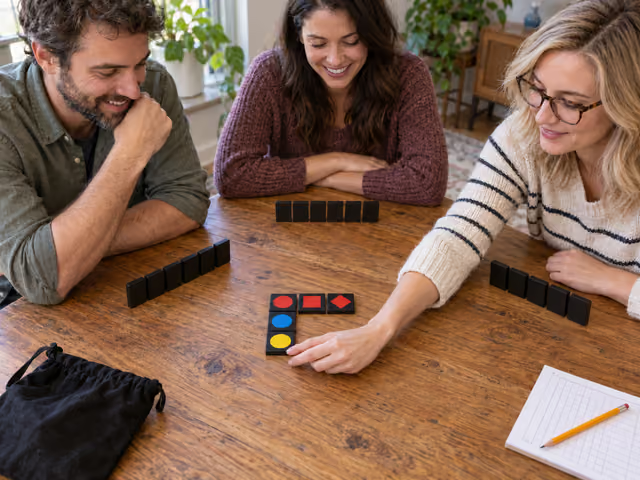
Use all 108 tiles: six colors crossed with six shapes, with three copies of each color–shape combination. Mix them in the opaque bag. The classic rule sheet also permits a shuffled face-down draw pile; the bag keeps the supply contained. There is no board. Leave clear table space around the center for lines to grow, and let everyone see and reach the layout.
Write a score column for each player. Each draws six tiles without looking into the bag and stands them with the shapes facing only themselves. Choose a scorekeeper; every player confirms their turn's arithmetic before the total is written.
Each person announces the size of their biggest set sharing one color or one shape. Identical tiles count once in that set. Three red shapes plus a duplicate red circle count as three, not four. The highest count starts; the oldest among tied players starts. That player lays the whole declared set in a straight row or column in the center, scores its tile count, and draws back to six. Turns then go clockwise.
Check every line your move touches
A line is an unbroken row or column of touching tiles. Every line of two or more must be either one color with all different shapes, or one shape with all different colors. A duplicate color–shape tile cannot occur twice in a line, even with another tile between them. Six is the maximum line length.
On a placing turn, add one or more tiles from your hand. If adding several, all your new tiles must share a color or shape and belong to one straight row or column. They may go on both ends of an existing line, with existing tiles between them, but the resulting line cannot have empty gaps. You cannot add one tile in a row and another around a corner in the same turn. New tiles must connect edge-to-edge to the existing layout, directly or through the other tiles in that move; diagonal contact alone does not connect.
Check the entire resulting line and every crossing line, including tiles already down. A tile that fits horizontally may be illegal vertically. You may change between color lines and shape lines anywhere the resulting lines are valid: rows are not permanently assigned colors, and columns are not permanently assigned shapes. Leave existing tiles in place; this game does not let you rearrange the layout.
Place or exchange, then pass the turn
Place and check
Choose a legal move, place its tiles, and check all affected rows and columns before drawing. Other players can help verify legality without choosing your move. If the move is invalid, take those tiles back and choose again before scoring; this correction procedure is a house suggestion, not a printed penalty.
Count each affected line once
Score one point per tile in each line you created or extended, including tiles already present. Count your main line once, then each perpendicular line containing a newly played tile once. Ignore untouched lines and empty directions; a lone tile is not an extra one-point crossing line. The opening single tile, if that is the starting set, scores one.
Add Qwirkle bonuses
For each line you complete to six, add six bonus points to its six tile points: that line scores 12. If one tile completes both a six-color shape line and a six-shape color line, the move scores 24. A completed line cannot take a seventh tile or earn its bonus again; it can still connect to new legal perpendicular lines.
Refill or exchange
After a placing move, draw enough tiles to restore six, or all remaining tiles if fewer are available. Instead of placing, you may exchange one or more tiles and score zero. Set the chosen tiles aside, draw the same number of replacements first, then mix the set-aside tiles into the bag. You do not place tiles that turn. If no placement is possible while replacements are available, exchange. This guide's house clarification limits an exchange to the number currently in the bag; do not return tiles first to create replacements.
Finish and compare totals
An empty bag alone does not end the game. Continue turns without refilling. When a player places their last tile with the supply empty, score that move, add a six-point finishing bonus, and stop immediately. Others get no final turn, and remaining hand tiles are not deducted. Highest total wins; going out does not itself guarantee victory. The printed sheet gives no final-score tiebreak, so this guide shares victory on equal highest totals.
Start with a red circle and red square next to each other. Put a blue circle directly below the red circle: that move scores two for the circle column, not another point for the single blue tile's horizontal direction. Now add a blue square beside the blue circle and below the red square: two for the blue row plus two for the square column equals four. Use four tiles from the set for this unscored demonstration, then return and remix them before the real deal.
Make the score easy to follow
Say each affected line's length before giving the turn total: for example, 'four in this row, two in this column, six points.' That makes a multiple-line move checkable. Agree before drawing whether people welcome strategic advice; legal blocking and leaving awkward spaces are part of the competitive game. Teaching advice is useful when requested, but avoid taking over another player's decision.
Look for crossings as well as Qwirkles. Extending a line to five may hand the next player an easy six-tile completion. There are only three copies of each exact tile, so a needed tile may already be unavailable. These are choices, not requirements to hold a tile or always chase a bonus.
Resolve a disputed move against all its rows and columns before refilling. The rules do not specify a later-discovered illegal-layout remedy: this guide suggests reversing it only when the last move can be reconstructed and no next turn has begun; otherwise agree a correction together and record any adjusted score. Do not present that as an official penalty.
If the empty supply leaves everyone unable to place a tile, use this house fallback: a player with no legal move passes for zero; after one complete circuit of consecutive passes, stop and compare scores without a finishing bonus. A legal placement resets that pass count. The reviewed sheet does not specify this stalled finish.
Before playing, confirm everyone can distinguish the six colors and six shapes under the room's light. The classic tiles should not be advertised as color-independent. A seated table game still requires seeing the layout, handling tiles and planning matches. Start a fresh game by gathering all tiles, mixing the complete set and dealing again.
Already know the game?
Ideas & Twists
Choose a variation together before you start.
Qwirkle · See main rules
House suggestion · 2–4 peopleOpen-hand teaching game
Lay each player's six hand tiles face up instead of hiding them, and keep refills visible. On their turn, the active player may ask everyone for legal-move and scoring help but makes the final choice. All placement, exchange, point and finishing rules stay the same, including individual scores and shared victory on ties. This changes hidden information for a learning game; agree before dealing so nobody expects the normal private-hand challenge.
Qwirkle · See main rules
House suggestion · exactly 4 peopleTwo consulting pairs
Make two teams of two and give each team one shared hidden hand of six tiles, rather than six per person. Treat each pair as one player under the two-player rules: announce each team's largest opening set, with the oldest member of tied teams breaking the start tie. Teams alternate turns, consult privately and keep one score per team; partners alternate who places and draws on their team's turns. Use the same legal moves, exchanges and bonuses. When the supply is empty and one team empties its hand, it earns six finishing points and ends play; highest team total wins, with equal leaders sharing victory.
Qwirkle · See main rules
House suggestion · 2–4 peopleSix-turn sprint
Use the full set and normal hands, placement and scoring, but play six turns per person. Count the opening placement as the starter's first turn and each exchange as a turn. Mark completed turns on the paper; continue clockwise until the player immediately before the starter completes their sixth turn, giving everyone six. Stop then, leave hands unscored and award no finishing bonus merely for the cutoff. Highest total wins, with shared victory on ties. If the normal empty-supply, empty-hand finish happens first, stop immediately and award its usual six points. A stalled finish uses the main guide's pass fallback. This is a turn cap, not a promised number of minutes.
About this guide
Main mechanics follow MindWare's classic item 32016 rule sheet; its older face-down draw-pile setup is retained as an option alongside the opaque bag included with the currently listed set. Travel Qwirkle's manufacturer sheet was cross-checked for bag setup and scoring but is not the purchased edition here. The opening age tiebreak is official; shared final victory, exchange supply limit, correction/pass/stalled-finish remedies, teaching demonstration and all three twists are explicitly authored house suggestions. Community posts inform the crossing-line explanation and host advice, not official rules.
Ready for something different?
Find another game →