

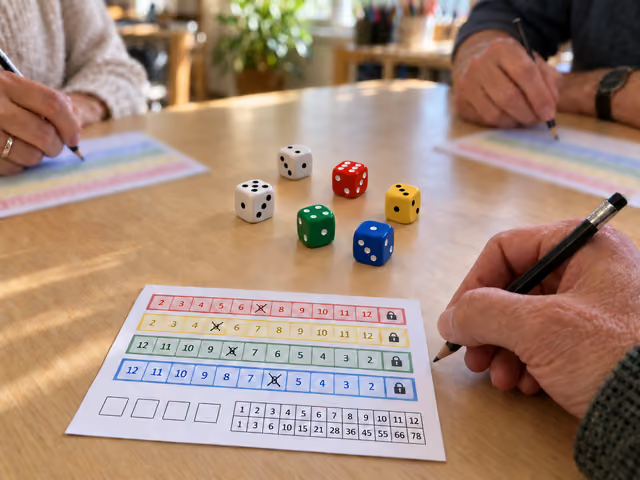
The quick version
Give each person a sheet. The roller announces the sum of the two white dice; everyone may mark that number in one open row. Then the roller alone may combine one white die with one colored die and mark that sum in the matching row. Both choices are optional, but a roller who marks nothing takes a penalty. Pass left. End immediately at two closed colors or anyone's fourth penalty; add row scores and subtract five per penalty. Highest total wins.
Saved on this device only — clearing your browser's cache or site data removes them (no account backup).
Give everyone four number rows
Use the standard Gamewright Qwixx edition, product 1201, with six ordinary six-sided dice and the classic score pad. This guide uses its linked English Rules of Play. Mixx, Longo and The Duel have different sheets or rules; keep them separate from this game.
Seat two to five people around a level table with room to see the dice. Give each player one unused classic sheet and a pen or pencil. Keep sheets face up as this table's hosting agreement. Red and yellow run from 2 to 12; green and blue run from 12 to 2. Each row has eleven numbers followed by a lock. The sheet also has four penalty boxes and a row-scoring table. Use a spare sheet for a demonstration if wanted; a dice tray is optional.
Marks in each row move left to right on the paper, including the descending green and blue rows. You may begin anywhere except the restricted final number. Once you mark a number, every unmarked number to its left becomes unavailable. You cannot go back or mark the same number twice. Only X marks earn points; skipped numbers do not. Short dashes through skipped boxes can help distinguish them from scoring Xs.
Take turns rolling a die until someone rolls a 6; that person is the first active player, meaning the person who rolls for this turn. These opening rolls do not mark any sheets. The first active player now rolls all six dice once for the actual turn.
Resolve two choices in order
Everyone considers the white sum
The active player adds the two white dice and says the total aloud. Each person, including the active player, may mark that total in exactly one open color row, or pass. Each sheet is independent: several people may use the same total in the same color. The number must be to the right of that person's latest X in that row. Complete everyone's decision before moving to the second action.
The roller gets one extra choice
If the game is still going, the active player may add either white die to one remaining colored die. They may mark that sum once in the row matching that colored die, or pass. Other players do not take this action. The roller may use either action, both in this order, or neither. Using a white die in the first action does not consume it. Both marks may be in the same row if the second is farther right; never mark twice in a single action.
Apply a penalty and pass left
If the game has not already ended and the active player marked no number in either action, they must X one penalty box, even if they deliberately passed legal choices. Other players never take a penalty for passing. Each penalty costs five points. The fourth ends the game immediately. Otherwise, when everyone is ready, the player to the left becomes active and rolls the two white dice and every colored die still in play. No dice are kept or rerolled for a better result.
Suppose the white dice show 2 and 4 and the red die shows 5. Everyone may put the shared 6 in one open row or pass. The roller then may use 2 + red 5 to mark red 7, or 4 + red 5 to mark red 9, or choose another colored die. On an empty red row, taking red 6 first and red 7 second is legal; taking red 6 then red 6 is not. A red 7 chosen as your first X makes red 2 through 6 unavailable.
Close a color for everyone
The rightmost number is red 12, yellow 12, green 2 or blue 2. To mark it, you must already have at least five numbered Xs in that same row. Four earlier Xs plus the endpoint is insufficient. Five Xs alone do not close anything: you still need a legal dice sum for the endpoint and must choose to use it.
When you mark the endpoint, also X the adjacent lock. Announce the color and remove that colored die immediately. The row is now closed for everyone, including people who have no marks in it. Only players who actually mark the endpoint and lock earn that extra lock X. Everyone else keeps their existing row marks; they do not receive a free endpoint or lock.
During the shared white-dice action, several eligible people can lock the same color together. Each must already have five numbered marks in that row; complete their simultaneous choices before removing the die. Each person still gets only one number from that action. Different colors can also close in that shared action, and all those simultaneous marks count.
A color closed in the shared action is unavailable for the roller's second action on that very turn. For example, white 1 + 1 can let another player close green; the roller cannot then use a green 5 plus white 1 to mark green 6. Use a different open color if the game continues. If that closure was the second closed color, the game stops after the shared action: there is no second action or extra turn.
Count marks, then subtract penalties
End as soon as two different colored dice have been removed, or anyone marks their fourth penalty, whichever happens first. Several people locking the same color removes one die, not several. A shared white action can close a third color simultaneously with the second; finish those simultaneous choices, then stop. Do not offer everyone an equal number of rolls or finish an unused second action after the ending trigger.
For each color, count your numbered Xs and add your lock X if you earned it. Zero marks score zero. For 1 through 12 marks, the row scores are 1, 3, 6, 10, 15, 21, 28, 36, 45, 55, 66, 78. Find each count on the printed table, or calculate count × (count + 1) ÷ 2. Add the four row scores, then subtract five for every penalty. Skipped boxes, blank locks and another player's marks score nothing on your sheet.
Example: six numbered marks plus your lock in red count as seven Xs for 28 points. Three yellow marks score 6, five green marks 15 and two blue marks 3. Two penalties cost 10: your total is 28 + 6 + 15 + 3 − 10 = 42. Highest total wins. The selected rule sheet gives no tiebreak; this guide's house finish is a shared win after checking the addition.
To play again, take fresh sheets and return all four colored dice. Use the same opening-player procedure unless the group chooses the match variation below.
Make the shared action clear
Say the white total, pause for everyone's mark or pass, and ask whether anyone is locking a color before the roller makes the extra choice. Nobody should have to race a pencil to get a simultaneous legal mark. Keep the six dice visible until the turn is settled; collect them only when everyone is ready.
Let people make their own decisions. A useful question is how many boxes this mark would skip. Filling a row steadily raises its value, but closing a color can also end opportunities for others; there is no single promised winning strategy. With visible sheets, players can notice which rows are near closure. This is a hosting choice because the selected rule sheet does not explicitly require public or hidden sheets.
Check the actual sum, row direction and earlier marks when settling a dispute. For a lock, count the five preceding numbered Xs on that person's sheet. A roller who used the white sum has already avoided the turn's penalty even if they pass the colored choice. A person who was not rolling can always pass without penalty.
For dice that leave the table or rest tilted, use this house remedy: reroll only those dice before anyone marks, keeping the other results. If an illegal X is noticed while the dice are still visible and before the next roll, erase or clearly void it and choose a legal mark or pass for that same action; then check whether the roller owes a penalty. After a later roll, pause and agree a remedy from what the group can actually reconstruct rather than inventing past dice values. These are hosting remedies, not publisher penalties.
Keep spare sheets available for another game. Use color names together with the row position and direction when explaining a choice. Players need to see numbers, distinguish rows, add dice and record marks; seating alone does not settle individual access needs.
Already know the game?
Ideas & Twists
Choose a variation together before you start.
Qwixx · See main rules
Suggested house matchThree-game total
Agree to play three complete games with the same two to five players. Keep every main-game rule and use fresh sheets for each game. Choose the first game's starter normally, then move the starting role one seat left for each later game instead of rolling for it. Record each final score, including penalties, and add all three. Highest combined total wins; tied totals share the match win. You need three sheets per person and a small written totals list. Finish all three games rather than ending when someone wins two; a low score can still be recovered.
Qwixx · See main rules
Suggested house team gamePartners on one sheet
For four, six, eight or ten people, form two to five pairs. Give each pair one classic sheet and one pencil, and seat pairs in a circle. Each pair acts as one player: discuss and choose a single shared-white mark or pass, and the active pair gets exactly one colored-die choice. Partners alternate who rolls and writes on successive turns when their pair is active. Other shared marks are written by the partner currently holding the pencil. Use the normal five-mark lock requirement, row scores and penalties on each pair's sheet; a pair's fourth penalty or the second closed color ends the game. Highest pair total wins, with shared wins for ties. There are no extra marks or turns for having two people; settle your choice together before writing.
About this guide
The main game follows Gamewright's standard six-die Qwixx and classic score sheet, using its English Rules of Play, ©2014. Product 1201 lists 2–5 players. Public sheets, shared ties, dice and marking remedies, and both variations are labeled house hosting choices. Community discussions inform the explanations of lock timing and visible sheets; they do not override the publisher's mechanics. Longo, Mixx, The Duel, apps and solo adaptations are separate formats.
Ready for something different?
Find another game →