

The quick version
On your turn, if you have an unused face-up sun disk, choose one action: draw one tile into the next auction space; invoke Ra to start an auction; or spend one or more previously won God tiles, each taking one non-God tile from the auction row. You cannot draw when the row is full. Acquired disasters resolve immediately. A drawn Ra tile advances the sun boat and starts an auction, except when it reaches the last track space: that ends the epoch immediately without an auction.
Saved on this device only — clearing your browser's cache or site data removes them (no account backup).
Prepare the table
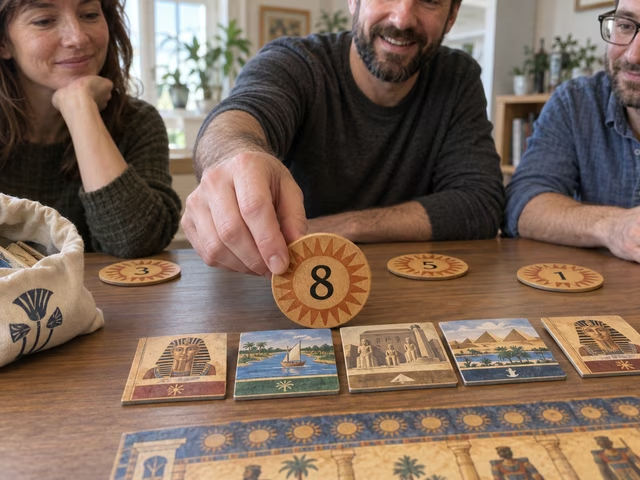
Use the 25th Century Games edition and its player-count sides. Randomly assign player boards and give each the sun disks printed for your player count; put disk one in the auction board's center. Each player starts with ten points hidden in scoring tokens. Bag all auction tiles, set the epoch to first, and place the sun boat at the printed start for your player count. Highest sun disk starts each epoch.
Play a turn
On your turn, if you have an unused face-up sun disk, choose one action: draw one tile into the next auction space; invoke Ra to start an auction; or spend one or more previously won God tiles, each taking one non-God tile from the auction row. You cannot draw when the row is full. Acquired disasters resolve immediately.
A drawn Ra tile advances the sun boat and starts an auction, except when it reaches the last track space: that ends the epoch immediately without an auction. Invoking Ra yourself does not advance the boat. The triggering player takes the Ra marker; starting on their left and ending with them, each player may bid one unused disk higher than the previous bid or pass. Losing bidders retain their disks. The winner takes all auction tiles, leaves their winning disk in the center and takes the previous center disk face down, unavailable until next epoch.
After a drawn Ra tile, everyone may pass and the lot stays. When invoking with a full row, everyone may pass and the lot is discarded. When invoking with a non-full row, the invoker must bid if everyone else passes. Resume play left of the triggering player, regardless of winner. A player without unused disks takes no further actions that epoch; a lone remaining bidder can continue drawing and invoking.
Each disaster removes up to two of your matching tiles, including newly acquired ones, then is discarded. Choose which matching tiles to lose; Drought must remove Floods before Nile tiles. Other disasters affect pharaohs, civilizations or monuments as pictured.
Finish and score
An epoch ends when all disks are spent or the sun boat reaches its final space. Each epoch, most pharaohs gains five and fewest loses two, with all ties receiving the amount unless everyone is equal. Floods score one each and enable one point per Nile tile; without a Flood, Nile scores zero. Gold scores three each and unspent Gods two each. Three, four or five different civilizations score five, ten or fifteen; no civilization loses five, while one or two types score zero. Never reduce your cumulative score below zero.
After scoring, discard Floods, Gold, Gods and Civilizations, plus unclaimed auction-row tiles. Keep Pharaohs, Nile and Monuments. Leave the center disk, turn your own disks face up and reset the boat for the next epoch.
After the third epoch also score Monuments: one point per distinct type through six types, ten for seven types, fifteen for eight; additionally, each group of three, four or five identical monuments scores five, ten or fifteen. Sum each player's disk values, including unused disks: highest total gains five and lowest loses five, with tied players receiving the full change unless all are equal. Most points wins, then highest individual sun disk.
Host the first game
The Reddit comparison of Ra and High Society discusses the different tension of bidding with fixed numbered disks. Show a complete auction before starting, including the disk exchange: winning both spends a bid now and changes your bidding strength next epoch. Keep the three all-pass cases beside the board.
Already know the game?
Ideas & Twists
Choose a variation together before you start.
Ra · See main rules
Original STUDplay house twistVisible score
Keep scoring tokens face up throughout. Players can judge current totals when deciding whether to risk another draw.
Ra · See main rules
Original STUDplay house twistOne warning tile
At the start of each epoch draw one random tile openly and leave it beside the bag as a preview. A draw action takes that tile and immediately reveals the next preview; resolve taken Ra tiles normally. At epoch end discard any still-visible preview.
Ra · See main rules
Original STUDplay house twistPublic opening lot
At each epoch's start draw until two non-Ra tiles are in the auction row, returning any Ra tiles drawn to the bag before mixing it again. These setup draws do not advance the boat. Then begin turns normally.
Ra · See main rules
Original STUDplay house twistGod restraint
A player may spend at most one God tile on a turn. That action still replaces drawing or invoking, and unused Gods retain normal scoring.
Ra · See main rules
Original STUDplay house twistOne protected monument
After your first successful auction of an epoch, designate one monument you own by turning it sideways. Earthquakes cannot discard it during that epoch; if you own none, gain no protection. It scores normally and becomes unprotected at epoch end.
About this guide
Requires the named physical game and its supplied components. Rules are paraphrased teaching guidance; keep the box's cards and reference diagrams beside the table. Original STUDplay house twists are optional, untested suggestions rather than publisher rules. Agree one before setup; unchanged rules still apply.
Ready for something different?
Find another game →