

The quick version
Deal ten cards into fixed slots. Draw from stock or discard and optionally replace a rack card, then discard. Complete an ascending rack to end the round. Score the round and play toward 500; two-player Rack-O also requires a consecutive run of three.
Saved on this device only — clearing your browser's cache or site data removes them (no account backup).
Deal straight into the rack
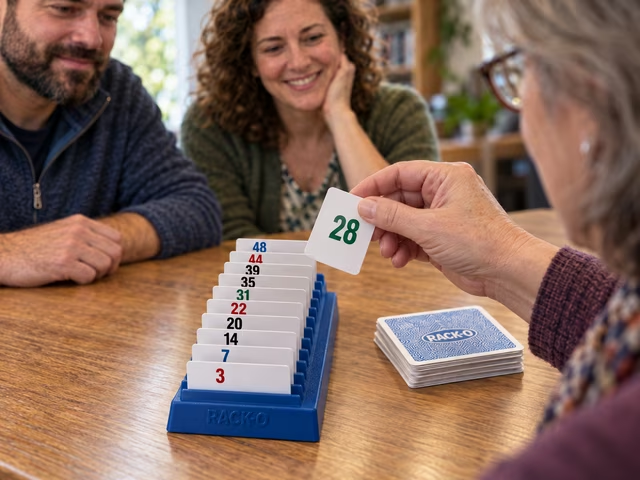
Use cards 1–40 for two players, 1–50 for three or 1–60 for four. Lowest cut chooses the first dealer. Shuffle and deal ten cards per person. Insert each dealt card immediately: first in the slot marked 50, next in 45, then downward through the slot marked 5. Do not sort the cards. Rack labels are scoring positions, not required card values.
Keep your card faces private. Remaining cards form a face-down stock; reveal its top card as a discard. Start left of the dealer and go clockwise.
Replace one position or reject the draw
Take either the top discard or the top stock card. A discard pickup MUST replace one card in your rack. A stock draw may replace one rack card or be discarded unused. Put any replacement into the EXACT slot vacated by the removed card, then discard the removed card face up.
You cannot move other rack cards to new slots. The target is strictly increasing values from the front slot marked 5 to the back slot marked 50. Consecutive values are unnecessary in the basic three- or four-player game. If stock runs out, turn the discard pile over as the new stock under this edition's rules.
Call Rack-O and score the leading sequence
A complete ascending rack ends the round immediately when its owner calls Rack-O. With two players it must ALSO contain at least three consecutive numbers in adjacent slots, such as 18, 19, 20. A merely ascending two-player rack is not enough.
The winner gets 75 points. Everyone else starts at the slot marked 5 and counts consecutive rack positions whose values keep increasing; stop before the first lower card. Score five per counted card, even if later rack cards form another ascending group. For example, 3, 9, 14, 8 starts with three valid positions for 15 points.
Pass the deal clockwise and repeat. Once a total reaches 500, highest total wins. If several equal the highest score after that round, play another round among the tied players as an explicit house resolution.
Explain fixed slots before dealing
Demonstrate replacing the fifth position without shifting its neighbors. New players often accidentally sort the starting rack or think the slot label limits the card. Keep score after every round; choosing just one round is a separate session agreement, not a 500-point match.
One recommendation request identifies Rack-O as a favorite of an adult player. Keep the first explanation focused on exchanging a single card without rearranging the rack.
Already know the game?
Ideas & Twists
Choose a variation together before you start.
Rack-O · See main rules
Publisher variantBonus runs
Only the player calling Rack-O receives a consecutive-run bonus: add 50 for a longest run of three, 100 for four, 200 for five or 400 for six or more. Add it to the usual 75. Score only the longest run, not several. Others use ordinary leading-sequence scoring; the match still targets 500.
Rack-O · See main rules
Publisher four-player variantPartners
Seat partners opposite each other. Play individual racks normally and add partners' round scores together. The partnership first reaching 500 wins; use highest total if both cross in one round. Do not exchange cards or rearrange a partner's rack.
Rack-O · See main rules
Original STUDplay house twistDescending racks
Reverse the target: values must strictly DECREASE from the slot marked 5 toward 50. Score an uninterrupted decreasing sequence from the front. At two players the required three-card consecutive run also descends, such as 20, 19, 18.
Rack-O · See main rules
Original STUDplay house twistOne rack repair
Give everyone one paper token each round. After drawing but before resolving that draw, a player may discard their token to swap two adjacent cards already in their own rack. They must still resolve the draw and discard normally. Unused tokens score nothing.
Rack-O · See main rules
Original STUDplay house twistVisible center
After dealing, reveal the card in each rack's slot marked 25 and leave its face visible to opponents throughout the round. Replacements in that slot remain visible. No other cards become public. This creates a small amount of reliable information for discard decisions.
About this guide
Use the named physical base game and its supplied cards, boards and rules. Rules below are paraphrased teaching guidance. Original STUDplay house twists are optional suggestions, not publisher rules or balance-tested claims; agree one before setup.
Ready for something different?
Find another game →